Altstadt in Zürich, Switzerland — Central Europe (the Alps)
Judengasse

August 17, 2024
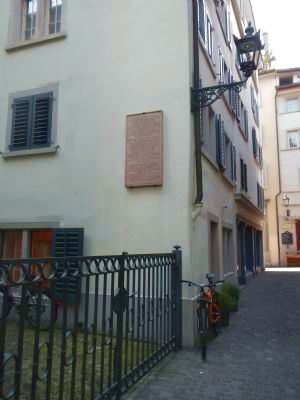
1. Judengasse Marker
Vor 1343 schuf rabbi Moses den «Zürcher Semak» , einen bis heute verwendeten Gesetzeskommentar die Blütezeit der jüdischen Gemeinde Zürichs fand im Pogrom von 1349 ein abruptes ende der grösste teil der jüdishen Bevölkerung Zürichs wurde gefangen, genommen, gefoltert, vertrieben oder verbrannt.
Bürgermeister und Räte belegten 1436 die Zürcher Jüdinnen und Juden mit einem Niederlassungsverbot erst das Emanzipationsgesetz von 1862 brachte der Jüdischen Bevölkerung das recht der freien Niederlassung.
(English translation:)
Jewish Quarter
In the late Middle Ages, most of Zurich's Jews lived on Froschaugasse ("Judengasse") and Brunngasse. Their synagogue was on the Wolfbach in the house at Froschaugasse 4 ("Judenschule", "Burghof"), and the Jewish cemetery was in front of the Lindentor.
Sometime before 1343, Rabbi Moses created the "Zürcher Semak", a legal commentary that is still used today. The heyday of Zurich's Jewish community came to an abrupt end in the pogrom of 1349. The majority of Zurich's Jewish population was captured or kidnapped, tortured, and expelled or burned.
In 1436, mayors and councillors banned Zurich's Jews from settling there. It was not until the Emancipation Act of 1862 that the Jewish population was granted the right to settle freely.
Topics and series. This historical marker is listed in this topic list: Religion & Religious Structures. In addition, it is included in the Synagogues series list. A significant historical year for this entry is 1343.
Location. 47° 22.361′ N, 8° 32.712′ E. Marker is in Zürich. It is in Altstadt. It is on Froschaugasse, on the right when traveling north. Touch for map. Marker is at or near this postal address: Froschaugasse 2,
this page online

Regionally, it is in Europe, Central Europe, the Schengen Area, Western Europe, and the Western World. Historically, it finds itself in what was once the Roman Empire and specifically also the Holy Roman Empire.
Other nearby markers. At least 8 other markers are within walking distance of this marker: Zum Burghof (here, next to this marker); Alte Burg (a few steps from this marker); Kleiner Prophet (a few steps from this marker); Pinkus & Co. (within shouting distance of this marker); Kerzenstock (within shouting distance of this marker); Swiss Veterans of the Spanish Civil War Memorial (within shouting distance of this marker); Das Haus zum Rech (within shouting distance of this marker); Schwarzer Amboss (within shouting distance of this marker). Touch for a list and map of all markers in Zürich.
Regarding Judengasse. 1348 - 1349 THE BLACK PLAGUE (Europe)
One third of Europe's population died from the Black Death (Bubonic plague). Though many Jews were among the dead, they were accused by local church leaders and tortured to confess that they had poisoned the wells (Chillon) in order to kill Christians. During the next few years - despite the protests of Pope Clement VI - over 60 large and 150 small Jewish communities were destroyed as a direct result of these accusations. These included untold atrocities in cities such as Basel, Cologne, Strasbourg, Worms, Zurich and others. The plague, which originated in China, was spread for the most part by rats which came aboard ships from Asia to European ports. It is estimated that 25 million people perished within three years.
Photographed by Barry Swackhamer, June 26, 2013
2. Judengasse Marker
Also see . . . History of the Jews in Zürich (Wikipedia).
Excerpt: The history of the Jews in Zürich dates back to at least the Middle Ages. Since the early 20th century, Zürich, Switzerland, has been among the Swiss cities where Judaism is most prevalent (alongside Basel and Geneva).(Submitted on September 5, 2024.)
Zürich's Jewish community was first mentioned in writing in 1234 and lived largely without incident amidst the city population. In the 14th century, the presence of a synagogue was recorded in Zürich near Froschaugasse, commemorated by today's Synagogen Gasse. At the time, Froschaugasse was known as Judengasse. The neighboring property Brunngasse 8 (Zum Brunnenhof) is home to significant wall paintings stylistically dated to around 1330, including coats of arms with Hebrew descriptions, which were re-discovered in 1996. The medieval inhabitants of the house, which probably also served as a meeting place for the Jewish community, were likely to be influential citizens: probably the brothers Moses and Gumprecht ben Menachem and their mother, Minne. The wall paintings were open to the public as a museum, the "Schauplatz Brungasse". Moses ben Menachem was a Hebrew scholar who wrote the Zürich Semak, a Hebrew commentary on the Sefer mitzvot Katan (small book of commandments)by Isaak ben Joseph of Corbeil. It remains the most influential work of Hebrew scholarship written in Switzerland to this day.August 17, 20243. Looking south on Froschaugasse (Judengasse)

Credits. This page was last revised on September 5, 2024. It was originally submitted on August 2, 2013, by Barry Swackhamer of Brentwood, California. This page has been viewed 956 times since then and 87 times this year. Photos: 1. submitted on September 5, 2024, by Andrew Ruppenstein of Lamorinda, California. 2. submitted on August 2, 2013, by Barry Swackhamer of Brentwood, California. 3. submitted on September 5, 2024. • Bill Pfingsten was the editor who published this page.
