
Near Wytheville in Wythe County, Virginia — The American South (Mid-Atlantic)
Battle of Wytheville
The Road to Mount Airy Depot
Photographed by Don Morfe, July 31, 2013
1. Battle of Wytheville Marker
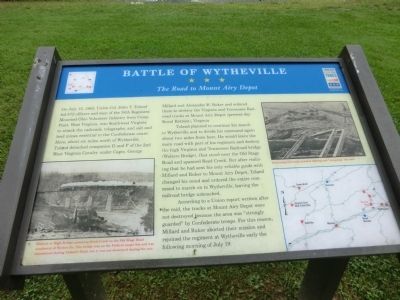
On July 13, 1863, Union Col. John T. Toland led 872 officers and men of the 34th Regiment Mounted Ohio Volunteer Infantry from Camp Piatt, West Virginia, into Southwest Virginia to attack the railroads, telegraphs and salt and lead mines essential to the Confederated cause. Here, about six miles north of Wytheville, Toland detached companies D and F of the 2nd West Virginia Cavalry under Capts. George Millard and Alexander H. Ruker and ordered them to destroy the Virginia and Tennessee Railroad tracks at Mount Airy Depot (present-day Rural Retreat), Virginia.
Toland planned to continue his march to Wytheville and to divide his command again about two miles from here. He would leave the main road with part of his regiment and destroy the high Virginia and Tennessee Railroad bridge (Walters Bridge), that stood near the Old Stage Road and spanned Reed Creek. But after realizing that he had sent his only reliable guide with Millard and Ruker to Mount Airy Depot, Toland changed his mind and ordered the entire command to march on to Wytheville, leaving the railroad bridge untouched.
According to a Union report written after the raid, the tracks at Mount Airy Depot were not destroyed because the areas was "strongly guarded" by Confederate troops. For this reason, Millard and Ruker aborted their mission and rejoined
this page online
(captions)
Walters or High Bridge spanning Reed Creek on the Old Stage Road southwest of Wytheville. The bridge was on the Federal target list and was threatened during Toland's Raid, but it was not destroyed during the war.
Destroying railroads included heating and "wrapping" the rails.
Erected by Virginia Civil War Trails. (Marker Number 3.)
Topics and series. This historical marker is listed in this topic list: War, US Civil. In addition, it is included in the Virginia Civil War Trails series list. A significant historical month for this entry is July 1869.
Location. 36° 57.93′ N, 81° 10.824′ W. Marker is near Wytheville, Virginia, in Wythe County. It is on Black Lick Road (Virginia Route 680) 0.2 miles south of Stony Fork Road (U.S. 52), on the right when traveling south. Touch for map. Marker is in this post office area: Wytheville VA 24382, United States of America. Touch for directions.

Regionally, this marker is in Southwest Virginia and in the Blue Ridge Highlands. It is also in the American South, specifically in the Upper South, in Appalachia, and specifically in Southern Appalachia. Globally, it is in the North Atlantic Region, North America, the Western Hemisphere, the Western World, and the Anglosphere. Historically, it finds itself in what was once the territory of the Mississippian Culture, one of the original Thirteen Colonies, one of the Confederate States of America, and the Antebellum South.
Other nearby markers. At least 8 other markers are within 5 miles of this marker, measured as the crow flies: A different marker also named Battle of Wytheville (approx. 3.1 miles away); Homesteader's Legacy (approx. 4.2 miles away); Patriot Burials (approx. 4.4 miles away); a different marker also named Battle of Wytheville (approx. 4.4 miles away);
Photographed by Don Morfe, July 31, 2013
2. Battle of Wytheville Marker
Another marker is no longer nearby. Battle of Wytheville (was approx. 4.4 miles away but has been replaced with another marker now near it).
Credits. This page was last revised on April 30, 2026. It was originally submitted on August 5, 2013, by Don Morfe of Baltimore, Maryland. This page has been viewed 1,321 times since then and 74 times this year. Last updated on April 30, 2026, by Jacob Gutman of Philadelphia, Pennsylvania. Photos: 1, 2. submitted on August 5, 2013, by Don Morfe of Baltimore, Maryland. • Devry Becker Jones was the editor who published this page.
