Washington in Beaufort County, North Carolina — The American South (South Atlantic)
John Gray Blount
1752~1833
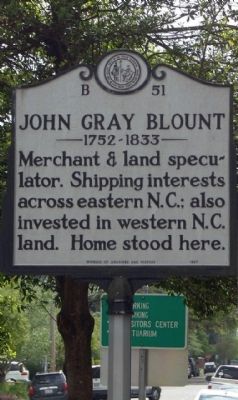
Photographed by Mike Stroud, April 19, 2013
1. John Gray Blount Marker
Erected 1987 by Division of Archives and History. (Marker Number B-51.)
Topics and series. This historical marker is listed in these topic lists: Industry & Commerce • Waterways & Vessels. In addition, it is included in the North Carolina Division of Archives and History series list.
Location. 35° 32.524′ N, 77° 3.312′ W. Marker is in Washington, North Carolina, in Beaufort County. It is on East Main Street near South Market Street, on the right when traveling east. Touch for map. Marker is in this post office area: Washington NC 27889, United States of America. Touch for directions.

Regionally, this marker is in the Coastal Plain. It is also in the American South, specifically in the Upper South, in the Tidewater, and on the Eastern Seaboard. Globally, it is in the North Atlantic Region, North America, the Western Hemisphere, the Western World, and the Anglosphere. Historically, it finds itself in what was once the territory of the Mississippian Culture, one of the original Thirteen Colonies, one of the Confederate States of America, and the Antebellum South.
Other nearby markers. At least 8 other markers are within walking distance of this marker: The Washington Market House (here, next to this marker); Dr. Washington (within shouting distance of this marker); Dr. Susan Dimock (within shouting distance of this marker); DeMille Family (about 300 feet away, measured in a direct line); Trigger's Climb (about 300 feet away); Carawan Ghost (about 400 feet away); Washington (about 400 feet away); Old Beaufort County Courthouse (about 400 feet away). Touch for a list and map of all markers in Washington.
Regarding John Gray Blount. John
this page online
J. G. Blount’s business dealings ranged westward to Tennessee and along the Atlantic seaboard and in the Caribbean, but his base of operation from his marriage in 1778 forward was in Washington. Blount made the town his home when it was still known as Forks of the Tar River. He and his business partners had large shipping interests, owning wharves, flat boats, and seagoing vessels. They also owned sawmills, gristmills, tanneries, and cotton gins, and engaged in agricultural pursuits and the slave trade. Blount was heavily involved in land speculation, employing agents to buy and sell large tracts in western North Carolina and Tennessee. Blount represented Beaufort in the House of Commons from 1782 to 1793, served in the constitutional convention of 1787, in the state Senate
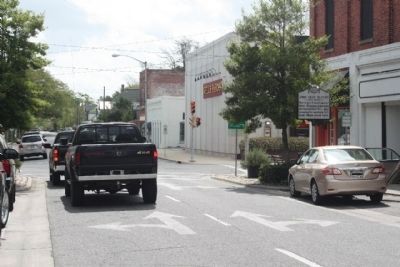
Photographed by Mike Stroud, April 19, 2013
2. John Gray Blount Marker seen on East Main Street
Alice Keith, editor of the first two volumes of the Blount papers, noted that John Gray Blount was “one of the most important figures in North Carolina in his day” in spite of the fact that he held not higher office and is generally less well known than his brothers. Blount’s home, a small frame building, is pictured in the second volume of the Blount papers with a caption noting, “Blount did contemplate building a home in keeping with his wealth and social station, but the opportune time never came.” The house was occupied by Blount’s descendants until its demolition in 1923. (North Carolina Office of Archives & History — Department of Cultural Resources)
Credits. This page was last revised on June 22, 2021. It was originally submitted on August 7, 2013, by Mike Stroud of Bluffton, South Carolina. This page has been viewed 991 times since then and 40 times this year. Photos: 1, 2. submitted on August 7, 2013, by Mike Stroud of Bluffton, South Carolina.
