Stonington in Southeastern Region, Connecticut — The American Northeast (New England)
Battle of Stonington Monument
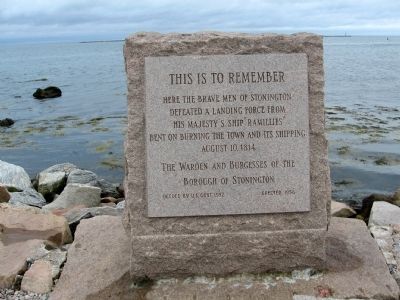
Photographed by Michael Herrick, August 27, 2013
1. Battle of Stonington Monument
Here the Brave Men of Stonington
Defeated a Landing Force From
His Majesty’s ship “Ramillies”
Bent on Burning the Town and its Shipping
August 10, 1814
The Warden and Burgesses of the
Borough of Stonington
Deeded by U.S. Govt. 1932 Erected 1956
Erected 1956 by the Warden and Burgesses of the Borough of Stonington.
Topics. This monument and memorial is listed in this topic list: War of 1812.
Location. 41° 19.64′ N, 71° 54.323′ W. Monument is in Stonington in Southeastern Region, Connecticut. It is at the intersection of Water Street and Omega Street, on the right when traveling south on Water Street. Touch for map. Monument is in this post office area: Stonington CT 06378, United States of America. Touch for directions.

Regionally, this memorial monument is on the Connecticut Shoreline, in Greater New London, in Mystic and the Eastern Shore, and in the Thames River Valley. It is also in the American Northeast, in New England, and on the Eastern Seaboard. Globally, it is in the North Atlantic Region, North America,
this page online
Other nearby markers. At least 8 other markers are within walking distance of this marker: The Defenders of the Fort (approx. 0.3 miles away); Thomas Howe House (approx. half a mile away); First Railroad Operated in Connecticut (approx. half a mile away); Dr. Silas Holmes House (approx. 0.6 miles away); Stonington Land Battery (approx. 0.6 miles away); Stonington Community Garden (approx. 0.9 miles away); Veterans Memorial (approx. 0.9 miles away); World War I Memorial (approx. 0.9 miles away). Touch for a list and map of all markers in Stonington.
Regarding Battle of Stonington Monument. During the War of 1812, between August 9 and 12, 1814, four British vessels, HMS Ramillies, HMS Pactolus, HMS Dispatch, and HMS Terror, under the command of Sir Thomas Hardy, appeared off Stonington harbor. The British demanded immediate surrender, but Stonington's citizens replied with a note that stated, "We shall defend the place to the last extremity; should
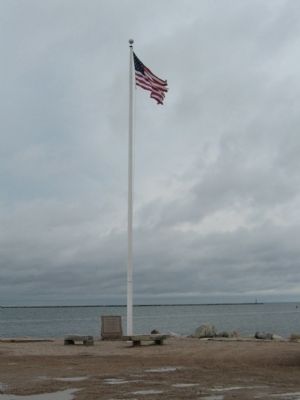
Photographed by Michael Herrick, August 27, 2013
2. The Battle of Stonington Monument Overlooking Stonington Harbor
For three days the Royal Navy pounded the town, but the only fatality was that of an elderly woman who was mortally ill. While many fires were started by shells and rockets, they were quickly put out and no buildings were destroyed. The townsmen located a supply of powder and shot, and using two cannons left from the Revolutionary War, fired back at the British ships. The British, after suffering significant damage with many dead and wounded, sailed off on 12 August.
Also see . . . The Defence of Stonington, by J. Hammond Trumbull, 1864 at Project Gutenberg. (Submitted on September 5, 2013, by Michael Herrick of Southbury, Connecticut.)
Credits. This page was last revised on May 19, 2026. It was originally submitted on September 5, 2013, by Michael Herrick of Southbury, Connecticut. This page has been viewed 1,682 times since then and 114 times this year. Photos: 1, 2. submitted on September 5, 2013, by Michael Herrick of Southbury, Connecticut.
