Gulf Shores in Baldwin County, Alabama — The American South (East South Central)
U.S. Model 1918M1 155mm Gun and Model 1918A1 Carriage
Photographed by Timothy Carr, June 19, 2013
1. U.S. Model 1918M1 155mm Gun and Model 1918A1 Carriage Marker
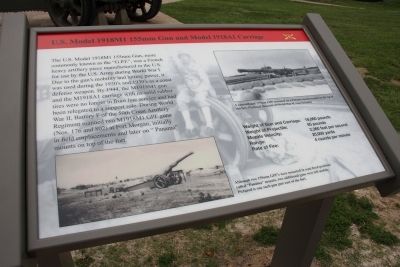
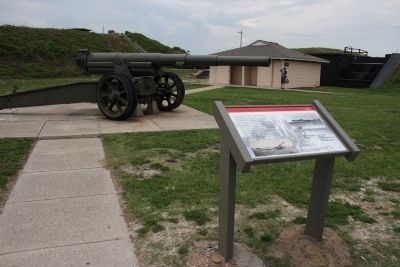
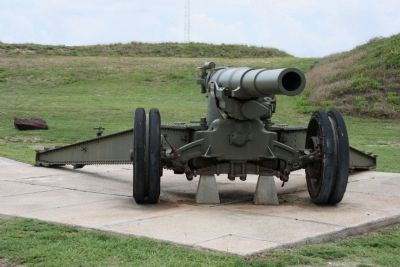
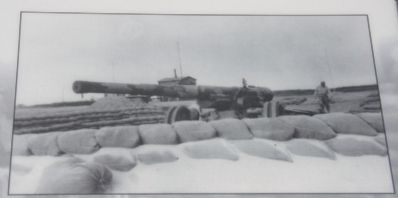
The U.S. Model 1918M1 155mm Gun, more commonly known as the “G.P.F.”, was a French heavy artillery piece manufactured in the U.S. for use by the U.S. Army during World War I. Due to the gun’s mobility and hitting power, it was used during the 1920’s and 1930’s as a coast defense weapon. By 1944, the M1918M1 gun and the M1918AA carriage with its solid rubber tires were no longer in front line service and had been relegated to a support role. During World War II, Battery F of the 50th Coast Artillery Regiment manned two M1918M1 GPF guns (Nos. 176 and 802) at Fort Morgan, initially in field emplacements and later on “Panama” mounts on top of the fort.
Weight of Gun and Carriage: 19,860 pounds
Weight of Projectile: 95 pounds
Muzzle Velocity: 2,360 feet per second
Range: 20,000 yards
Rate of Fire: 4 rounds per minute
Topics. This historical marker is listed in these topic lists: Forts and Castles • War, World I • War, World II. A significant historical year for this entry is 1944.
Location. 30° 13.77′ N, 88° 1.38′ W. Marker is in Gulf Shores, Alabama, in Baldwin County. It is on Fort Morgan
this page online

Regionally, this marker is on Alabama’s Gulf Coast and in the Mobile Bay area. It is also in the American South, specifically in the Deep South, and on the Gulf Coast. Globally, it is in North America, a Gulf of Mexico state, the Western Hemisphere, the Western World, and the Anglosphere. Historically, it finds itself in what was once New Spain, the Viceroyalty of New France, the territory of the Mississippian Culture, one of the Confederate States of America, and the Antebellum South.
Other nearby markers. At least 8 other markers are within walking distance of this marker: Lafayette’s Tour (within shouting distance of this marker); Battery Schenck (1899-1923) (within shouting distance of this marker); 6.4” (100 pounder) Parrott Rifle / 7” Brooke Rifle
Photographed by Timothy Carr, June 19, 2013
2. U.S. Model 1918M1 155mm Gun and Model 1918A1 Carriage Marker
Photographed by Timothy Carr, June 19, 2013
3. U.S. Model 1918M1 155mm Gun and Model 1918A1 Carriage
Photographed by Timothy Carr, June 19, 2013
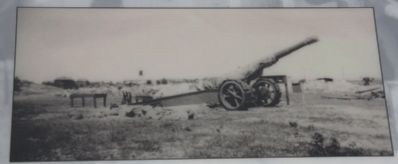
4. Left Image:
Although two 155 GPF’s were mounted in semi fixed positions called “Panama” mounts, two additional guns were left mobile. Pictured is one such gun just east of the fort.
Photographed by Timothy Carr, June 19, 2013
5. Right Image:
A camouflaged 155 GPF mounted on a Panama mount located on the top of the fort. (National Museum of World War II, New Orleans)
Credits. This page was last revised on July 25, 2018. It was originally submitted on November 2, 2013, by Timothy Carr of Birmingham, Alabama. This page has been viewed 2,222 times since then and 82 times this year. Photos: 1, 2, 3, 4, 5. submitted on November 2, 2013, by Timothy Carr of Birmingham, Alabama. • Bernard Fisher was the editor who published this page.
