Eastern Neck National Wildlife Refuge near Rock Hall in Kent County, Maryland — The American Northeast (Mid-Atlantic)
Long Distance Travelers
Eastern Neck National Wildlife Refuge
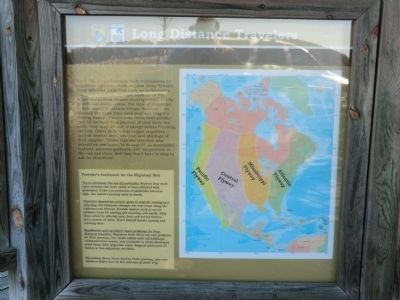
Photographed by Don Morfe, October 27, 2013
1. Long Distance Travelers Marker
Much like people travel to their destinations on interstate highways, birds migrate along flyways. Many different roads lead onto major highways. The same is true for flyways: birds fly to the major routes from various starting points and fly to different destinations. The time of migration is determined by various things. Hormones are released the same time each year and trigger a feeding frenzy. A bird’s body turns food quickly into fat for their long journey. If they leave too early, they may run out of energy before finishing the trip. Other factors that trigger migration include shorter days, weather, and shortage of food supplies. Unlike highway travelers who depend on roadmaps, birds depend on landmarks, instinct, parental guidance, and the position of the sun and stars. And they don’t have to stop to ask for directions.
Traveler’s Assistance for the Migratory Bird
Try to eliminate the use of pesticides. Raptors may feast upon animals that have eaten or been infected with pesticides. If the concentration of pesticides becomes high, the raptor’s journey ends in death.
Travelers depend on certain spots to stop for
this page online
Roadblocks and accidents cause problems for long-distance travelers.; Migratory birds often run into problems on the their journeys, too. Some collide with tall buildings, communication towers, and windmills in newly developed areas along their migration route. Support placement of towers in non-migratory corridors.
By aiding these birds during their journey, you can make a difference in the success of their trip.
Erected by Fish & Wildlife Service, U.S. Department of the Interior.
Topics. This historical marker is listed in these topic lists: Animals • Environment.
Location. Marker has been permanently removed. It was located near 39° 2.683′ N, 76° 13.283′ W. Marker was near Rock Hall, Maryland, in Kent County. It was in Eastern Neck National Wildlife Refuge. It was at the

Photographed by Don Morfe, October 27, 2013
2. Long Distance Travelers Marker
We have been informed that this marker is no longer there and will not be replaced. This page is an archival view of what was.
Regionally, this marker was on the Eastern Shore. It was also in the American Mid-Atlantic, on the Delmarva Peninsula, in the Tidewater, in the Chesapeake Bay Region, and on the Eastern Seaboard. Globally, it was in the North Atlantic Region, North America, the Western Hemisphere, the Western World, and the Anglosphere. Historically, it found itself in what was once one of the original Thirteen Colonies and also the Antebellum South.

Other nearby markers. At least 8 other markers are within 2 miles of this location, measured as the crow flies: In Recognition of Howard E. McIntyre (within shouting distance of this marker); Tundra Swan Range (approx. 0.6 miles away); Living Shorelines at Eastern Neck National Wildlife Refuge

Photographed by Don Morfe, October 27, 2013
3. The Tubby Cove Boardwalk Trail
Other markers no longer nearby. Birds of Prey-Hunters in the Sky (was here, next to this marker but has been permanently removed); Clever Ruse (was approx. 0.6 miles away but has been permanently removed).
Additional commentary.
1. About the signage
At the time this profile was published, nature markers were included on the database. New profiles that exclusively share natural history are not included.
— Submitted May 25, 2025, by Devry Becker Jones of Washington, District of Columbia.

Photographed by Don Morfe, October 27, 2013
4. Signage for Eastern Neck National Wildlife Refuge
Credits. This page was last revised on May 25, 2025. It was originally submitted on November 2, 2013, by Don Morfe of Baltimore, Maryland. This page has been viewed 504 times since then and 11 times this year. Photos: 1, 2, 3, 4. submitted on November 2, 2013, by Don Morfe of Baltimore, Maryland. • Bill Pfingsten was the editor who published this page.
