Fort Mason in San Francisco City and County, California — The American West (Pacific Coastal)
Fort Mason
Historic San Francisco Port of Embarkation
Photographed by Barry Swackhamer, October 16, 2013
1. Fort Mason Marker
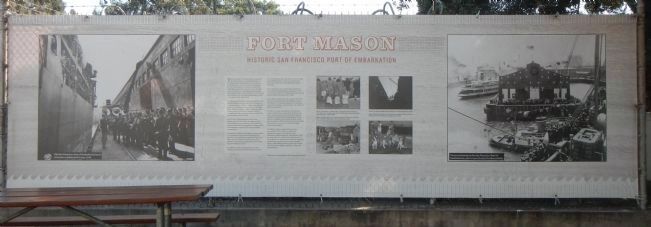
Captions: The San Francisco Port of Embarkation band welcomes a shipload of troops 1944. (left), Warbrides and babies from Australian and New Zealand arriving at the San Francisco Port of Embarkation aboard Matson Liner “Lurline”, April 7, 1948. (center top left); San Francisco Port of Embarkation, U.S. Army Fort Mason, San Francisco, California. View toward west, 1920. (center bottom left); Troops boarding. San Francisco Port of Embarkation, 1940’s (center top right); War dogs brought back from service in the Pacific to the San Francisco Port of Embarkation, February 2, 1946. (center bottom left); Troops returning to the San Francisco Port of Embarkation, pier 2, (now Herbst Pavilion) 1940s. (left). All photos courtesy of National Park Service Park Archives.
As the Port of Embarkation, Fort Mason played a critical role in the emergence of the United States as a world power. One of its first missions was delivering supplies and personnel to the western portion of the Panama Canal construction.
During World War II, Fort Mason commanded a vast network of personnel and shipping facilities that existed throughout the Bay Area. More than 1.5 million troops and over 23.5 million tons of cargo shipped out to the Pacific from Fort Mason’s piers.
In addition to the outgoing personnel and supplies, all American dead being returned to United States from the Pacific were brought through Fort Mason. Japanese and German prisoners of war were projected through its facilities.
The coming of peace saw the flow of soldiers and cargo
this page online
In 1962 the army declared the site military surplus. Fort Mason, along with the Presidio, was turned over to the National Park Service. Under the leadership of Congressman Philip Burton, Congress established the first urban national park in 1972, the Golden Gate National Recreation Area, with the idea of bringing parks to the people.
Fort Mason Center opened its doors as a nonprofit in 1977 to offer an affordable supportive campus for nonprofit arts, education, and recreational organizations. The mission today has evolved but remains true to the original concept of connecting and engaging people with arts and culture and providing a vibrant, affordable gathering place and a home for thought-provoking programs, events, and organizations.
Erected by Golden Gate National Recreation Area.
Topics. This historical marker is listed in these topic lists: Forts and Castles • War, World II. A significant historical year for this entry is 1906.
Location. Marker is missing. It was located near 37° 48.347′ N, 122° 25.919′ W.
Photographed by Barry Swackhamer, October 16, 2013
2. Fort Mason Marker

Regionally, this marker was on California’s Coast Ranges. It was also on the American Pacific Coast. Globally, it was in North America, on the Ring of Fire, on the Pacific Rim, in the Western Hemisphere, in the Western World, and in the Anglosphere. Historically, it found itself in what was once New Spain and also Mexico’s Alta California.
Other nearby markers. At least 8 other markers are within walking distance of this location: Fort Mason Historic District (about 300 feet away, measured in a direct line); a different marker also named Fort Mason Historic District (about 700 feet away); Brigantine Galilee (approx. 0.2 miles away); Phillip Burton (approx. 0.2 miles away); Golden Gate National Recreation Area Legislation (approx. 0.2 miles away); a different marker also named San Francisco Port of Embarkation
Photographed by Diane Phillips
3. Fort Mason Marker
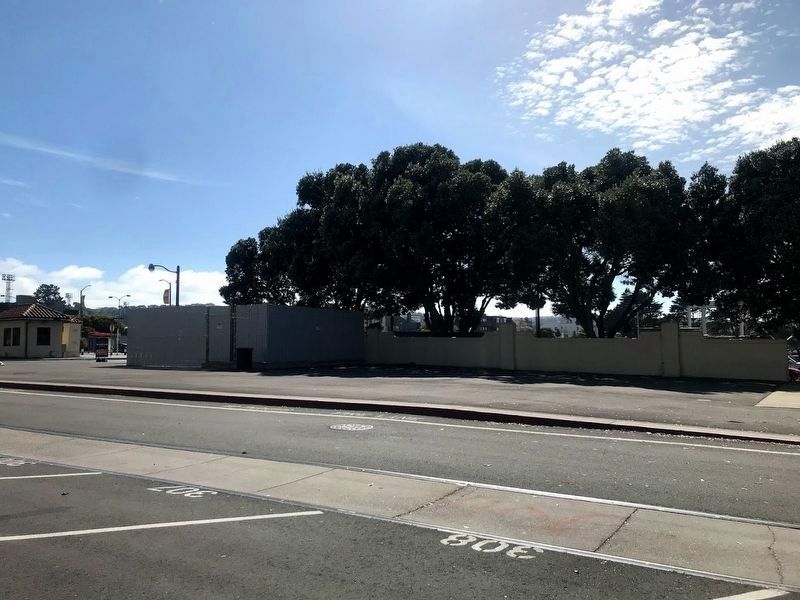
The marker is missing.
Other markers no longer nearby. San Francisco Port of Embarkation (was within shouting distance of this marker but has been confirmed missing); Congressman Phillip Burton (was approx. 0.2 miles away but has been permanently removed).
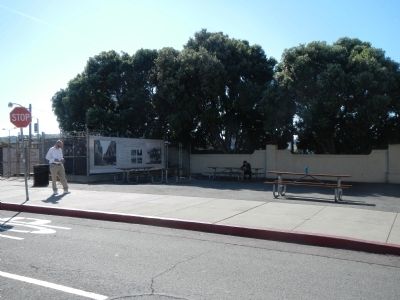
More about this marker. This marker is located in the lower parking lot of Fort Mason Center, near Building A.
Also see . . . Fort Mason - Wikipedia. Fort Mason can be split into two distinct areas. The upper area, sometimes called Fort Mason, is situated on a headland and was the site of the original coastal fortifications. The lower area, Fort Mason Center, is situated close to water level to the west of Upper Fort Mason, and is the site of the former military port, with its piers and warehouses. (Submitted on November 6, 2013, by Barry Swackhamer of Brentwood, California.)
Credits. This page was last revised on February 7, 2023. It was originally submitted on November 6, 2013, by Barry Swackhamer of Brentwood, California. This page has been viewed 858 times since then and 34 times this year. Photos: 1, 2. submitted on November 6, 2013, by Barry Swackhamer of Brentwood, California. 3. submitted on April 7, 2021, by Diane Phillips of Pittsburg, California. • Al Wolf was the editor who published this page.
