Uniontown in Perry County, Alabama — The American South (East South Central)
Green Gables
1928-1983
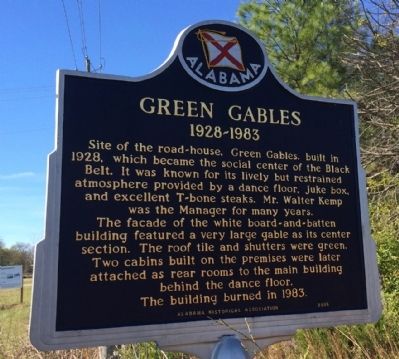
Photographed by Mark Hilton, November 8, 2013
1. Green Gables Marker
The facade of the white board-and-batten building featured a very large gable as its center section. The roof tile and shutters were green. Two cabins built on the premises were later attached as rear rooms to the main building behind the dance floor.
The building burned in 1983.
Erected 2005 by Alabama Historical Association.
Topics and series. This historical marker is listed in these topic lists: African Americans • Entertainment. In addition, it is included in the Alabama Historical Association series list. A significant historical year for this entry is 1928.
Location. 32° 26.99′ N, 87° 30.037′ W. Marker is in Uniontown, Alabama, in Perry County. It is on Washington Street (U.S. 80) 0.2 miles east of Village Avenue, on the left when traveling east. Touch for map. Marker is at or near this postal address: 1260 Washington Street, Uniontown
this page online

Regionally, this marker is in the American South, specifically in the Deep South, and in the Black Belt. Globally, it is in North America, a Gulf of Mexico state, the Western Hemisphere, the Western World, and the Anglosphere. Historically, it finds itself in what was once New Spain, the territory of the Mississippian Culture, one of the Confederate States of America, and the Antebellum South.
Other nearby markers. At least 8 other markers are within 11 miles of this marker, measured as the crow flies: First Colored Missionary Baptist Church (approx. 0.6 miles away); Church of the Holy Cross (approx. one mile away); New Hope Cemetery (approx. 2.9 miles away); St. Michael's Cemetery (approx. 6.4 miles away); Paulling Place Cemetery (approx. 6.4 miles away); St. Michael's Episcopal Churchyard (approx. 6.4 miles away); Newbern Presbyterian Church (approx. 10.1 miles away); Freetown (approx. 10.2 miles away). Touch for a list and map of all markers in Uniontown.
Also see . . . The Black Belt in the American South. The Black Belt in the American South refers
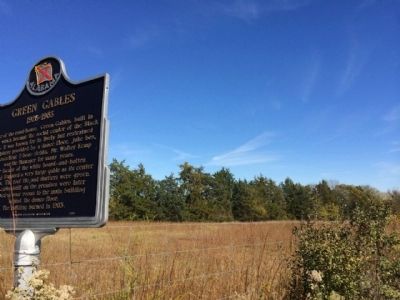
Photographed by Mark Hilton, November 8, 2013
2. Green Gables Location

Photographed by Jimmy Emerson, April 8, 2026
3. Green Gables Marker
Credits. This page was last revised on April 16, 2026. It was originally submitted on November 8, 2013, by Mark Hilton of Montgomery, Alabama. This page has been viewed 1,616 times since then and 72 times this year. Photos: 1, 2. submitted on November 8, 2013, by Mark Hilton of Montgomery, Alabama. 3. submitted on April 15, 2026, by Jimmy Emerson of Dalton, Georgia. • Bernard Fisher was the editor who published this page.
