Near Petersburg in Prince George County, Virginia — The American South (Mid-Atlantic)
Battery 8 of the Dimmock Line
Photographed by Bill Coughlin, April 23, 2008
1. Battery 8 Marker
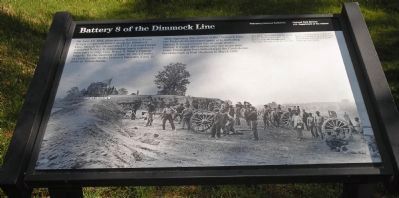
After capturing this section of the Dimmock Line, the Federals incorporated parts of it, including Battery 8, into a second line of siege works. Battery 8 would see combat only one more time, when Union guns here helped repel the Confederate breakthrough at Fort Stedman in March 1865.
Erected by Petersburg National Battlefield - National Park Service - Dept of the Interior.
Topics. This historical marker is listed in this topic list: War, US Civil. A significant historical month for this entry is March 1865.
Location. 37° 14.186′ N, 77° 21.479′ W. Marker is near Petersburg, Virginia, in Prince George County. It is on Siege Road, on the right when traveling south. Marker is in Petersburg National Battlefield on the Auto Tour Road at Tour Stop 2. Touch for map. Marker is in this post
this page online

Regionally, this marker is in Coastal Virginia. It is also in the American South, specifically in the Upper South, in the Tidewater, and on the Eastern Seaboard. Globally, it is in the North Atlantic Region, North America, the Western Hemisphere, the Western World, and the Anglosphere. Historically, it finds itself in what was once the territory of the Mississippian Culture, one of the original Thirteen Colonies, one of the Confederate States of America, and the Antebellum South.
Other nearby markers. At least 8 other markers are within walking distance of this marker: Training for War on Hallowed Ground (approx. ¼ mile away); “A Splendid Charge” (approx. 0.3 miles away); a different marker also named Infantry Earthworks (approx. 0.3 miles away); Monotonous Toil (approx. 0.3 miles away); U.S. Colored Troops (approx. 0.3 miles away); Dividing Point (approx. 0.4 miles away); Artillery at Petersburg (approx. half a mile away); Jordan Family Cemetery (approx. half a mile away). Touch for a list and map of all markers in Petersburg.
Other
Photographed by Bill Coughlin, April 23, 2007
2. Marker at Tour Stop 2
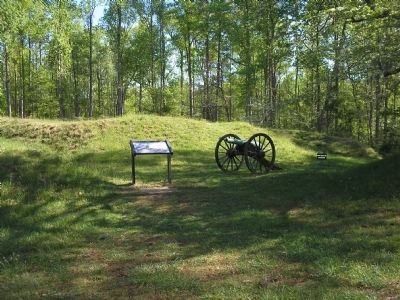
This battery was captured on June 15, 1864 and renamed Fort Friend for the nearby Friend House. The fort was refaced and served as a supporting artillery position for the duration of the siege.
More about this marker. The background of the marker is a war-time photograph with the caption, This photo, taken from a point across the tour road to your right, shows Battery 8 (in the background) five days after its capture by the Federals. In the coming weeks, Confederate Battery 8 would be demolished by the Federals and replaced by the redan you see today.
Also see . . .
1. The Siege of Petersburg. (Submitted on April 12, 2008, by Bill Coughlin of Woodland Park, New Jersey.)
2. Petersburg National Battlefield. National Park Service. (Submitted on April 12, 2008, by Bill Coughlin of Woodland Park, New Jersey.)
Photographed by Bill Coughlin, April 23, 2007
3. Battery 8 Artillery
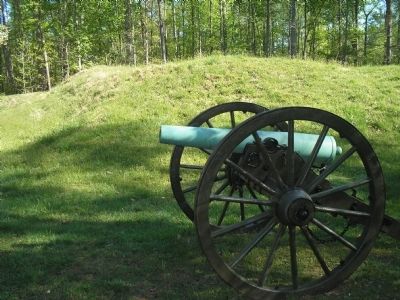
The artillery located inside of Fort Friend (Battery 8) participated in the defense of Fort Stedman in March 25, 1865. This particular artillery piece is a Confederate 3-inch Rifle cast by A.B. Reading and Brothers, of Vicksburg, Mississippi in 1862.
Photographed by Craig Swain, November 22, 2008
4. Sawtooth Rifling
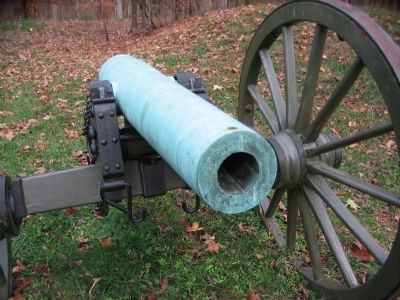
The A.B. Reading rifle used rather distinctive sawtooth rifling. Most Civil War rifled cannon used flat "lands and grooves" rifling.
Credits. This page was last revised on October 21, 2024. It was originally submitted on April 12, 2008, by Bill Coughlin of Woodland Park, New Jersey. This page has been viewed 1,813 times since then and 48 times this year. Photos: 1, 2, 3. submitted on April 12, 2008, by Bill Coughlin of Woodland Park, New Jersey. 4. submitted on December 22, 2008, by Craig Swain of Leesburg, Virginia. • Craig Swain was the editor who published this page.
