Near Petersburg in Prince George County, Virginia — The American South (Mid-Atlantic)
Dividing Point
Photographed by Bradley Owen, October 20, 2021
1. Dividing Point Marker
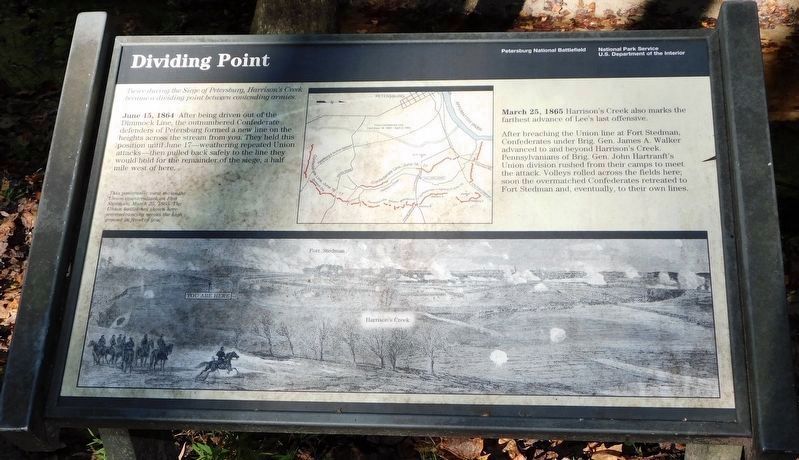
June 15, 1864 After being driven out of the Dimmock Line, the outnumbered Confederate defenders of Petersburg formed a new line on the heights across the stream from you. They held this position until June 17 - weathering repeated Union attacks - then pulled back safely to the line they would hold for the remainder of the siege, a half mile west of here.
March 25, 1865 Harrison’s Creek also marks the farthest advance of Lee’s last offensive.
After breaching the Union lines at Fort Stedman, Confederates under Brig. Gen. James A. Walker advanced to and beyond Harrison’s Creek. Pennsylvanians of Brig. Gen. John Hartranft’s Union division rushed from their camps to meet the attack. Volleys rolled across the fields here; soon the overmatched Confederates retreated to Fort Stedman and, eventually, to their own lines.
Erected by National Park Service, U.S. Department of the Interior.
Topics. This historical marker is listed in this topic list: War, US Civil. A significant historical month for this entry is March 1865.
Location. 37° 13.953′ N, 77° 21.811′ W.
this page online

Regionally, this marker is in Coastal Virginia. It is also in the American South, specifically in the Upper South, in the Tidewater, and on the Eastern Seaboard. Globally, it is in the North Atlantic Region, North America, the Western Hemisphere, the Western World, and the Anglosphere. Historically, it finds itself in what was once the territory of the Mississippian Culture, one of the original Thirteen Colonies, one of the Confederate States of America, and the Antebellum South.
Other nearby markers. At least 8 other markers are within walking distance of this marker: Prince George Court House Road (approx. 0.3 miles away); Siege of Petersburg—Lee Strikes Back (approx. 0.3 miles away); A Final Effort (approx. 0.3 miles away); Fort Stedman (approx. 0.3 miles away); a different marker also named Fort Stedman
Photographed by Bill Coughlin, April 23, 2007
2. Dividing Point Marker
Other markers no longer nearby. Colquitt’s Salient Trail (was approx. 0.3 miles away but has been reported to have been replaced with another marker now near it); Hare House Site (was approx. 0.4 miles away but has been permanently removed); Wasted Valor (was approx. half a mile away but has been replaced with another marker now near it).
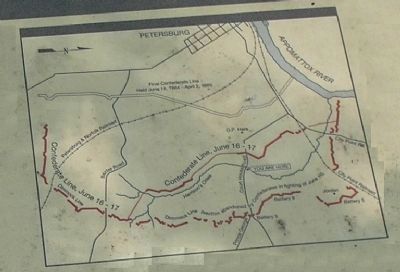
More about this marker. The upper center of the marker contains a map of the Confederate defensive lines during the 1864-65 siege.
The bottom of the marker features a sketch of the siege lines showing the locations of Fort Stedman, Harrison’s Creek and the marker itself. It includes the caption This panoramic view shows the Union counterattack on Fort Stedman, March 25, 1865. The Union battlelines shown here were advancing across the high ground in front of you.
Also see . . .
1. The Siege of Petersburg. (Submitted on April 12, 2008, by Bill Coughlin of Woodland Park, New Jersey.)
2. Petersburg National Battlefield.
Photographed by Bill Coughlin, April 23, 2007
3. Closeup of Map
Map showing the Confederate fortifications around Petersburg during the siege.
Photographed by Bill Coughlin, April 23, 2007
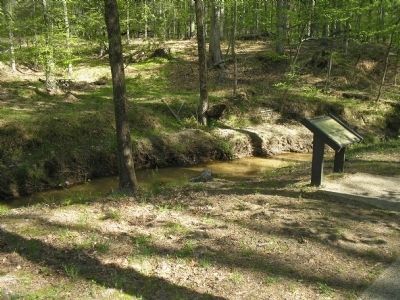
4. Marker at Harrison's Creek
Confederate troops fell back to this point on June 15, 1864 and dug in along the stream. After holding this position for two days, they fell back to a new line closer to Petersburg.
Photographed by Bradley Owen, October 20, 2021
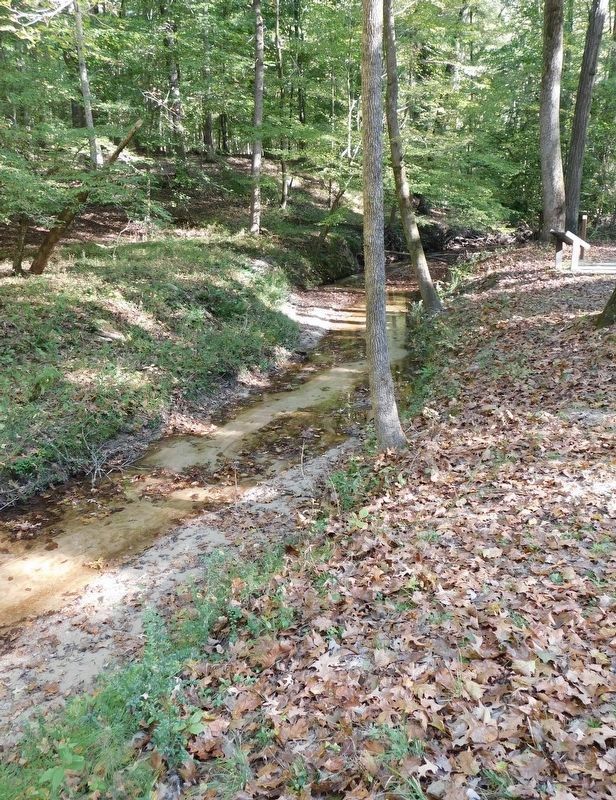
5. Dividing Point Marker
Harrison’s Creek viewed from the Park Tour Road. The marker can be seen at the far right.
Credits. This page was last revised on October 21, 2024. It was originally submitted on April 12, 2008, by Bill Coughlin of Woodland Park, New Jersey. This page has been viewed 1,758 times since then and 23 times this year. Photos: 1. submitted on November 13, 2021, by Bradley Owen of Morgantown, West Virginia. 2, 3, 4. submitted on April 12, 2008, by Bill Coughlin of Woodland Park, New Jersey. 5. submitted on November 13, 2021, by Bradley Owen of Morgantown, West Virginia. • Craig Swain was the editor who published this page.
