Greenville in Pitt County, North Carolina — The American South (South Atlantic)
Red Banks Church
"… suddenly and unexpectedly met the enemy"
Photographed by Don Morfe, September 26, 2013
1. Red Banks Church Marker
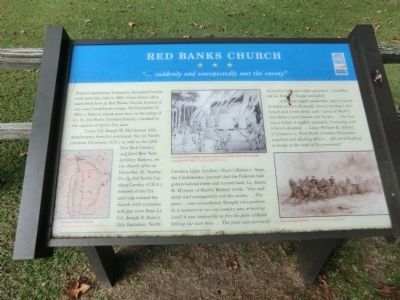
Federal expeditions frequently disrupted Confederate activities late in 1863. Union forces often assembled here at Red Banks Church because it was near Confederate camps. On December 17, 1863, a Federal attack near here on the camp of Co. H, 3rd North Carolina Cavalry, resulted in the capture of thirty-five men.
Union Col. Joseph M. McChesney with detachments from his command, the 1st North Carolina Volunteers (U.S), as well as the 12th New York Cavalry and 23rd New York Artillery Battery, set the church afire on December 30. Nearby Co. G, 3rd North Carolina Cavalry (C.S.A.), learned of the fire and rode toward the church with a cannon and gun crew from Lt. Col. Joseph B. Starr’s 13th Battalion, North Carolina Light Artillery (Starr’s Battery). Soon, the Confederates learned that the Federals had gotten behind them and turned back. Lt. James H. Myrover of Starr’s Battery wrote, “they suddenly and unexpectedly met the enemy. … The piece … was immediately brought into position. In a moment or two our cavalry was retreating (and) it was impossible to fire the piece without killing our own men. … The piece was surrounded (and) 4 men were taken prisoners.”
this page online
A Federal report noted that “after a hand-to-hand conflict the enemy retired, leaving 1 lieutenant and 5 men dead, with 1 piece of Starr’s fine battery, and caisson and horses. …Our loss was 1 killed, 6 slightly wounded 1 missing, and 3 horses disabled. … Lieut. William K. Adams, of Company L, First North Carolina Volunteers, a gallant and dashing officer…fell while making a charge at the head of the command.”
(captions)
(lower left) Eastern North Carolina Courtesy University of North Carolina
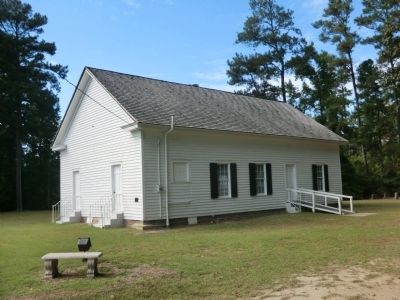
(center) Burning of Red Bank Church which was rebuilt after the war and remodeled in 1893. - Courtesy Roger Kammerer
(lower right) Horse-drawn artillery - Courtesy Library of Congress
Erected by North Carolina Civil War Trails.
Topics and series. This historical marker is listed in these topic lists: Religion & Religious Structures • War, US Civil. In addition, it is included in the North Carolina Civil War Trails series list. A significant historical month for this entry is December 1820.
Location. This marker has been replaced by another marker nearby. It was located near 35° 34.306′ N, 77° 20.44′ W.
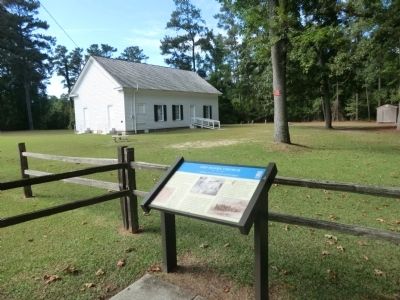
Photographed by Don Morfe, September 26, 2013
2. Red Banks Church Marker

Regionally, this marker was in North Carolina’s Coastal Plain. It was also in the American South, specifically in the Upper South, and on the Eastern Seaboard. Globally, it was in the North Atlantic Region, North America, the Western Hemisphere, the Western World, and the Anglosphere. Historically, it found itself in what was once the territory of the Mississippian Culture, one of the original Thirteen Colonies, one of the Confederate States of America, and the Antebellum South.
Other nearby markers. At least 8 other markers are within 4 miles of this location, measured as the crow flies: A different marker also named Red Banks Church (here, next to this marker); East Carolina College Veterans Memorial (approx. 2.6 miles away); East Carolina University Veterans Memorial (approx. 2.6 miles away); East Carolina University
Photographed by Don Morfe, September 26, 2013
3. Red Banks Church Marker
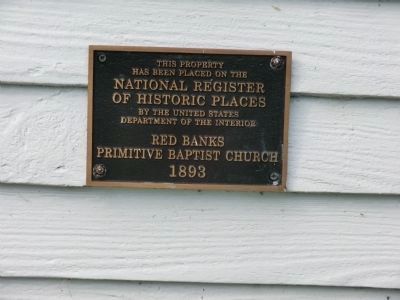
This marker is affixed to the side of the church building
Related marker. Click here for another marker that is related to this marker. This marker has been replaced with the linked marker.
Photographed by Don Morfe, September 26, 2013
4. Red Banks Church Marker
Credits. This page was last revised on June 23, 2025. It was originally submitted on November 29, 2013, by Don Morfe of Baltimore, Maryland. This page has been viewed 1,068 times since then and 41 times this year. Photos: 1, 2, 3, 4. submitted on November 29, 2013, by Don Morfe of Baltimore, Maryland. • Bernard Fisher was the editor who published this page.
