Girdwood in Anchorage, Alaska — Northwest (North America)
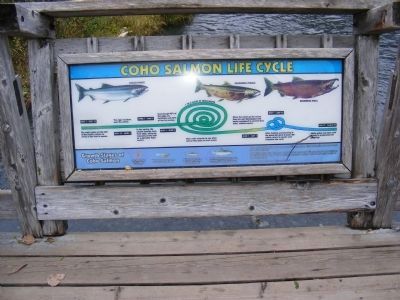
Coho Salmon Life Cycle
Photographed by Don Morfe, September 11, 2009
1. Coho Salmon Life Cycle Marker
Most coho migrate to sea after one or two years in fresh water.
Sept 1-Nov 15 The adult cohos are the last of the Pacific salmon to arrive in the river to spawn.
Nov 15-April 1 The eggs incubate over the winter.
April 1-May 1 In the spring, the alevins emerge from their eggs, using the remnants of the yolk as a portable food source.
May 1-June 1 Even though 90% of the eggs are fertilized, only 20% of the fry survive.
June 1-July 1When the smolt go the ocean they are well developed and better equipped to survive than other salmon smolts.
July 1-July 15 After feeding and growing in the ocean for up to 2 years, the adults return to spawn and complete the cycle.
July 15-August 31 Adults gather near their natal stream in preparation for spawning.
Growth Stages of Coho Salmon-Each female lays approximately 3800 eggs
–Note the orange egg sac that the alevin uses for food
—Twenty percent of the fertilized eggs develop into the fry stage
—After spending up to four years in fresh water, fry develop into smolts that are adapted for salt water.
—Coho are excellent jumpers.
this page online
Topics. This historical marker is listed in this topic list: Waterways & Vessels.
Location. 60° 47.259′ N, 148° 52.726′ W. Marker is in Anchorage, Alaska. It is in Girdwood. It is on Portage Glacier Road. The marker is located on the Williwaw Salmon Viewing Platform. Touch for map. Marker is at or near this postal address: 4450 Portage Glacier Rd, Girdwood AK 99587, United States of America. Touch for directions.

Regionally, this marker is in the Alaska Railroad Corridor, in the Athabascan Region, in the Prince William Sound, and in Southcentral Alaska. It is also on the American Pacific Coast. Globally, it is in North America, on the Ring of Fire, on the Pacific Rim, in the Western Hemisphere, in the Western World, and in the Anglosphere. Historically, it
Photographed by Don Morfe, September 11, 2009
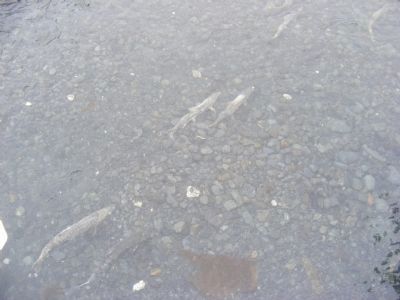
2. Coho Salmon in the stream
Other nearby markers. At least 7 other markers are within 5 miles of this marker, measured as the crow flies: Atlantic Salmon-A Threat to the Chugach National Forest? (here, next to this marker); Chugach National Forest (approx. 1.3 miles away); 1964 Earthquake (approx. 4.1 miles away); Moose Calves (approx. 4.2 miles away); Our Living National Symbol (approx. 4.3 miles away); A Prickly World (approx. 4.3 miles away); Brown Bears of AWCC (approx. 4.3 miles away).
Photographed by Don Morfe, September 11, 2009
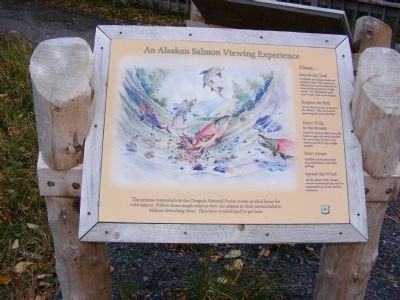
3. An Alaskan Salmon Viewing Experience
The pristine watershed in the Chugach National Forest create an ideal home for wild salmon. Follow these simple rules to view the salmon in their natural habitat without disturbing them. They have worked hard to get here.
Credits. This page was last revised on June 16, 2016. It was originally submitted on December 12, 2013, by Don Morfe of Baltimore, Maryland. This page has been viewed 742 times since then and 25 times this year. Photos: 1, 2, 3. submitted on December 12, 2013, by Don Morfe of Baltimore, Maryland. • Al Wolf was the editor who published this page.
