Northern Waterfront in San Francisco City and County, California — The American West (Pacific Coastal)
Gold Mountain
Photographed by Barry Swackhamer, December 16, 2013
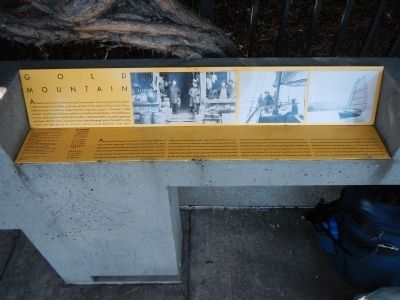
1. Gold Mountain Marker
Inscription.
As dreams and the spirit of adventure lured “fortune-hunters” from many parts of the world to California during the mid 1800s, so the news spread to the far reaches of China. To the Chinese, California came to symbolize an image of salvation, hope and prosperity – “Gum Saan” – Gold Mountain. Struck by natural disasters, political turmoil and forced colonization, China had become a country transformed from a land of cultural wealth to a land devastated by war, political oppression and famine. With little choice, many packed what modest belongings they had, boarded the sailing vessels and embarked on an uncertain, perilous voyage bound for “Gum Saan”.
Although not all Chinese who traveled to San Francisco between 1850 and 1915 stayed permanently, approximately 150,000 made the Bay Area their home. Despite disappointments during the Gold Rush and unconstitutional United States laws, the Chinese made vast contributions to the Pacific railroad, shipping and fishing industries, reclamation of the tule swamplands in the Sacramento and San Joaquin Valleys and construction in the
Click or scan to see this page online
Napa Valley Vineyard region, among others. Locally, the Chinese in a short period of time started and owned most of the city’s laundries, slipper, shoe and boot industries, and many of its restaurants. Known as excellent sailors with experience in the rough waters of the China seas, it was quite natural for them to manufacture and maneuver their junks and sampans trough the California waters. It was not uncommon to see junks measuring up to 59 feet in length sailing side by side with European clipper ships in the Bay. As the shrimping industry flourished, the Chinese established fishing villages similar to those found on the coast of China, lining the Bay from Tamales Bay and Point San Pedro in Marin County to Monterey Bay. At the height of the shrimping industry in 1895, the shrimp catch was worth $162,749, about $40,000 more than California’s salmon catch. The surrounding beaches and hillsides were used to dry the shrimp catch, most of which then shipped to China on the San Francisco based Pacific Mail Steamship Line. Over time, the Chinese fishing communities suffered a decline for several reasons, among which were the anti-Chinese
Photographed by Barry Swackhamer, December 16, 2013
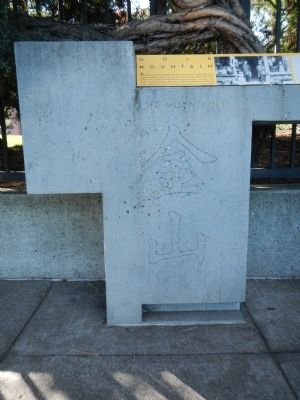
2. Gold Mountain Marker
legislation and the pollution of the Bay and bay fill which destroyed the shrimp beds. From 1876 to 1916 the Chinese as seamen, were the backbone of the great movement of transpacific ocean lines. The Pacific Mail Steamship Company made its first transpacific run in 1867. Along with the Occidental & Oriental Steamship Company, their combined fleet of 27 vessels made more than 1,000 round trips between San Francisco and Hong Kong via Yokohama. Over the next 30 years the number of individual Chinese holding maritime positions was 78,433.
The Chinese characters for "Gum Saan", Gold Mountain, are found on the pedestal.
Topics. This historical marker is listed in this topic list: Asian Americans. A significant historical year for this entry is 1850.
Location. 37° 48.198′ N, 122° 24.091′ W. Marker is in San Francisco, California, in San Francisco City and County. It is in Northern Waterfront. It is on The Embarcadero near Battery Street, on the left when traveling south. Touch for map. Marker is in this post office area: San Francisco CA 94111, United States of America. Touch for directions.
Regionally, this marker is on California’s
Photographed by Barry Swackhamer, December 16, 2013
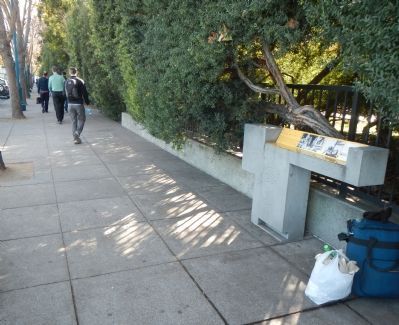
3. Gold Mountain Marker
Coast Ranges. It is also on the American Pacific Coast. Globally, it is in North America, on the Ring of Fire, on the Pacific Rim, in the Western Hemisphere, in the Western World, and in the Anglosphere. Historically, it finds itself in what was once New Spain and also Mexico’s Alta California.
More about this marker. This marker is located on The Embarcadero, opposite Pier 23.
Credits. This page was last revised on February 7, 2023. It was originally submitted on December 20, 2013, by Barry Swackhamer of Brentwood, California. This page has been viewed 942 times since then and 93 times this year. Photos:1, 2, 3. submitted on December 20, 2013, by Barry Swackhamer of Brentwood, California. • Syd Whittle was the editor who published this page.