Historic District in St. Augustine in St. Johns County, Florida — The American South (South Atlantic)
General Biassou House
Photographed by Craig Swain, August 1, 2011
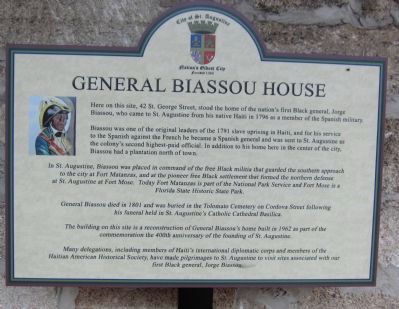
1. General Biassou House Marker
Biassou was one of the original leaders of the 1791 slave uprising in Haiti, and for his service to the Spanish against the French he became a Spanish general and came to St. Augustine as the colony's second highest-paid official. In addition to his home here in the center of the city, Biassou had a plantation north of town.
In St. Augustine, Biassou was placed in command of the free Black militia that guarded the southern approach to the city at Fort Matanzas, and at the pioneer free Black settlement that formed the northern defense at St. Augustine at Fort Mose. Today Fort Matanzas is part of the National Park Service and Fort Mose is a Florida State Historic State Park.
General Biassou died in 1801 and was buried in Tolomato Cemetery on Cordova Street following his funeral held in St. Augustine's Catholic Cathedral Basilica.
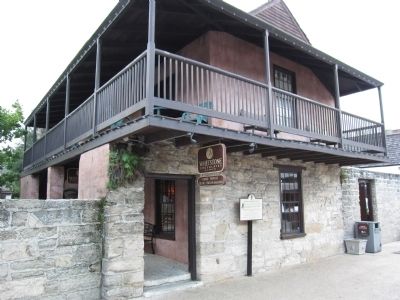
The building on this site is a reconstruction of General Biassou's home built in 1962
this page online
Many delegations, including members of Haiti's international diplomatic corps and members of the Haitian Historical Society, have all made pilgrimages to St. Augustine to visit sites associated with our first Black general, Jorge Biassou.
Erected by City of St. Augustine.
Topics. This historical marker is listed in this topic list: African Americans. A significant historical year for this entry is 1796.
Location. This marker has been replaced by another marker nearby. 29° 53.84′ N, 81° 18.808′ W. Marker is in St. Augustine, Florida, in St. Johns County. It is in the Historic District. It is on St. George Street, on the right when traveling north. St. George Street is closed to vehicle traffic. Touch for map. Marker is at or near this postal address: 42 St George Street, Saint Augustine FL 32084, United States of America. Touch for directions.

Regionally, this marker is in First Coast and in Greater Jacksonville. It is also in the American South and on the Eastern Seaboard. Globally, it is in the North Atlantic Region, North America,
Photographed by Craig Swain, August 1, 2011
2. General Biassou House and Marker
Other nearby markers. At least 8 other markers are within walking distance of this location: The Salcedo House (here, next to this marker); Gallegos House (within shouting distance of this marker); Juan de Ribera / Juan de Rivera (within shouting distance of this marker); Gomez House (within shouting distance of this marker); Ribera House (within shouting distance of this marker); This Gate Opened in 1739 (within shouting distance of this marker); The City Gate (within shouting distance of this marker); Triay House (within shouting distance of this marker). Touch for a list and map of all markers in St. Augustine.
More about this marker. This marker was replaced by a new one named The Salcedo House (see nearby markers).
Also see . . . General Jorge Biassou. (Submitted on August 31, 2011, by Craig Swain of Leesburg, Virginia.)
Credits. This page was last revised on January 2, 2019. It was originally submitted on August 31, 2011, by Craig Swain of Leesburg, Virginia. This page has been viewed 2,647 times since then and 200 times this year. Last updated on December 27, 2013, by Tim Fillmon of Webster, Florida. Photos: 1, 2. submitted on August 31, 2011, by Craig Swain of Leesburg, Virginia. • Bernard Fisher was the editor who published this page.
