Wheeling in Ohio County, West Virginia — The American South (Appalachia)
Wheeling Suspension Bridge
Gateway to the West
Photographed by Allen C. Browne, December 30, 2013
1. Wheeling Suspension Bridge Marker
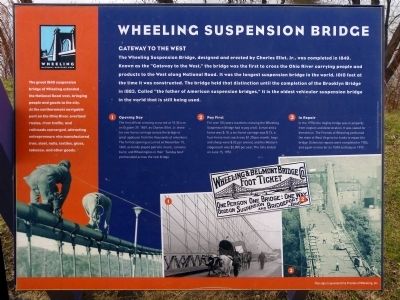
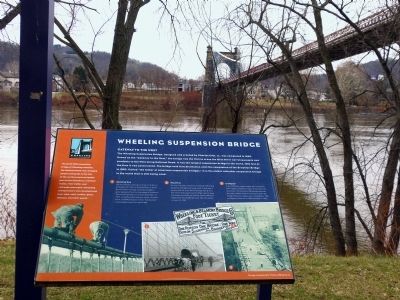
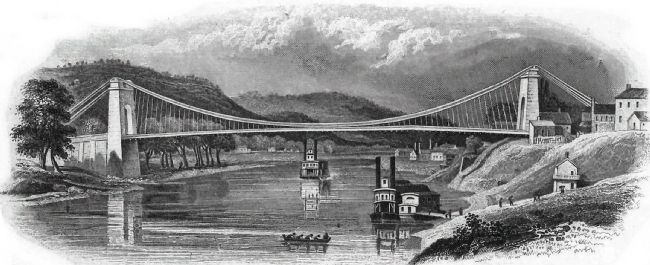
The great 1849 suspension bridge at Wheeling extended the National Road west, bringing people and goods to the city. At the northernmost navigable part on the Ohio River, overland routes, river traffic, and railroads converged, attracting entrepreneurs who manufactured iron, steel, nails, textiles, glass, tobacco, and other goods.
Erected by The Friends of Wheeling.
Topics. This historical marker is listed in this topic list: Bridges & Viaducts. A significant historical year for this entry is 1849.
Location. 40° 4.193′ N, 80° 43.515′ W. Marker is in Wheeling, West
this page online

Regionally, this marker is in the Northern Panhandle and in the High Valley. It is also in the American South, specifically in the Upper South, in the Ohio River Valley, in Appalachia, and specifically in Northern Appalachia. Globally, it is in North America, the Western Hemisphere, the Western World, and the Anglosphere. Historically, it finds itself in what was once the territory of the Mississippian Culture.
Other nearby markers. At least 8 other markers are within walking distance of this marker: Wheeling Suspension Bridge - 1849 (within shouting distance of this marker); Fort Henry (within shouting distance of this marker); Old Trails Road (within shouting distance of this marker); a different marker also named Wheeling Suspension Bridge (within shouting distance of this marker); a different marker also named Fort Henry (about 400 feet away, measured
Photographed by Allen C. Browne, December 30, 2013
2. Wheeling Suspension Bridge Marker
Photographed by Allen C. Browne, December 30, 2013
3. Opening Day
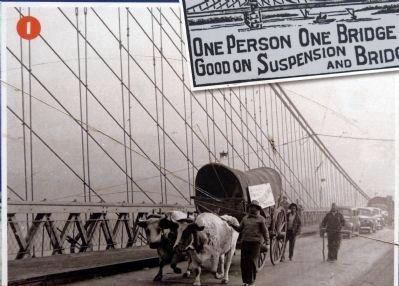
❶ The first official crossing occurred at 10:30 a.m. on October 29, 1849, as Charles Ellet, Jr. drove his one-horse carriage across the bridge to great applause from thousands of onlookers. The formal opening occurred on November 15, 1848, as bands played patriotic music, cannon burst, and Wheelingites in their "Sunday best" promenaded across the bridge.Close-up of photo on marker
Photographed by Allen C. Browne, December 30, 2013
4. Pay First
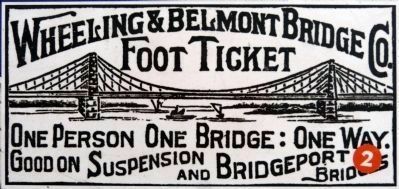
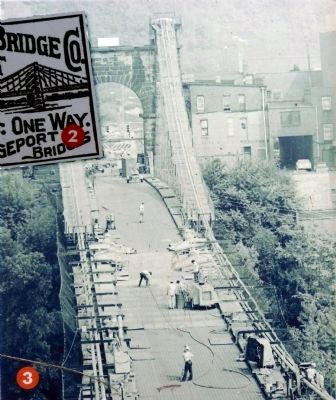
❷ For over 104 years travelers crossed the Wheeling Suspension Bridge had to pay a toll. A man and horse was $.10, a six-horse carriage was 15, a four-horse mail coach was $1.25 per month, hogs and sheep were $.02 per animal, and the Western stagecoach was $2,000 per year. The tolls ended on June 15, 1953.Close-up of image on marker
Photographed by Allen C. Browne, December 30, 2013
5. In Repair
❸ In the 1970s the mighty bridge was in jeopardy from neglect and deterioration. It was slated for demolition. The Friends of Wheeling petitioned the state of West Virginia for funds to repair the bridge. Extensive repairs were completed in 1983, and again in time for its 150th birthday in 1999.Close-up of photo on marker
Photographed by Allen C. Browne, December 30, 2013
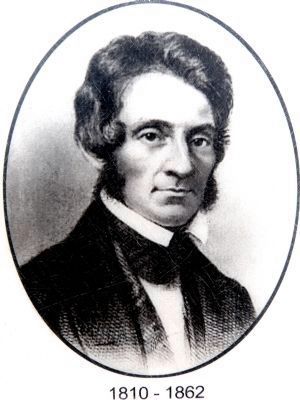
6. Charles Ellet Jr.
Designer of the Bridge
Designer of the Bridge
Photographed by Wikipedia
7. The Wheeling Suspension Bridge
Credits. This page was last revised on June 16, 2016. It was originally submitted on January 1, 2014, by Allen C. Browne of Silver Spring, Maryland. This page has been viewed 2,312 times since then and 33 times this year. Photos: 1, 2, 3, 4, 5, 6, 7. submitted on January 1, 2014, by Allen C. Browne of Silver Spring, Maryland. • Bill Pfingsten was the editor who published this page.
