Massachusetts Heights in Northwest Washington in Washington, District of Columbia — The American Northeast (Mid-Atlantic)
Why Are These Stones Here?
| — | [Washington National Cathedral] | — |
Photographed by Richard E. Miller, April 28, 2013
1. "Why Are These Stones Here?" Marker
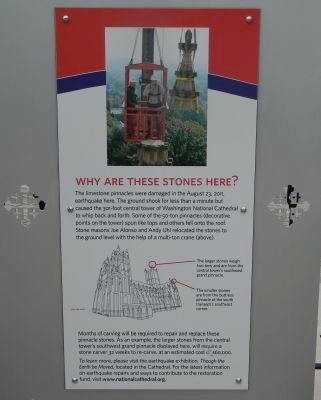
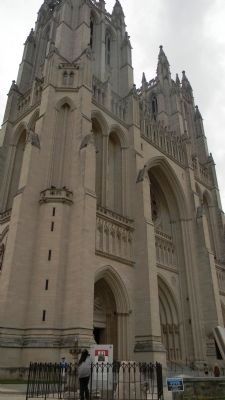
The limestone pinnacles were damaged in the August 23, 2011, earthquake here. The ground shook for less than a minute but caused the 301-foot central tower of Washington National Cathedral to whip back and forth. Some of the 50-ton pinnacles (decorative points on the tower) spun like tops and others fell onto the roof. Stone masons Joe Alonso and Andy Uhl relocated the stones to the ground level with the help of a multi-ton crane (above).
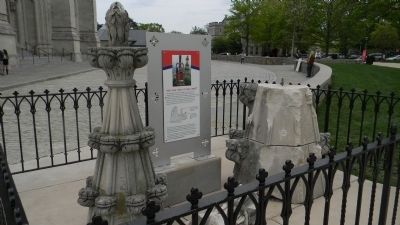
Months of carving will be required to repair and replace these pinnacle stones. As an example, the larger stones from the central tower’s southwest grand pinnacle displayed here, will require a stone carver 32 weeks to re-carve, at an estimated cost of $60,000.
To learn more, please visit the earthquake exhibition, “Though the Earth be Moved,” located in the Cathedral. For the latest information on earthquake repairs and ways to contribute to the restoration fund, visit www.nationalcathedral.org.
[Captions:]
The larger stones weigh two tons and are from the central tower’s southwest grand pinnacle.
The smaller stones are from the buttress pinnacle at the south transept’s southeast corner.
Erected 2012
this page online
Topics. This historical marker is listed in these topic lists: Architecture • Disasters • Religion & Religious Structures. A significant historical year for this entry is 2011.
Location. 38° 55.832′ N, 77° 4.314′ W. Marker is in Northwest Washington in Washington, District of Columbia. It is in Massachusetts Heights. It can be reached from Wisconsin Avenue Northwest north of Massachusetts Avenue Northwest, on the right when traveling north. Touch for map. Marker is at or near this postal address: 3101 Wisconsin Ave NW, Washington DC 20016, United States of America. Touch for directions.

Regionally, this marker is in the Washington Metropolitan Area. It is also in the American Northeast, in the Upper South, in the Mid-Atlantic, in the Tidewater, and in the Chesapeake Bay Region. Globally, it is in North America, the Western Hemisphere, the Western World, and the Anglosphere.
Other nearby markers. At least 8 other markers are within walking distance of this marker: Earthquake Update (here, next to this marker); All Hallows Guild (a few steps from this marker); Herb Cottage (about
Photographed by Richard E. Miller, April 28, 2013
2. "Why Are These Stones Here?" Marker
Other markers no longer nearby. Twisted Pinnacles! (was within shouting distance of this marker but has been permanently removed); Damage Alert! (was within shouting distance of this marker but has been permanently removed); a different marker also named Damage Alert! (was within shouting distance of this marker but has been permanently removed); a different marker also named Damage Alert! (was about 300 feet away but has been permanently removed); a different marker also named Damage Alert! (was about 300 feet away but has been permanently removed); a different marker also named Damage Alert! (was about 400 feet away but has been permanently removed); Broken Buttresses! (was about 500 feet away but has been permanently removed).
Related marker. Click here for another marker that is related
Photographed by Richard E. Miller, April 28, 2013
3. "Why Are These Stones Here?" Marker
Also see . . . "Mysteries of the Washington National Cathedral". (Submitted on January 10, 2014, by Richard E. Miller of Oxon Hill, Maryland.)
Credits. This page was last revised on January 30, 2023. It was originally submitted on January 10, 2014, by Richard E. Miller of Oxon Hill, Maryland. This page has been viewed 906 times since then and 20 times this year. Photos: 1, 2, 3. submitted on January 10, 2014, by Richard E. Miller of Oxon Hill, Maryland. • Bill Pfingsten was the editor who published this page.
