Union Square in San Francisco City and County, California — The American West (Pacific Coastal)
Phelan Building
Thor Equities
Photographed by Barry Swackhamer, February 10, 2014
1. Phelan Building Marker
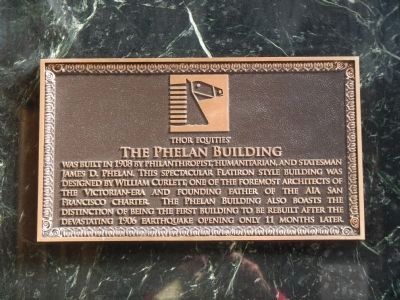
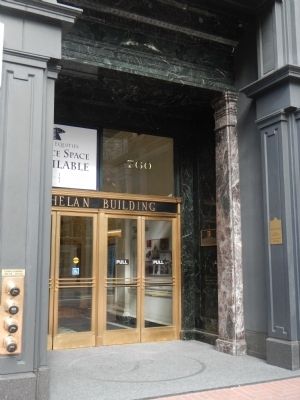
was built in 1908 by philanthropist, humanitarian, and statesman James D. Phelan. This spectacular Flatiron style building was designed by William Curlett, one of the foremost architects of the Victorian-era and founding father of the AIA San Francisco Chapter. The Phelan Building also boasts the distinction of being the first building to be rebuilt after the devastating 1906 earthquake opening only 11 months later.
Erected by Thor Equities.
Topics. This historical marker is listed in this topic list: Notable Buildings. A significant historical year for this entry is 1908.
Location. 37° 47.187′ N, 122° 24.317′ W. Marker is in San Francisco, California, in San Francisco City and County. It is in Union Square. It is on Market Street near O'Farrell Street, on the left when traveling north. Touch for map. Marker is at or near this postal address: 760 Market Street, San Francisco CA 94102, United States of America. Touch for directions.

Regionally, this marker is on California’s Coast Ranges. It is also on the American Pacific Coast. Globally, it is in North America, on the Ring of Fire, on the Pacific Rim,
this page online
Other nearby markers. At least 8 other markers are within walking distance of this marker: 49 Fourth Street (about 500 feet away, measured in a direct line); John's Grill (about 700 feet away); St. Ignatius College (about 700 feet away); William Randolph Hearst (about 700 feet away); Parrot Building (about 800 feet away); Luisa Tetrazzini (about 800 feet away); Dewey Monument (approx. 0.2 miles away); Mayors of San Francisco (approx. 0.2 miles away). Touch for a list and map of all markers in San Francisco.
Another marker is no longer nearby. “The D’Arcy Building” (was about 600 feet away but has been confirmed missing).
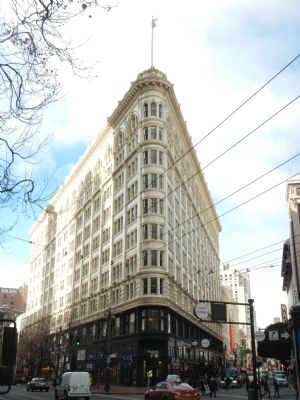
Regarding Phelan Building. The second of two Phelan Buildings on the same site, the current building bears the name of one of San Francisco's most prominent early families. The first Phelan building was a 6-story, bay-windowed, mansard-roofed flatiron constructed by the elder James Phelan. Destroyed in the fire of 1906, it was quickly
Photographed by Barry Swackhamer, February 10, 2014
2. Phelan Building Marker
Also see . . . Phalen Building. Wikipedia (Submitted on November 29, 2015, by Allen C. Browne of Silver Spring, Maryland.)
Photographed by Allen C. Browne, November 16, 2015
3. Phelan Building Marker
Photographed by Barry Swackhamer, February 10, 2014
4. The Phelan Building
Photographed by Allen C. Browne, November 16, 2015
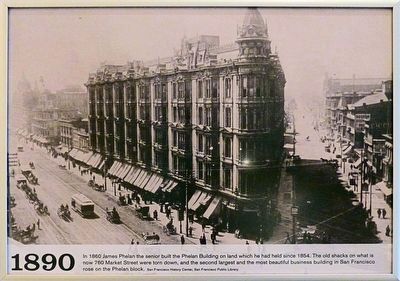
5. 1890
In 1860 James Phelan the senior built the Phelan Building on land he held since 1854. The old shacks on what is now 760 Market Street were torn down, and the second largest and most beautiful business building in San Francisco rose on the Phelan block. Close-up of photo inside the Phelan Building
Photographed by Allen C. Browne, November 16, 2015
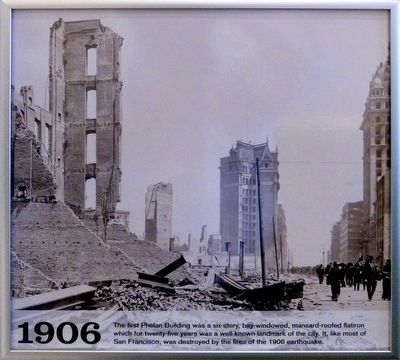
6. 1906
The first Phelan Building was a six story bay-windowed, mansard-roofed flatiron which for twenty -five years was a well-known landmark of the city. It, like most of San Francisco, was destroyed by the fires of the 1906 earthquake. Close-up of photo inside the Phelan Building
Photographed by Allen C. Browne, November 16, 2015
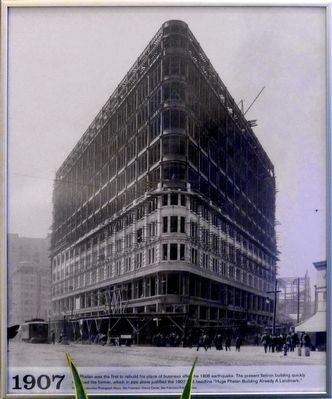
7. 1907
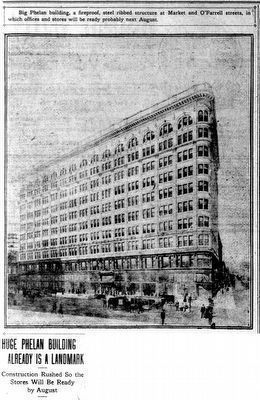
Phelan was the first to rebuild his place of business after the 1906 earthquake. The present flatiron building quickly replace the former which in size alone justified the 1907 Call Headline “Huge Phelan Building Already a Landmark.” Close-up of photo inside the Phelan Building
The San Fransisco Call, December 29, 1907
8. Huge Phelan Building Already is a Landmark
Stores Will be Ready by August
Photographed by Allen C. Browne, November 16, 2015
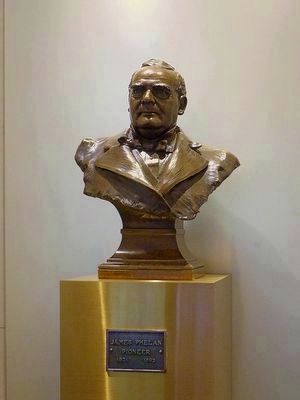
9. James Phelan Pioneer
1821 - 1892
1821 - 1892
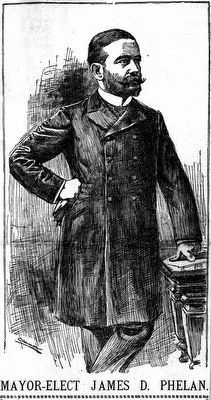
The San Francisco Call, November 10, 1898
10. Mayor Elect James D. Phelan
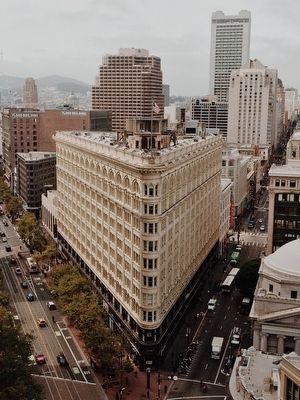
Photographed by Marcin Wichary, Wikipedia, April 11, 2014
11. A view of the Phelan Building in San Francisco from the Central Tower
Credits. This page was last revised on February 7, 2023. It was originally submitted on February 19, 2014, by Barry Swackhamer of Brentwood, California. This page has been viewed 1,997 times since then and 152 times this year. Photos: 1, 2. submitted on February 19, 2014, by Barry Swackhamer of Brentwood, California. 3. submitted on November 29, 2015, by Allen C. Browne of Silver Spring, Maryland. 4. submitted on February 19, 2014, by Barry Swackhamer of Brentwood, California. 5, 6, 7, 8, 9, 10, 11. submitted on November 29, 2015, by Allen C. Browne of Silver Spring, Maryland. • Syd Whittle was the editor who published this page.
