Downtown Oakland in Alameda County, California — The American West (Pacific Coastal)
Alameda County Courthouses
Photographed by Barry Swackhamer, February 20, 2014
1. Alameda County’s 1st Courthouse Marker
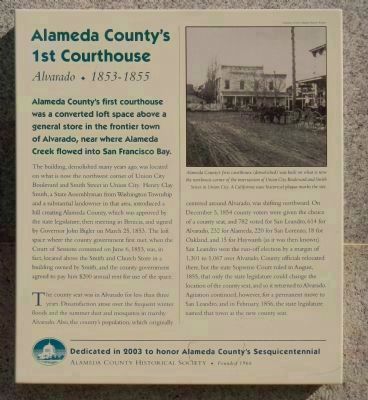
Caption: Alameda County’s first courthouse (demolished) was built on what is now the northwest corner of the intersection of Union City Boulevard and Smith Street in Union City. A California state historical plaque marks the site.
Click on link to view marker:
Click for more information.
Click on link to view marker:
Click for more information.
Alvarado • 1853-1855
Alameda County’s first courthouse was a converted loft space above a general store in the frontier town of Alvarado, near where Alameda Creek flowed into San Francisco Bay.
The building, demolished many years ago, was located on what is now the northwest corner of Union City Boulevard and Smith Street in Union City. Henry Clay Smith, a State Assemblyman from Washington Township and a substantial landowner in that area, introduced a bill creating Alameda County, which was approved by the state legislature, then meeting in Benicia, and signed by Governor John Bigler on March 25, 1852. The loft space where the county government first met, when the Court of Sessions convened on June 6, 1853, was, in fact, located above the Smith and Church Store in a building owned by Smith, and the county government agreed to pay him $200 annual rent for use of the space.
The county seat was in Alvarado for less than three years. Dissatisfaction arose over the frequent winter floods and summer dust and
this page online
San Leandro • 1855-1873
The Estudillo family, holders of the original Mexican land grant, was instrumental in bringing the county seat to the town of San Leandro.
They donated four city blocks of their land for public purposes, around which the new town of San Leandro arose. A temporary courthouse had been built in 1855, but
Photographed by Barry Swackhamer, February 20, 2014
2. Alameda County’s 2nd Courthouse Marker
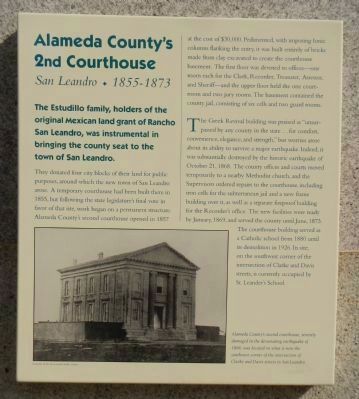
Caption: Alameda County’s second courthouse, severely damaged in the devastating earthquake of 1868, was located on what is now the southwest corner of the intersection of Clarke and Davis streets in San Leandro.
The Greek Revival building was praised as “unsurpassed by any county in the state... for comfort, convenience, elegance, and strength,” but worries arose about its ability to survive a major earthquake. Indeed, it was substantially destroyed by the historic earthquake of October 21, 1868. The county offices and courts moved temporarily to a nearby Methodist Church, and the Supervisors ordered repairs to the courthouse, including iron cells for the subterranean jail and a new frame building over it, as well as a separate fireproof
Photographed by Barry Swackhamer, February 20, 2014
3. Alameda County’s 3rd Courthouse Marker
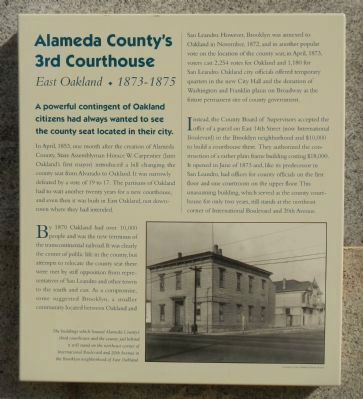
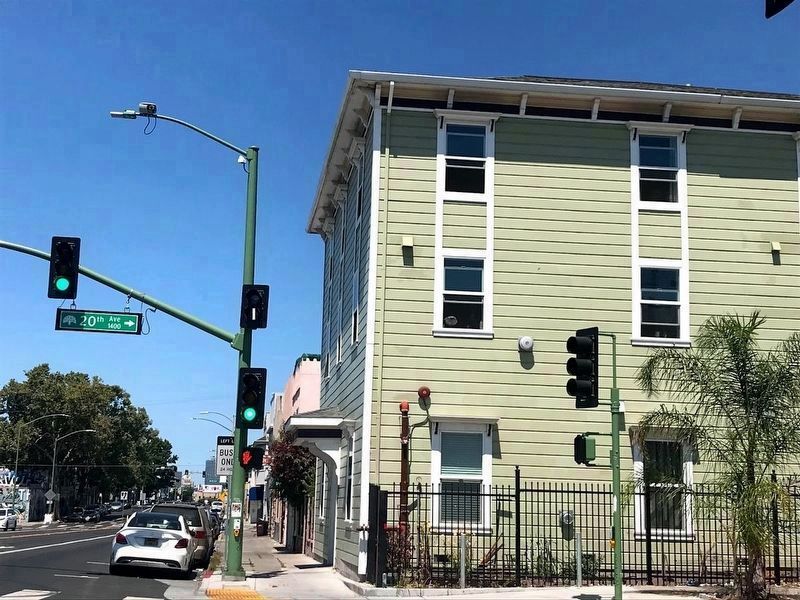
Caption: The buildings which housed Alameda County’s third courthouse and the county jail behind it still stand on the northeast corner of International Boulevard and 20th Avenue in the Brooklyn neighborhood of East Oakland.
East Oakland • 1873-1875
A powerful contingent of Oakland citizens has always wanted to see the county seat located in their city.
April, 1853, one month after the creation of Alameda County, State Assemblyman Horace W. Carpentier (later Oakland’s first mayor) introduced a bill changing the county seat from Alvarado to Oakland. It was narrowly defeated by a vote of 19 to 17. The partisans of Oakland had to wait another twenty years for a new courthouse, and even then it was built in East Oakland, not downtown where they had intended.
By 1870 Oakland had over 10,000 people and was the new terminus of the transcontinental railroad. It was clearly the center of public life in the county, but attempts to relocate the county seat there were met by stiff
Photographed by Barry Swackhamer, February 20, 2014
4. Alameda County’s 4th Courthouse Marker
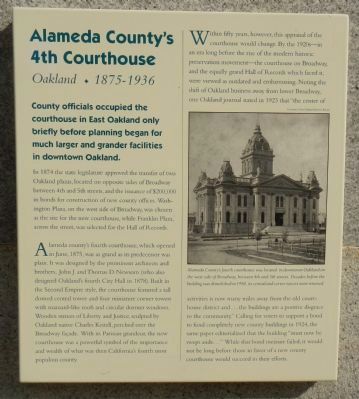
Caption: Alameda County’s fourth courthouse was located in downtown Oakland on the west side of Broadway, between 4th and 5th streets. Decades before the building was demolished in 1950, its central and corner towers were removed.
Instead, the County Board of Supervisors accepted the offer of a parcel on East 14th Street, (now International Boulevard) in the Brooklyn neighborhood and $10,000 to build a courthouse there. They authorized the construction of a rather plain frame building costing $18,000. It opened in June of 1873 and, like its predecessor in San Leandro, had offices for county officials on the first floor and one courtroom on the upper floor. This unassuming building, which served as the county courthouse for only two years, still stands at the northeast corner of International
Photographed by Barry Swackhamer, February 20, 2014
5. Alameda County’s 5th Courthouse Marker
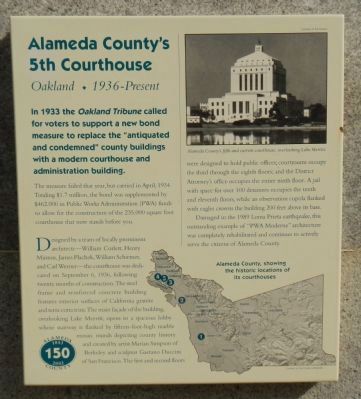
Captions: Alameda County’s fifth and current courthouse, overlooking Lake Merritt. (above); Alameda County, showing the historic locations of its courthouses (bottom).
Oakland • 1875-1936
County officials occupied the courthouse in East Oakland only briefly before planning began for much larger and grander facilities in downtown Oakland.
In 1874 the state legislature approved the transfer of two Oakland plazas, located on opposite sides of Broadway between 4th and 5th streets, and the issuance of $200,000 in bonds for construction of new county offices. Washington Plaza, on the west side of Broadway, was chosen as the site for the new courthouse, while Franklin Plaza, across the street, was selected for the Hall of Records.
Alameda county’s fourth courthouse, which opened in June, 1897, was as grand as its predecessor was plain. It was designed by the prominent architects and brothers, John J. and Thomas D. Newsom (who also designed Oakland’s fourth City Hall in 1878). Built in the Second Empire style, the courthouse featured a tall domed central tower and four miniature corner towers with mansard-like roofs and circular dormer windows. Wooden statures of Liberty and Justice, sculpted by Oakland native Charles Keitell, perched
Photographed by Barry Swackhamer, February 20, 2014
6. Alameda County Courthouses Panels
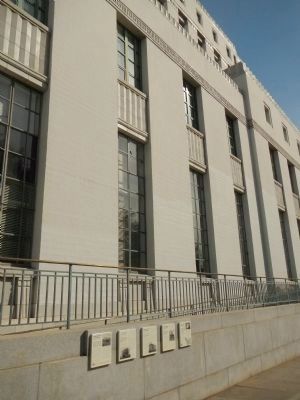
Within fifty years, however, this appraisal of the courthouse would change. By the 1920s – in an era long before the rise of the modern historic preservation movement – the courthouse on Broadway, and the equally grand Hall of Records which faced it, were viewed as outdated and embarrassing. Noting the shift of Oakland business away from lower Broadway, one Oakland journal stated in 1923 that “the center of activities is now many miles away from the old courthouse district and... the buildings are a positive disgrace to the community.” Calling for voters to support a bond to fund completely new county buildings in 1924, the same paper editorialized that the building “must now be swept aside...” While that bond measure failed, it would not be long before those in favor of a new county courthouse would succeed in their efforts.
Oakland • 1936-Present
In 1933 the Oakland Tribune called for voters to support a new bond measure to replace the “antiquated and condemned” county buildings with a modern courthouse and administrative building.
The
Photographed by Barry Swackhamer, February 20, 2014
7. The fifth Alameda County Courthouse
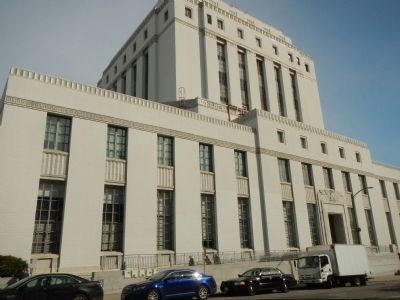
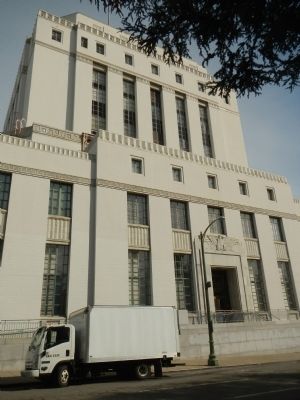
Designed by a team of locally prominent architects – William Corlett, Henry Minton, James Plachek, William Schirmer, and Carl Werner – the courthouse was dedicated on September 6, 1936, following twenty months of construction. The steel frame and reinforced concrete building features exterior surfaces of California granite and terra cotta trim. The main façade of the building overlooking Lake Merritt, opens to a spacious lobby whose stairway is flanked by fifteen-foot-high marble mosaic murals depicting county history and created by artist Marian Simpson of Berkeley and sculptor Gaetano Duccini of San Francisco. The first and second floors were designed to hold public offices, courtrooms occupy the third through the eighth floors, and the District Attorney’s office occupies the entire ninth floor. A jail with space for over 100 detainees occupies the tenth and eleventh
Photographed by Barry Swackhamer, February 20, 2014
8. The fifth Alameda County Courthouse
Damaged in the 1989 Loma Prieta earthquake, this outstanding example of “PWA Moderne” architecture was completely rehabilitated and continues to actively serve the citizens of Alameda County.
Dedicated in 2003 to honor Alameda County’s Sesquicentennial
Erected 2003 by Alameda County Historical Society.
Topics. This historical marker is listed in these topic lists: Government & Politics • Notable Buildings. A significant historical month for this entry is January 1869.
Location. 37° 47.984′ N, 122° 15.813′ W. Marker is in Oakland, California, in Alameda County. It is in Downtown Oakland. It is on 12th Street near Oak Street, on the left when traveling east. Touch for map. Marker is at or near this postal address: 26 12th Street, Oakland CA 94612, United States of America. Touch for directions.

Regionally, this marker is in California’s San Francisco Bay Area and on the Coast Ranges. It is also on the American Pacific Coast. Globally, it is in North America, on the Ring of Fire, on the Pacific Rim, in
Photographed by Diane Phillips
9. Alameda County Courthouses
This is the building on the corner of International Boulevard and 20th Avenue which served as the third courthouse.
Other nearby markers. At least 8 other markers are within walking distance of this marker: Oakland War Memorial (about 400 feet away, measured in a direct line); Masters of Navigation (approx. ¼ mile away); A Chinese Junk Boat for Oakland (approx. ¼ mile away); Oakland’s Chinatowns (approx. ¼ mile away); Asian Resource Center (approx. 0.4 miles away); Waterfront Warehouse District (approx. 0.4 miles away); Oakland’s Waterfront Warehouse District (approx. 0.4 miles away); Site of College of California (approx. 0.4 miles away). Touch for a list and map of all markers in Oakland.
Credits. This page was last revised on February 7, 2023. It was originally submitted on March 2, 2014, by Barry Swackhamer of Brentwood, California. This page has been viewed 1,292 times since then and 143 times this year. Photos: 1, 2, 3, 4, 5, 6, 7, 8. submitted on March 2, 2014, by Barry Swackhamer of Brentwood, California. 9. submitted on August 2, 2020, by Diane Phillips of Pittsburg, California. • Syd Whittle was the editor who published this page.
