
Pensacola in Escambia County, Florida — The American South (South Atlantic)
St. Joseph Catholic Church
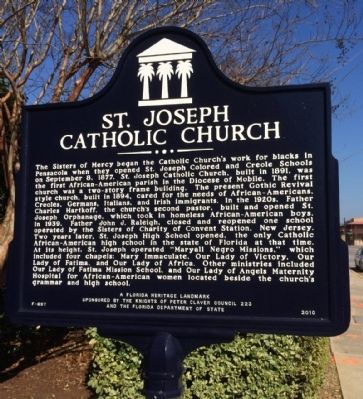
Photographed by Mark Hilton, March 10, 2014
1. St. Joseph Catholic Church Marker
this page online
Erected 2010 by the Knights of Peter Claver Council 233 & the Florida Department of State. (Marker Number F-697.)
Topics. This historical marker is listed in these topic lists: African Americans • Religion & Religious Structures. A significant historical month for this entry is September 1846.
Location. 30° 24.53′ N, 87° 13.061′ W. Marker is in Pensacola, Florida, in Escambia County. It is at the intersection of West Government Street and South Spring Street, on the right when traveling west on West Government Street. Touch for map. Marker is at or near this postal address: 140 West Government Street, Pensacola FL 32502, United States of America. Touch for directions.

Regionally, this marker is on the Florida Panhandle. It is also in the American South, specifically in the Deep South, and on the Gulf Coast. Globally, it is in the North Atlantic Region, North America, a Gulf of Mexico state, the Western Hemisphere, the Western World, and the Anglosphere. Historically, it finds itself in what was once New Spain, the territory of the Mississippian
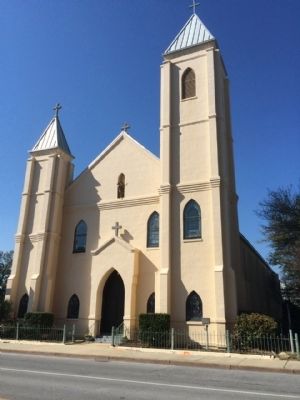
Photographed by Mark Hilton, March 10, 2014
2. St. Joseph Catholic Church
The marker is far to the right, in profile.
Other nearby markers. At least 8 other markers are within walking distance of this marker: Site of Panton Leslie & Co's (about 600 feet away, measured in a direct line); Gen. Andrew Jackson Residence (approx. 0.2 miles away); 407 South Palafox (approx. 0.2 miles away); William Dudley Chipley (approx. ¼ mile away); Gen. Andrew Jackson (approx. ¼ mile away); Industry At Sea (approx. ¼ mile away); Frank L. Mayes (approx. ¼ mile away); Trader Jon's (approx. ¼ mile away). Touch for a list and map of all markers in Pensacola.
Another marker is no longer nearby. First Telephone Exchange (was approx. 0.2 miles away but has been confirmed missing).
Credits. This page was last revised on August 1, 2017. It was originally submitted on March 12, 2014, by Mark Hilton of Montgomery, Alabama. This page has been viewed 1,831 times since then and 96 times this year. Photos: 1, 2. submitted on March 12, 2014, by Mark Hilton of Montgomery, Alabama. • Bill Pfingsten was the editor who published this page.
