Denison in Grayson County, Texas — The American South (West South Central)
Birthplace of President Dwight D. Eisenhower
(1890 - 1969)
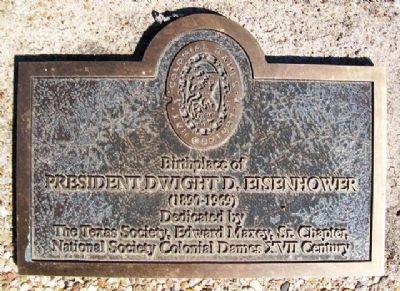
Photographed by William Fischer, Jr., March 7, 2014
1. Birthplace of President Dwight D. Eisenhower Marker
Erected by The Texas Society, Edward Maxey, Sr. Chapter, National Society Colonial Dames XVII Century.
Topics and series. This historical marker is listed in these topic lists: Patriots & Patriotism • War, Cold • War, World I • War, World II. In addition, it is included in the Former U.S. Presidents: #34 Dwight D. Eisenhower, and the The Colonial Dames XVII Century, National Society series lists.
Location. 33° 44.941′ N, 96° 32.05′ W. Marker is in Denison, Texas, in Grayson County. It can be reached from East Day Street. Marker is on the median at the parking lot near the Eisenhower Birthplace, on Day Street south of Shepherd Street, at Eisenhower Birthplace State Historic Site. Touch for map. Marker is at or near this postal address: 609 South Lamar Avenue, Denison TX 75021, United States of America. Touch for directions.

Regionally, this marker is in the Prairies & Lakes Region. It is also in the American South. Globally, it is in North America, a Gulf of Mexico state, the Western Hemisphere, the Western World, and the Anglosphere.
this page online
Other nearby markers. At least 8 other markers are within walking distance of this marker: Texas Veterans Memorial (here, next to this marker); Dwight David Eisenhower (within shouting distance of this marker); Birthplace of Dwight David Eisenhower (about 300 feet away, measured in a direct line); Waples-Platter Grocery Company (approx. 0.4 miles away); The E. M. Kohl Building (approx. 0.4 miles away); North-South Railway Connection (approx. 0.4 miles away); Forest Park (approx. 0.4 miles away); Signal Company Texas 36th Inf. Div. Veterans Memorial (approx. 0.4 miles away). Touch for a list and map of all markers in Denison.
Another marker is no longer nearby. Birthplace of Dwight Eisenhower (was within shouting distance of this marker but has been confirmed missing).
Also see . . .
1. Eisenhower Presidential Library, Museum, and Boyhood Home. (Submitted on April 6, 2014, by William Fischer, Jr. of Reynoldsburg, Ohio.)
2. Dwight Eisenhower (1890-1969). (Submitted on April 6, 2014, by William Fischer, Jr. of Reynoldsburg, Ohio.)
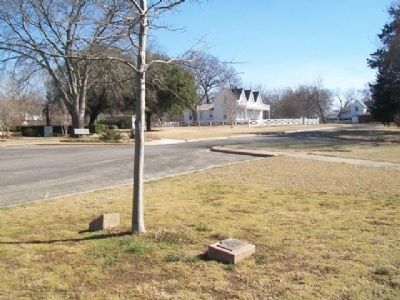
Photographed by William Fischer, Jr., March 7, 2014
2. Birthplace of President Dwight D. Eisenhower Marker
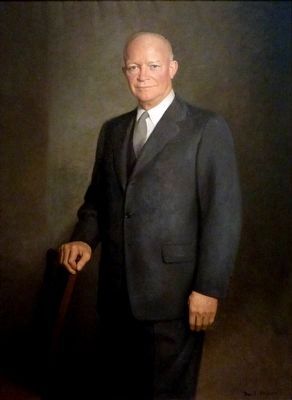
Photographed by Allen C. Browne, August 9, 2015
3. Dwight D. Eisenhower
This 1955 portrait of Dwight D. Eisenhower by Thomas E. Stephens hangs in the National Portrait Gallery in Washington, DC.
“In American politics, a successful military career has often led to the presidency, and so it proved with Dwight D. Eisenhower, who gained fame during World War II as supreme commander in Europe. Eisenhower was courted by both political parties, and he became the Republican nominee in 1952, chosen over the more conservative Robert Taft. Eisenhower defeated Illinois governor Adlai Stevenson in a campaign that attacked the Democrat's foreign policy savvy and toughness. With Eisenhower's personal appeal — the slogan was ‘I Like Ike’ — and military background, the Republican ticket was elected and then reelected in 1956. In office, Eisenhower ended the Korean War, maintained an uneasy balance with the Soviet bloc, and domestically presided over a period of general prosperity. A moderate conservative, he was cautious on issues of civil liberties and civil rights but left office warning of the growth of a ‘military industrial complex’ that threatened both government and American values. Once criticized as too passive a president, Eisenhower now draws widespread praise for his quiet, effective leadership during the 1950s.” — National Portrait Gallery
“In American politics, a successful military career has often led to the presidency, and so it proved with Dwight D. Eisenhower, who gained fame during World War II as supreme commander in Europe. Eisenhower was courted by both political parties, and he became the Republican nominee in 1952, chosen over the more conservative Robert Taft. Eisenhower defeated Illinois governor Adlai Stevenson in a campaign that attacked the Democrat's foreign policy savvy and toughness. With Eisenhower's personal appeal — the slogan was ‘I Like Ike’ — and military background, the Republican ticket was elected and then reelected in 1956. In office, Eisenhower ended the Korean War, maintained an uneasy balance with the Soviet bloc, and domestically presided over a period of general prosperity. A moderate conservative, he was cautious on issues of civil liberties and civil rights but left office warning of the growth of a ‘military industrial complex’ that threatened both government and American values. Once criticized as too passive a president, Eisenhower now draws widespread praise for his quiet, effective leadership during the 1950s.” — National Portrait Gallery
Credits. This page was last revised on February 6, 2025. It was originally submitted on April 6, 2014, by William Fischer, Jr. of Reynoldsburg, Ohio. This page has been viewed 900 times since then and 70 times this year. Photos: 1, 2. submitted on April 6, 2014, by William Fischer, Jr. of Reynoldsburg, Ohio. 3. submitted on August 22, 2015, by Allen C. Browne of Silver Spring, Maryland.
