Linden in Marengo County, Alabama — The American South (East South Central)
History of Linden, Alabama
Photographed by Mark Hilton, April 12, 2014
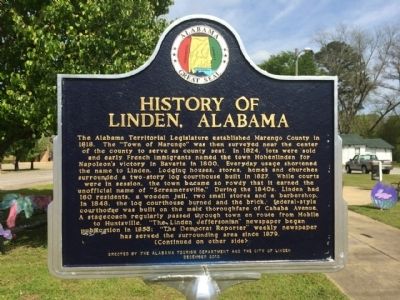
1. History of Linden Marker
The Alabama Territorial Legislature established Marengo County in 1818. The “Town of Marengo” was then surveyed near the center of the county to serve as county seat. In 1824 lots were sold, and early French immigrants named the town Hohenlinden for Napoleon's victory in Bavaria in 1800. Everyday usage shortened the name to Linden. Lodging houses, stores, homes and churches surrounded a two-story log courthouse built in 1827. While courts were in session, the town became so rowdy that it earned the unofficial name of “Screamersville.” During the 1840's Linden had 160 residents, a wooden jail, two small stores and a barber shop. In 1848 the log courthouse burned, and the brick, federal style courthouse was built on the main thoroughfare of Cahaba Avenue. A stagecoach regularly passed through town en route from Mobile to Huntsville. “The Linden Jeffersonian” newspaper began publication in 1853; “The Democrat Reporter” weekly newspaper has served the surrounding area since 1879.
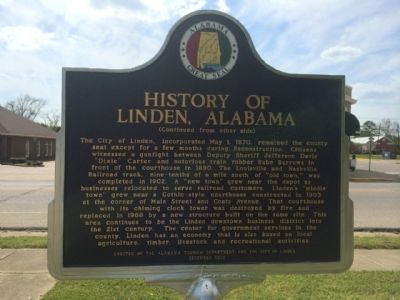
The City of Linden, incorporated March 1, 1870, remained the county seat except for a few months during Reconstruction. Citizens witnessed a
this page online
Erected 2010 by the Alabama Tourism Department and the City of Linden.
Topics and series. This historical marker is listed in these topic lists: Railroads & Streetcars • Settlements & Settlers. In addition, it is included in the Alabama Tourism Department series list. A significant historical date for this entry is March 1, 1842.
Location. 32° 18.307′ N,
Photographed by Mark Hilton, April 12, 2014
2. History of Linden Marker (reverse)

Regionally, this marker is in the American South, specifically in the Deep South, and in the Black Belt. Globally, it is in North America, a Gulf of Mexico state, the Western Hemisphere, the Western World, and the Anglosphere. Historically, it finds itself in what was once New Spain, the territory of the Mississippian Culture, one of the Confederate States of America, and the Antebellum South.
Other nearby markers. At least 8 other markers are within 11 miles of this marker, measured as the crow flies: A County Older Than the State (about 500 feet away, measured in a direct line); Old Marengo County Courthouse (approx. half a mile away); Legacy of Dr. Edd W. Shields D.D. (approx. 0.6 miles away); Holt Cemetery (approx. 7.6 miles away); Jefferson Methodist Church
Photographed by Mark Hilton, April 12, 2014
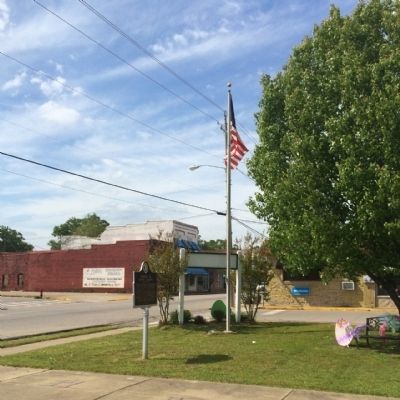
3. Marker location at Farmers Market park
Also see . . . Linden. Encyclopedia of Alabama entry. (Submitted on August 30, 2020, by Larry Gertner of New York, New York.)
Credits. This page was last revised on November 20, 2024. It was originally submitted on April 13, 2014, by Mark Hilton of Montgomery, Alabama. This page has been viewed 1,645 times since then and 83 times this year. Photos: 1, 2, 3. submitted on April 13, 2014, by Mark Hilton of Montgomery, Alabama. • Bernard Fisher was the editor who published this page.
