
Near Muleshoe in Bailey County, Texas — The American South (West South Central)
Muleshoe National Wildlife Refuge
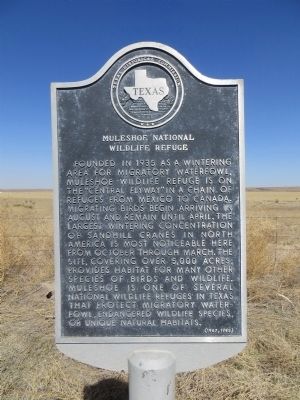
Photographed by Bill Kirchner, April 29, 2014
1. Muleshoe National Wildlife Refuge Marker
Erected 1985 by Texas Historical Commission. (Marker Number 3530.)
Topics. This historical marker is listed in this topic list: Animals. A significant historical year for this entry is 1935.
Location. 33° 57.014′ N, 102° 44.52′ W. Marker is near Muleshoe, Texas, in Bailey County. It is at the intersection of State Highway 214 and Farm to Market Road 1248, on the left when traveling north on State Highway 214. Touch for map. Marker is in this post office area: Muleshoe TX 79347, United States of America. Touch for directions.

Regionally,
this page online
Other nearby markers. At least 8 other markers are within 15 miles of this marker, measured as the crow flies: Quanah Parker Trail (approx. 2 miles away); La Pista de Vida Agua (approx. 2.8 miles away); Pastores of Bailey County (approx. 2.8 miles away); Enochs Cemetery (approx. 5.7 miles away); a different marker also named Enochs Cemetery (approx. 5.7 miles away); Site of Virginia City (approx. 9½ miles away); Maple Cemetery (approx. 12 miles away); Coyote Lake (approx. 14.2 miles away).
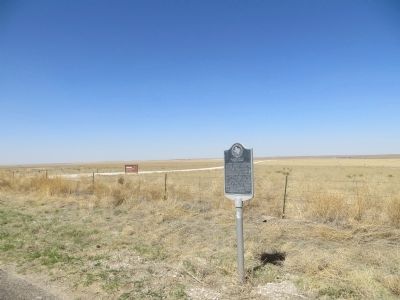
Photographed by Bill Kirchner, April 29, 2014
2. Muleshoe National Wildlife Refuge Marker

Photographed by Jeff Leichsenring, December 14, 2025
3. Muleshoe National Wildlife Refuge Marker
Credits. This page was last revised on December 20, 2025. It was originally submitted on May 13, 2014, by Bill Kirchner of Tucson, Arizona. This page has been viewed 1,388 times since then and 118 times this year. Photos: 1, 2. submitted on May 13, 2014, by Bill Kirchner of Tucson, Arizona. 3. submitted on December 18, 2025, by Jeff Leichsenring of Garland, Texas. • Bernard Fisher was the editor who published this page.
