Loretto in Essex County, Virginia — The American South (Mid-Atlantic)
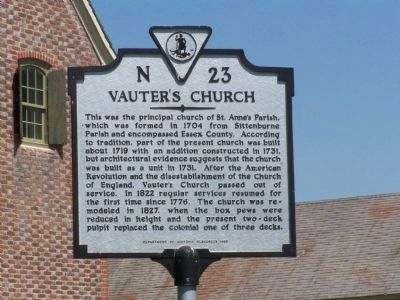
Vauter's Church
Photographed by Beverly Pfingsten, April 18, 2008
1. Vauter's Church Marker
Erected 1993 by Department of Historic Resources. (Marker Number N-23.)
Topics and series. This historical marker is listed in these topic lists: Colonial Era • Religion & Religious Structures • War, US Revolutionary. In addition, it is included in the Virginia Department of Historic Resources (DHR) series list. A significant historical year for this entry is 1704.
Location. 38° 5.205′ N, 77° 4.127′ W. Marker is in Loretto, Virginia, in Essex County. It is on US 17
this page online

Regionally, this marker is on Virginia’s Middle Peninsula. It is also in the American South, specifically in the Upper South, in the Tidewater, in the Chesapeake Bay Region, and on the Eastern Seaboard. Globally, it is in the North Atlantic Region, North America, the Western Hemisphere, the Western World, and the Anglosphere. Historically, it finds itself in what was once the territory of the Mississippian Culture, one of the original Thirteen Colonies, one of the Confederate States of America, and the Antebellum South.
Other nearby markers. At least 8 other markers are within 4 miles of this marker, measured as the crow flies: Portobacco Indians (approx. 1.1 miles away); Saunders’s Wharf (approx. 1.8 miles away); Layton’s Landing Wharf and Ferry (approx. 3½ miles away); Early Settlement (approx. 3½ miles away); Essex County / Caroline County (approx. 3.6 miles away); Pissaseck Indians (approx. 3.8 miles away); Leedstown (approx. 3.9
Photographed by Beverly Pfingsten, April 18, 2008
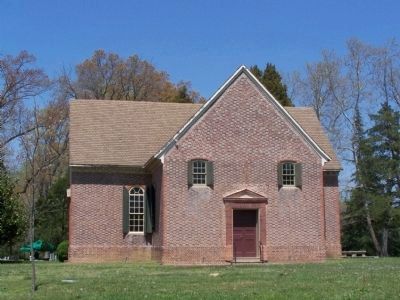
2. Vauter's Church
Also see . . . On the Road in Essex County - N-23 Vauter’s Church. 2019 article by Zorine Shirley in the River Country News. Excerpt:
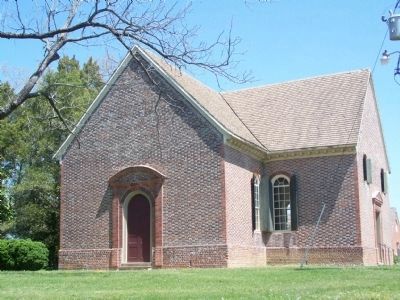
The “T” or “cruciform” shape of the building makes it rather unusual for the time. The brick pattern is known as Flemish bond. Each course or layer of brick contains alternating ‘stretchers’ (the long end of the brick) and ‘headers’ (the short end of the brick). Flemish bond became the pattern of choice for masonry in the early 1700’s replacing the English bond of the 1600’s.(Submitted on September 17, 2020.)
Photographed by Beverly Pfingsten, April 18, 2008
3. Vauter's Church
Photographed by Beverly Pfingsten, April 18, 2008
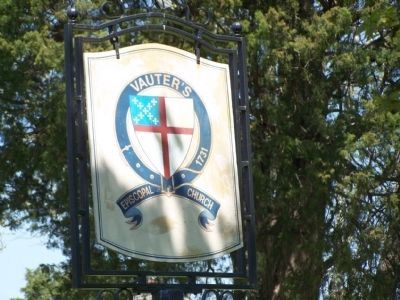
4. Church Plaque
Credits. This page was last revised on November 2, 2024. It was originally submitted on April 27, 2008, by Bill Pfingsten of Bel Air, Maryland. This page has been viewed 3,540 times since then and 104 times this year. Photos: 1, 2, 3, 4. submitted on April 27, 2008, by Bill Pfingsten of Bel Air, Maryland.
