Vallonia in Jackson County, Indiana — The American Midwest (Great Lakes)
Site of Fort Vallonia
Photographed by Duane Hall, May 22, 2014
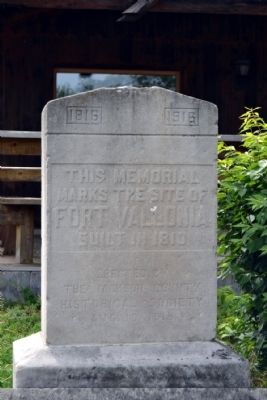
1. Site of Fort Vallonia Marker
Marks the Site of
Fort Vallonia
Built in 1810
Erected by
The Jackson County
Historical Society
Aug. 10, 1916
Erected 1916 by Jackson County Historical Society.
Topics. This historical marker is listed in this topic list: Forts and Castles. A significant historical month for this entry is August 1812.
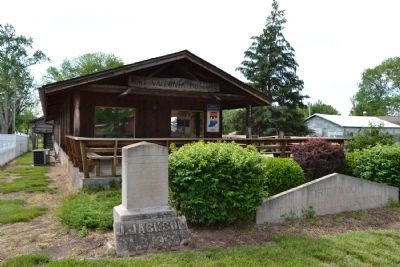
Location. 38° 50.665′ N, 86° 5.88′ W. Marker is in Vallonia, Indiana, in Jackson County. It can be reached from S. Main Street (County Road S310W) south of Water Street, on the right when traveling south. Marker is located in front of the Fort Vallonia Museum building. Touch for map. Marker is at or near this postal address: 2444 S Main St, Vallonia IN 47281, United States of America. Touch for directions.

Regionally, this marker is in Southern Indiana. It is also in the American Midwest and in the Corn Belt. Globally, it is in North America, the Western Hemisphere, the Western World, and the Anglosphere. Historically, it finds itself in what was once the territory of the Mississippian Culture and also the Northwest Territory.
Other nearby markers. At least 8 other markers are within 4 miles of this marker, measured as the crow flies: Bartholomew Trail (within shouting distance of this marker); Fort Vallonia (approx. half a mile away); Indian Ambush (approx. 0.7 miles away); Medora Covered Bridge (approx. 3.2 miles away); Driftwood Church and Cemetery (approx. 3.2 miles away); In Memory of Col. John Ketcham / Time Capsule (approx. 3.8 miles away); All Veterans Honor Roll Memorial (approx. 3.8 miles away); The Freedom Tree (approx. 3.8 miles away). Touch for a list and map of all markers in Vallonia.
Also see . . . Vallonia, Indiana - Wikipedia entry. Includes a history on Fort Vallonia. (Submitted on May 29, 2014.)
this page online
Photographed by Duane Hall, May 22, 2014
2. Site of Fort Vallonia Marker
Photographed by Duane Hall, May 22, 2014
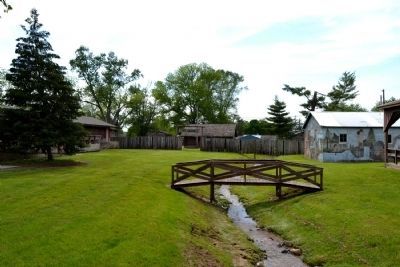
3. Reproduction of Fort Vallonia
Photographed by Duane Hall, May 22, 2014
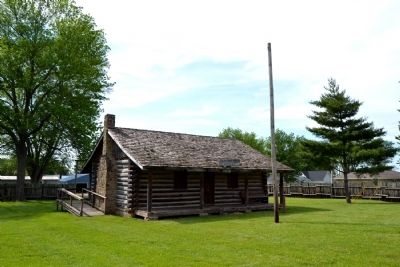
4. Garrison House
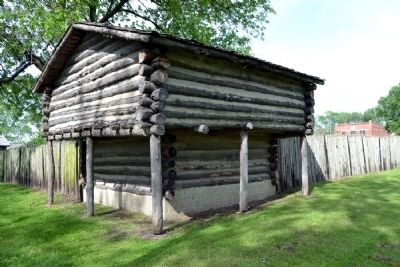
Photographed by Duane Hall, May 22, 2014
5. Corner Blockhouse
Credits. This page was last revised on June 16, 2016. It was originally submitted on May 29, 2014, by Duane Hall of Abilene, Texas. This page has been viewed 1,005 times since then and 26 times this year. Photos: 1, 2, 3, 4, 5. submitted on May 29, 2014, by Duane Hall of Abilene, Texas.
