Princeville in Edgecombe County, North Carolina — The American South (South Atlantic)
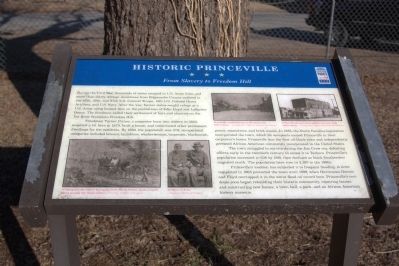
Historic Princeville
From Slavery to Freedom Hill

During the Civil War, thousands of slaves escaped to U.S. Army lines, and more than thirty African Americans from Edgecombe County enlisted in the 35th, 36th, and 37th U.S. Colored Troops, 14th U.S. Colored Heavy Artillery, and U.S. Navy. After the war, former slaves sought refuge at a U.S. Army camp located here on the plantations of John Lloyd and Lafayette Dancy. The freedmen called their settlement of huts and shanties on the Tar River floodplain Freedom Hill.
Freedman Turner Prince, a carpenter born into slavery in 1843, acquired a lot here in 1873, built a house, and constructed other permanent dwellings for the residents. By 1880, the population was 379; occupational categories included laborer, laundress, washerwoman, carpenter, blacksmith, grocer, seamstress, and brick mason. In 1885, the North Carolina legislature incorporated the town, which its occupants named Princeville in their carpenter's honor. Princeville was the first all-black town and independently governed African American community incorporated in the United States.
The town struggled to survive during the Jim Crow era, defeating efforts
this page online
Princeville's location has subjected it to frequent flooding. A levee completed in 1965 protected the town until 1999, when Hurricanes Dennis and Floyd overtopped it in the worst flood on record here. Princeville's residents soon began rebuilding their historic community, repairing houses and constructing new homes, a town hall, a park, and an African American history museum.
Erected by North Carolina Civil War Trails.
Topics. This historical marker is listed in these topic lists: African Americans • War, US Civil. A significant historical year for this entry is 1843.
Location. 35° 53.422′ N, 77° 31.582′ W. Marker is in Princeville, North Carolina, in Edgecombe County. It is on Mutual Boulevard (U.S. 258) west of South Main Street (Business U.S. 64), on the right. The marker stands in the parking lot of the Museum & Welcome Center. Touch for map. Marker is at or near this postal address: 310 Mutual Blvd, Tarboro NC 27886,
Photographed by J. J. Prats, February 14, 2014
2. Historic Princeville Marker
This is a photo of the marker from before it was cleaned or replaced.

Regionally, this marker is in North Carolina’s Coastal Plain. It is also in the American South and specifically in the Upper South. Globally, it is in North America, the Western Hemisphere, the Western World, and the Anglosphere. Historically, it finds itself in what was once the territory of the Mississippian Culture, one of the original Thirteen Colonies, one of the Confederate States of America, and the Antebellum South.
Other nearby markers. At least 8 other markers are within walking distance of this marker: Freedom Hill (approx. ¼ mile away); Hurricane Floyd (approx. 0.3 miles away); Welcome to Princeville (approx. 0.4 miles away); Quigless Clinic-Hospital (approx. half a mile away); St. Paul A.M.E. Zion Church (approx. half a mile away); George H. White (approx. half a mile away); The Charters of Freedom (approx. 0.6 miles away); George Washington Visit (approx. 0.6 miles away). Touch for a list and map of all markers in Princeville.
More about this marker. There are four images reproduced on this marker with the these captions: “Princeville residential area

Regarding Historic Princeville. Princeville is the oldest town incorporated by African-Americans in the United States.
Photographed by J. J. Prats, February 14, 2014
4. Historic Princeville Marker
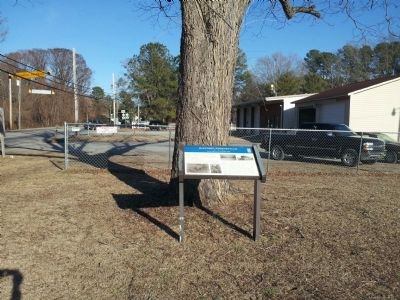
This is a photo from before the tree was removed.

Photographed by Devry Becker Jones (CC0), December 27, 2025
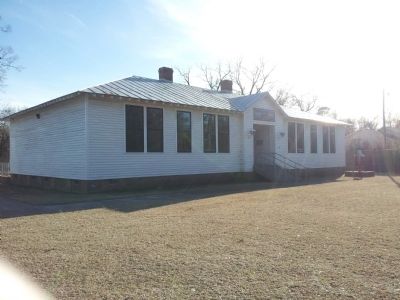
5. The Princeville Museum and Welcome Center
Photographed by J. J. Prats, February 14, 2014
6. Museum / Welcome Center
Photographed by Edwin Forbes
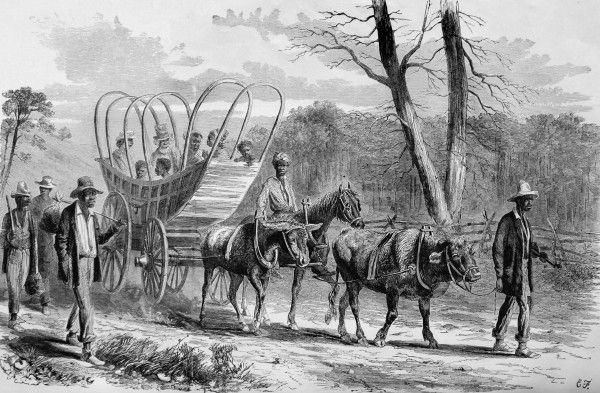
7. Passing into the Lines
This image from the Library of Congress is one of the images reproduced on the marker.
Credits. This page was last revised on December 28, 2025. It was originally submitted on May 31, 2014, by J. J. Prats of Powell, Ohio. This page has been viewed 1,697 times since then and 106 times this year. Last updated on June 1, 2014, by Keith S Smith of West Chester, Pennsylvania. Photos: 1. submitted on December 28, 2025, by Devry Becker Jones of Washington, District of Columbia. 2. submitted on May 31, 2014, by J. J. Prats of Powell, Ohio. 3. submitted on December 28, 2025, by Devry Becker Jones of Washington, District of Columbia. 4. submitted on May 31, 2014, by J. J. Prats of Powell, Ohio. 5. submitted on December 28, 2025, by Devry Becker Jones of Washington, District of Columbia. 6, 7. submitted on May 31, 2014, by J. J. Prats of Powell, Ohio. • Bill Pfingsten was the editor who published this page.
