Annapolis in Anne Arundel County, Maryland — The American Northeast (Mid-Atlantic)
Macedonian Monument
Photographed by Kevin W., March 15, 2008
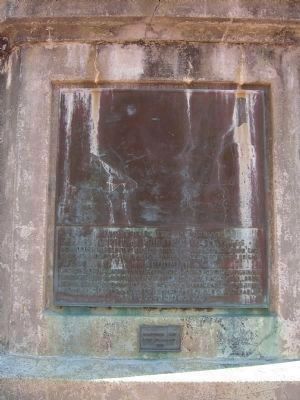
1. Macedonian Monument Marker
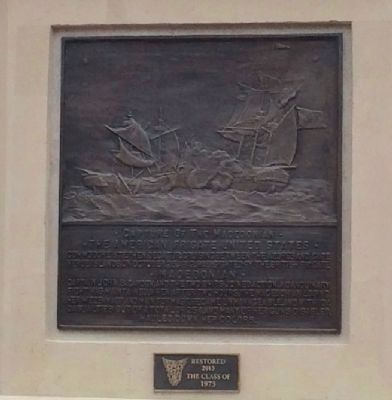
The bronze relief, Capture of the Macedonian, depicts the battle between the USS United States the British Frigate Macedonian. The relief, by Edward Berge (1876-1924), was purchased in 1924. It is approximately 25 inches by 26 inches.
· The American Frigate United States ·
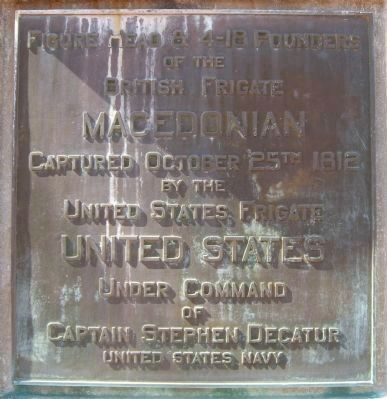
[Back of Monument]:
Figurehead & 4 - 18 pounders of the British Frigate
Erected 1925.
Topics. This historical marker and monument is listed in this topic list: War of 1812. A significant historical month for this entry is October 1835.
Location. 38° 59.001′ N, 76° 29.155′ W. Marker is in Annapolis, Maryland, in Anne Arundel County. It is on Maryland Avenue, on the right when traveling east. Marker is located on the grounds of the United States
this page online

Regionally, this marker and monument is in Central Maryland. It is also in the American Mid-Atlantic, in the Chesapeake Bay Region, and on the Eastern Seaboard. Globally, it is in the North Atlantic Region, North America, the Western Hemisphere, the Western World, and the Anglosphere. Historically, it finds itself in what was once one of the original Thirteen Colonies and also the Antebellum South.
Other nearby markers. At least 8 other markers are within walking distance of this marker: Sampson Hall (within shouting distance of this marker); Carter Hall (within shouting distance of this marker); In Honor of Albert Abraham Michelson (within shouting distance of this marker); a different marker also named Mahan Hall (within shouting distance of this marker); Naval School (within shouting distance of this marker); St. Joseph (about 300 feet away, measured in a direct line); Mexican War Midshipmen's Monument
Photographed by Kevin W., March 15, 2008
2. Macedonian Monument Marker (back)
Other markers no longer nearby. HMS Macedonian Monument (was here, next to this marker but has been permanently removed); Mahan Hall (was within shouting distance of this marker but has been permanently removed); Maury Hall (was within shouting distance of this marker but has been replaced with another marker now near it).
More about this marker. Below the Marker on the front of the monument is a smaller plaque identifying that the monument was restored in 1967 by the Class of 1925
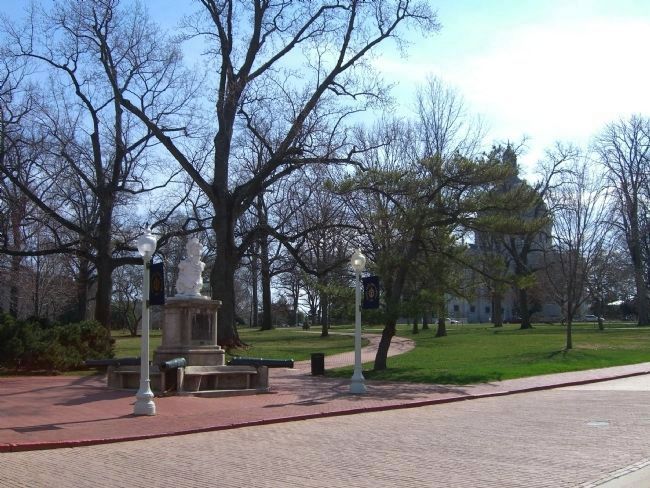
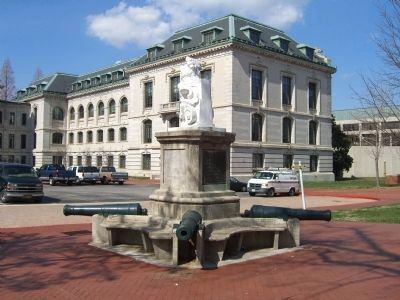
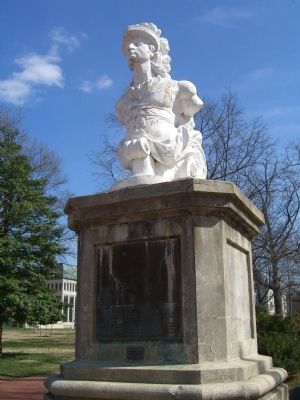
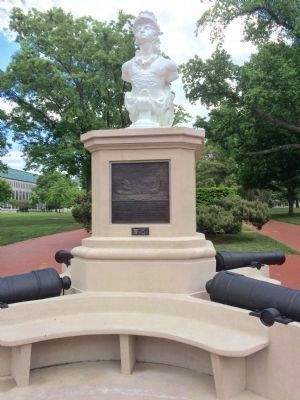
Regarding Macedonian Monument. Atop the monument is the wooden ship's figurehead from the captured British frigate "Macedonian" depicting a bust of Alexander the Great (356-323 B. C.). It is dressed in a shirt with ruffles at the neck and a helmet adorned with long plumes. The sculpture is painted white and is installed atop a square stone base. Each side of the base is adorned with a curved stone bench. A green-painted cannon tube extends from each corner.
Additional commentary.
1. American Sailers on
Photographed by Kevin W., March 15, 2008
3. Macedonian Monument Marker
According to Roosevelt, eight Americans were among the crew of the Macedonian. They asked Captain Carden to go below during the battle but were forced to fight. Three were killed in the battle; the others joined the American service.
— Submitted June 20, 2013, by Allen C. Browne of Silver Spring, Maryland.
2. Monument Refreshed in 2014
The monument was refreshened in 2014. The figurehead was replaced with a newly carved mahogany version, the benches were replaced, the concrete base was repaired, and the cannons and plaques were refurbished. The project cost $300,000, provided as a gift by the Academy class of 1973. The rededication ceremony was April 25th, 2014.
— Submitted June 3, 2015, by Mark Hilton of Montgomery, Alabama.
Photographed by Kevin W., March 15, 2008
4. Macedonian Monument Marker (back)
Photographed by Kevin W., March 15, 2008
5. Macedonian Monument Marker
This bust of Alexander the Great (356-323 B. C.) was once the figurehead on the British frigate Macedonian, until its capture by the American frigate United States on Oct. 25, 1812. The figurehead was located in the Norfolk Navy Yard, Norfolk, Virginia until 1875.
Photographed by Theodore Roosvelt
6. Dance of the United States and the Macedonian
Photographed by Allen C. Browne, June 11, 2013
7. Macedonian Sign
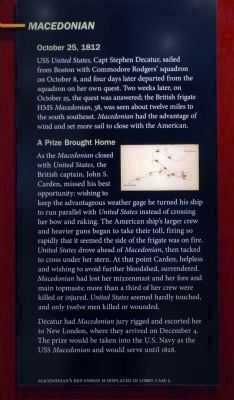
Macedonian
October 25, 1812
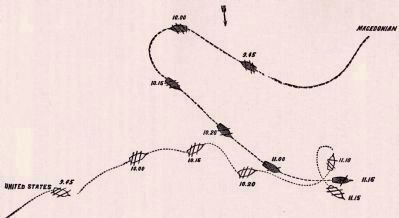
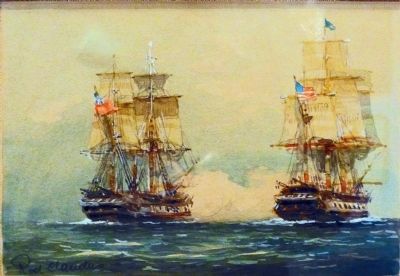
USS United States, Capt Stephen Decatur, sailed from Boston with Commodore Rodgers' squadron on October 8, and four days later, on October 25, the quest was answered; the British frigate HMS Macedonian, 38, was seen about twelve miles to the south southeast. Macedonian had the advantage of wind and set more sail to close with the American.
A Prize Brought Home
As the Macedonian closed with the United States, the British captain John S. Carden, missed his best opportunity: wishing to keep the advantageous weather gage he turned his ship to run parallel with United States instead of crossing her bow and raking. The American ship's larger crew and heavier guns began to take their toll, firing so rapidly that it seemed the side of the frigate was on fire, United States drove ahead of Macedonian, then tacked to cross under her stern. At that point Carden, helpless and wishing to avoid further bloodshed, surrendered. Macedonian had lost her mizzenmast and her fore and main topmasts; more than a third of her crew were killed or injured. United States seemed hardly touched, and only twelve men killed or wounded.
Decatur had Macedonian jury rigged and escorted her to New London, where they arrived on December 4. The prize would be taken into the U.S. Navy as the USS Macedonian and would serve until 1828.
Photographed by Rod Claudus
8. United States and Macedonian
Photographed by John Wesley Jarvis
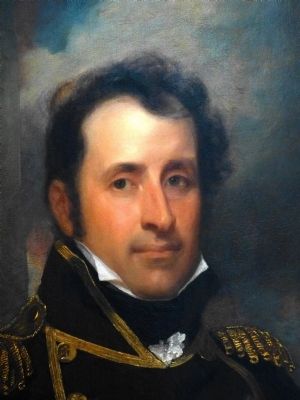
9. Captain Stephen Decatur
USNA Museum Collection (USNA 1892.001.0001)
Photographed by Mark Hilton, May 12, 2015
10. Capture of the Macedonian Marker
Photographed by Mark Hilton, May 12, 2015
11. Capture of the Macedonian Monument
Credits. This page was last revised on June 16, 2016. It was originally submitted on April 27, 2008, by Kevin W. of Stafford, Virginia. This page has been viewed 3,610 times since then and 58 times this year. Photos: 1, 2, 3, 4, 5. submitted on April 27, 2008, by Kevin W. of Stafford, Virginia. 6, 7, 8. submitted on June 19, 2013, by Allen C. Browne of Silver Spring, Maryland. 9. submitted on June 18, 2013, by Allen C. Browne of Silver Spring, Maryland. 10, 11. submitted on June 3, 2015, by Mark Hilton of Montgomery, Alabama.
