Helena in Shelby County, Alabama — The American South (East South Central)
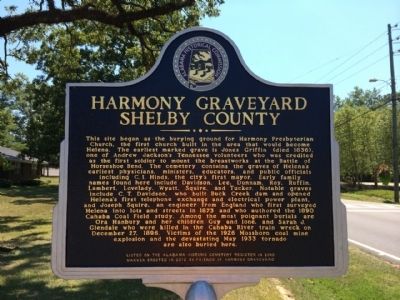
Harmony Graveyard
Shelby County
Photographed by Mark Hilton, August 14, 2014
1. Harmony Graveyard Marker
this page online
Erected 2012 by the Friends of Harmony Graveyard.
Topics and series. This historical marker is listed in these topic lists: Cemeteries & Burial Sites • Disasters • Religion & Religious Structures • Settlements & Settlers. In addition, it is included in the Former U.S. Presidents: #07 Andrew Jackson series list. A significant historical year for this entry is 1873.
Location. 33° 17.338′ N, 86° 50.705′ W. Marker is in Helena, Alabama, in Shelby County. It is at the intersection of Helena Road (Alabama Route 261) and 3rd Street, on the right when traveling north on Helena Road. Touch for map. Marker is at or near this postal address: 3396 Helena Rd, Helena AL 35080, United States of America. Touch for directions.

Regionally, this marker is in the Birmingham Metropolitan Area. It is also in the American South and specifically in the Deep South. Globally, it is in North America, a Gulf of Mexico state, the Western Hemisphere, the Western World, and the Anglosphere. Historically, it finds itself in what was once New
Photographed by Mark Hilton, August 14, 2014
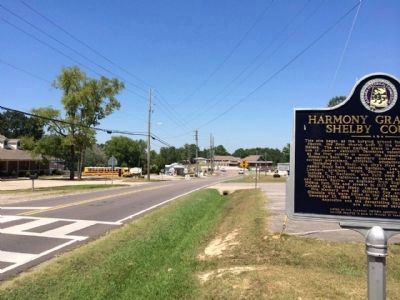
2. Harmony Graveyard Marker Area
Other nearby markers. At least 8 other markers are within 4 miles of this marker, measured as the crow flies: Helena, Alabama (approx. 0.4 miles away); Central Iron Works (approx. half a mile away); Helena Freight House & Depot (approx. half a mile away); Cedar Grove Cemetery (approx. 3.4 miles away); Fungo Hollow (approx. 3.8 miles away); Brock’s Gap / Historic Gateway To Birmingham (approx. 3.8 miles away); Buck Creek Jail and Water Tower (approx. 4 miles away); The Founding of Alabaster / Siluria (approx. 4.1 miles away). Touch for a list and map of all markers in Helena.
Another marker is no longer nearby. Shelbyville, A. T. (was approx. 2 miles away but has been confirmed missing).
Also see . . .
1. Church History. (Submitted on August 14, 2014, by Mark Hilton of Montgomery, Alabama.)
2. Helena City News article about train wreck. (Submitted on August 14, 2014, by Mark Hilton of Montgomery, Alabama.)
3. Find-A-Grave Memorial notes. (Submitted on August 14, 2014, by Mark Hilton of Montgomery, Alabama.)
Photographed by Mark Hilton, August 14, 2014
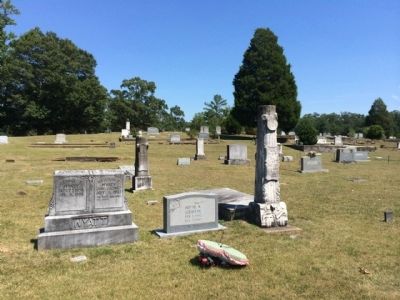
3. Harmony Graveyard & Helena Cemetery
Photographed by Mark Hilton, August 14, 2014
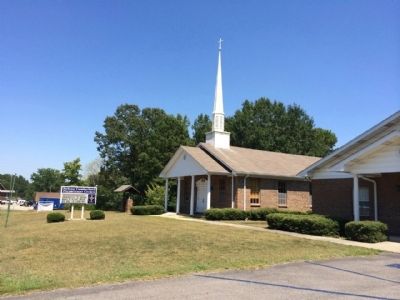
4. Helena Cumberland Presbyterian Church
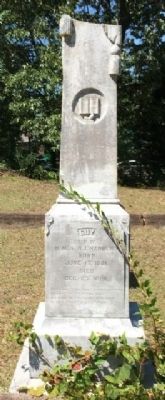
Photographed by Mark Hilton, August 14, 2014
5. Grave of Guy Hanbury
Killed in 1896 train wreck & buried here.
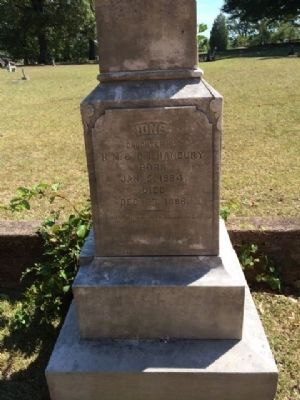
Photographed by Mark Hilton, August 14, 2014
6. Ione Hanbury
Killed in 1896 train wreck & buried here.
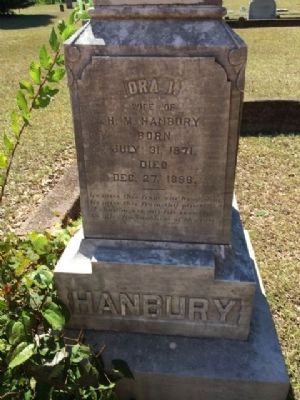
Photographed by Mark Hilton, August 14, 2014
7. Grave of Ora Hanbury
Killed in 1896 train wreck & buried here.
Credits. This page was last revised on November 23, 2025. It was originally submitted on August 14, 2014, by Mark Hilton of Montgomery, Alabama. This page has been viewed 1,403 times since then and 64 times this year. Photos: 1, 2, 3, 4, 5, 6, 7. submitted on August 14, 2014, by Mark Hilton of Montgomery, Alabama. • Bernard Fisher was the editor who published this page.
