
Fort Lee in Bergen County, New Jersey — The American Northeast (Mid-Atlantic)
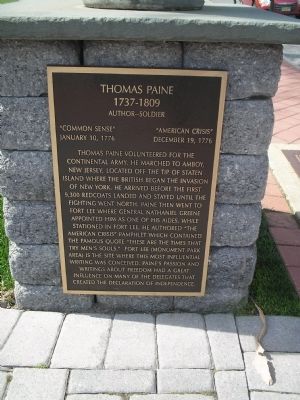
Thomas Paine
1737-1809
Photographed by Bill Coughlin, April 25, 2008
1. Thomas Paine Marker
“Common Sense” “American Crisis”
January 10, 1776 December 19, 1776
Thomas Paine volunteered for the Continental Army. He marched to Amboy, New Jersey, located off the tip of Staten Island where the British began the invasion of New York. He arrived before the first 9,3000 Redcoats landed and stayed until the fighting went north. Paine then went to Fort Lee where General Nathaniel Greene appointed him as one of his aides. While stationed at Fort Lee, he authored “The American Crisis” pamphlet which contained the famous quote “These are the times that try men’s souls.” Fort Lee (Monument Park area) is the site where this most influential writing was conceived. Paine’s passion and writings about freedom had a great influence on many of the delegates that created the Declaration of Independence.
Erected 2004 by Borough of Fort Lee.
Topics. This historical marker is listed in these topic lists: Arts, Letters, Music • Forts and Castles • War, US Revolutionary. A significant historical month for this entry is January 1812.
Location. 40° 50.946′ N,
this page online

Regionally, this marker is in New Jersey’s North Jersey, in Greater Newark, and in the New York City Metropolitan Area. It is also in the American Northeast, in the Mid-Atlantic, and on the Eastern Seaboard. Globally, it is in the North Atlantic Region, North America, the Western Hemisphere, the Western World, and the Anglosphere. Historically, it finds itself in what was once New Netherland and also one of the original Thirteen Colonies.
Other nearby markers. At least 8 other markers are within walking distance of this marker: General John “Black Jack” Pershing (here, next to this marker); General George Washington (within shouting distance of this marker); Soldiers of the American Revolution
Photographed by Bill Coughlin, April 25, 2008
2. Marker at Monument Park
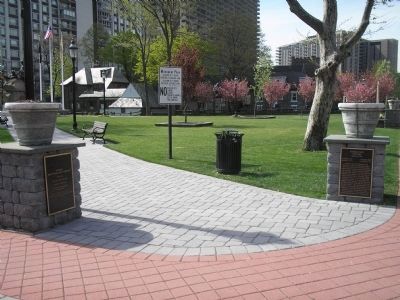
At this entrance to Monument Park, the Thomas Paine marker is on the pillar to the right. Monument Park is the site of Continental Army encampment in 1776.
Related markers. Click here for a list of markers that are related to this marker. This set of markers is located in Fort Lee’s Monument Park.
Also see . . .
1. Thomas Paine. Portraits in Revolution website entry (Submitted on August 11, 2022, by Larry Gertner of New York, New York.)
2. Battle of Fort Washington. Revolutionary War website entry (Submitted on September 1, 2021, by Larry Gertner of New York, New York.)
3. Common Sense. Political And Miscellaneous Works of Thomas Paine, Volume I, 1819; Internet Archive website entry (Submitted on April 19, 2015, by Allen C. Browne of Silver Spring, Maryland.)
Photographed by Bill Coughlin, April 25, 2008
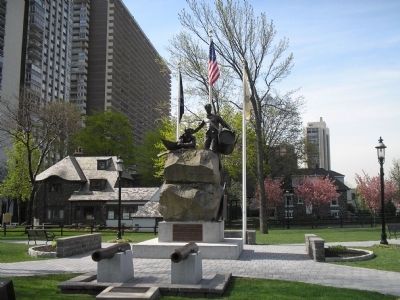
3. Soldiers of the American Revolution Monument
Monument Park, where the Continental Army camped during the Battle of New York, is home to a number of markers and monuments.
Click for more information.
Click for more information.
Photographed by Allen C. Browne, February 16, 2015
4. Thomas Paine
1737-1809
Born Thetford, England
1737-1809
Born Thetford, England
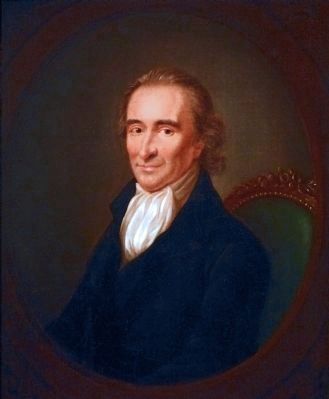
This 1791 portrait of Thomas Paine by Laurent Dabos hangs in the National Portrait Gallery in Washington DC.
“‘For God's sake, let us come to a final separation,‘ pleaded an anonymous author in a brief pamphlet called Common Sense, published in Philadelphia on January 9, 1776. ’You have it in your power to begin the world all over again’ Written by Thomas Paine, a down-at-the-heels immigrant recently arrived from England, this call for an immediate declaration of independence had a stunning effect, rousing spirits within Congress and without.
In December 1776 Paine was with the Continental army as it retreated across New Jersey, and George Washington confessed privately that the game was nearly up. ‘The summer soldier and the sunshine patriot will, in this crisis, shrink from the service of their country,’ Paine wrote in an essay that Washington read to the troops, ‘but he that stands by it Now, deserves the love and thanks of man and woman.’” — National Portrait Gallery
“‘For God's sake, let us come to a final separation,‘ pleaded an anonymous author in a brief pamphlet called Common Sense, published in Philadelphia on January 9, 1776. ’You have it in your power to begin the world all over again’ Written by Thomas Paine, a down-at-the-heels immigrant recently arrived from England, this call for an immediate declaration of independence had a stunning effect, rousing spirits within Congress and without.
In December 1776 Paine was with the Continental army as it retreated across New Jersey, and George Washington confessed privately that the game was nearly up. ‘The summer soldier and the sunshine patriot will, in this crisis, shrink from the service of their country,’ Paine wrote in an essay that Washington read to the troops, ‘but he that stands by it Now, deserves the love and thanks of man and woman.’” — National Portrait Gallery
Credits. This page was last revised on August 12, 2022. It was originally submitted on May 7, 2008, by Bill Coughlin of Woodland Park, New Jersey. This page has been viewed 3,429 times since then and 116 times this year. Photos: 1, 2, 3. submitted on May 7, 2008, by Bill Coughlin of Woodland Park, New Jersey. 4. submitted on April 19, 2015, by Allen C. Browne of Silver Spring, Maryland. • Kevin W. was the editor who published this page.
