Knotts Island in Currituck County, North Carolina — The American South (South Atlantic)
Knotts Island
Salts Works Center
Photographed by Don Morfe, August 11, 2014
1. Knotts Island Marker
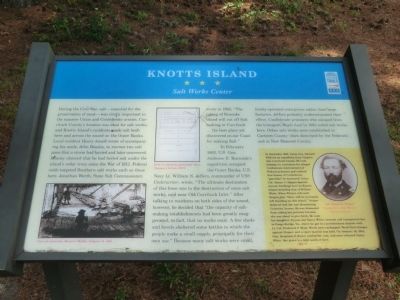
In February 1862 U.S. Gen. Ambrose E. Burnside's expedition occupied the Outer Banks. U.S. Navy Lt. William N. Jeffers, commander of USS Underwriter, wrote “The ultimate destination of this force was to the destruction of some salt works, said near Old Currituck Inlet.” After talking to residents on both sides of the sound, however, he decided that “the capacity of salt-making
this page online
(sidebar)
In December 1863, Union Gen. Edward Wild led an expedition from Virginia into Currituck County. He took hostages in retaliation for alleged Confederate mistreatment of Federal prisoners and ordered that houses of Confederate “guerillas” be destroyed. Union Col. Alonzo G. Draper burned several dwellings here on Knotts Island including that of William White. When White's wife told Draper that “there will be no houses left standing on this island,” Draper deduced that she was threatening Unionists' houses. He was dissuaded from taking her prisoner because she was about to give birth. He took
Photographed by Don Morfe, August 11, 2014
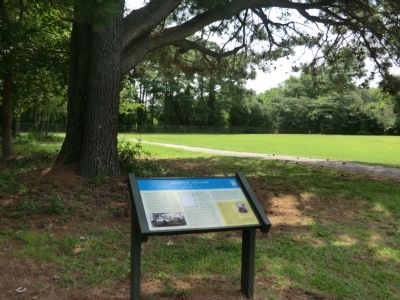
2. Knotts Island Marker
(captions)
(lower left) View of saltworks, Harper's Weekly, January 14, 1865
(upper center) Plan of saltworks, from Salt: That Necessary Article (1973)
(lower right) Col. Alonzo G. Drper Courtesy U.S. Army Military History Institute
Erected by North Carolina Civil War Trails.
Topics and series. This historical marker is listed in these topic lists: Industry & Commerce • War, US Civil. In addition, it is included in the North Carolina Civil War Trails series list. A significant historical month for this entry is January 1863.
Location. This marker has been replaced by another marker nearby. It was located near 36° 30.486′ N, 75° 55.248′ W. Marker was on Knotts Island, North Carolina, in Currituck County. It could be reached from Brumley Road 0.2 miles east
Photographed by Don Morfe, August 11, 2014
3. Knotts Island Ruritan Park

Regionally, this marker was in the Coastal Plain and in the Hampton Roads Metropolitan Area. It was also in the American South, specifically in the Upper South, in the Tidewater, and on the Eastern Seaboard. Globally, it was in the North Atlantic Region, North America, the Western Hemisphere, the Western World, and the Anglosphere. Historically, it found itself in what was once the territory of the Mississippian Culture, one of the original Thirteen Colonies, one of the Confederate States of America, and the Antebellum South.
Other nearby markers. At least 8 other markers are within 7 miles of this location, measured as the crow flies: Knotts Island Salt Works (a few steps from this marker); Partnership in Wildlife Management (approx. 0.7 miles away); Mackay Island National Wildlife Refuge (approx. 0.7 miles away); Dividing Line
Photographed by Don Morfe, August 11, 2014
4. Knotts Island
Another marker is no longer nearby. Currituck County Courthouse (was approx. 6.7 miles away but has been replaced with another marker now near it).
Credits. This page was last revised on June 5, 2026. It was originally submitted on August 26, 2014, by Don Morfe of Baltimore, Maryland. This page has been viewed 1,483 times since then and 98 times this year. Photos: 1, 2, 3, 4. submitted on August 26, 2014, by Don Morfe of Baltimore, Maryland. • Bernard Fisher was the editor who published this page.
