Beaver Crossing in Seward County, Nebraska — The American Midwest (Upper Plains)
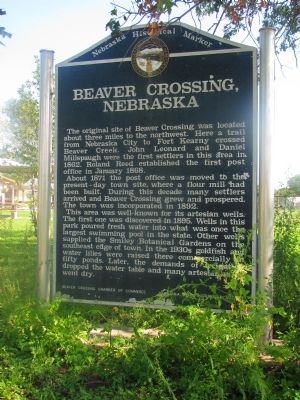
Beaver Crossing, Nebraska
Photographed by Joan Shurtliff, September 1, 2014
1. Beaver Crossing, Nebraska Marker
The original site of Beaver Crossing was located about three miles to the northwest. Here a trail from Nebraska City to Fort Kearny crossed Beaver Creek. John Leonard and Daniel Millspaugh were the first settlers in this area in 1862. Roland Reed established the first post office in January 1868.
About 1871 the post office was moved to the present-day town site where a flour mill had been built. During this decade many settlers arrived and Beaver Crossing grew and prospered. The town was incorporated in 1892.
This area was well known for its artesian wells. The first one was discovered in 1895. Wells in this park poured fresh water into what was once the largest swimming pool in the state. Other wells supplied the Smiley Botanical Gardens on the southeast edge of town. In the 1930s goldfish and water lilies were raised there commercially in fifty ponds. Later, the demands of irrigation dropped the water table and the artesian wells went dry.
Erected by Beaver Crossing Chamber of Commerce; Nebraska State Historical Society. (Marker Number 363.)
Topics and series. This historical marker is listed in these
this page online
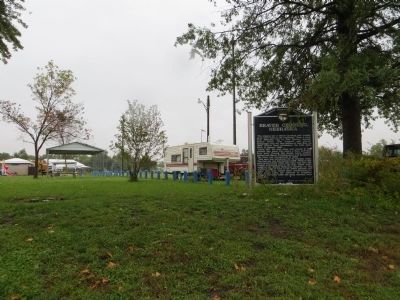
Location. 40° 46.583′ N, 97° 16.638′ W. Marker is in Beaver Crossing, Nebraska, in Seward County. It is on Elk Street, on the left when traveling east. South side of Beaver Crossing city park. Touch for map. Marker is in this post office area: Beaver Crossing NE 68313, United States of America. Touch for directions.

Regionally, this marker is in Eastern Nebraska and in Greater Lincoln. It is also in the American Midwest, in the Corn Belt, and on the prairies. Globally, it is in North America, the Western Hemisphere, the Western World, and the Anglosphere. Historically, it finds itself in what was once the Louisiana Purchase.
Other nearby markers. At least 8 other markers are within 14 miles of this marker, measured as the crow flies: The Beaver Crossing Mill (within shouting distance of this marker); Nebraska City Cut-Off of the Oregon Trail (approx. 10.1 miles away); PFC Charley Havlat (approx.
Photographed by Bill Kirchner, September 23, 2014
2. Beaver Crossing, Nebraska Marker
Photographed by Bill Kirchner, September 23, 2014
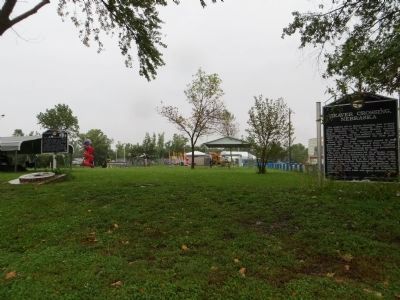
3. Beaver Crossing, Nebraska Marker
The Beaver Crossing Mill Marker is at the far left.
Credits. This page was last revised on December 22, 2024. It was originally submitted on September 1, 2014, by Joan Shurtliff of Seward, Nebraska. This page has been viewed 1,047 times since then and 48 times this year. Photos: 1. submitted on September 1, 2014, by Joan Shurtliff of Seward, Nebraska. 2, 3. submitted on October 16, 2014, by Bill Kirchner of Tucson, Arizona. • Bill Pfingsten was the editor who published this page.
