Black Jack in Pitt County, North Carolina — The American South (South Atlantic)
Black Jack
Four Corners or The Chapel
| — | Potter's Raid | — |
Photographed by Don Morfe, August 14, 2014
1. Black Jack Marker
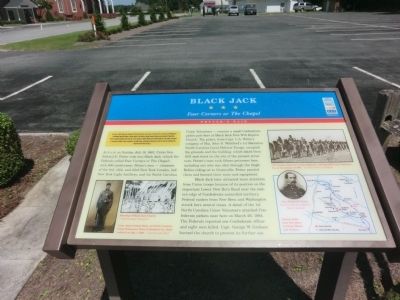
On July 18, 1863, Union Gen. Edward E. Potter led infantry and cavalry from New Bern to destroy the Wilmington and Weldon Railroad bridge at Rocky Mount. The infantry feinted toward Kinston and returned to New Bern. Potter raided Greenville, then sent part of his cavalry to Rocky Mount and occupied Tarboro. The raiders damaged or destroyed bridges, trains, munitions, and mills before returning to New Bern on July 23, but the Confederates restored rail service by Aug. 1.
(main text)
At 8 a.m. on Sunday, July 19, 1863, Union Gen. Edward E. Potter rode into Black Jack (which the Federals called Four Corners or The Chapel) with 800 cavalrymen. Potter’s men—elements of the 3rd, 12th, and 23rd New York Cavalry, 3rd New York Light Artillery, and 1st North Carolina Union Volunteers—overran a small Confederate picket post here at Black Jack Free Will Baptist Church. The picket, from Capt. C.A. White’s company of Maj. John N. Whitford’s 1st Battalion North Carolina Local Defense Troops, occupied the grounds of the building, which dated from 1831 and stood on the site of the present structure. Potter’s men took fifteen
this page online
Black Jack later attracted more attention from Union troops because of its position on the important Lower New Bern Road near the eastern edge of Confederate–controlled territory. Federal raiders from New Bern and Washington struck here several times. A detail of the 1st North Carolina Union Volunteers attacked Confederate pickets near here on March 26, 1864. The Federals reported one Confederate officer and eight men killed. Capt. George W. Graham burned the church to prevent its further use.
(captions)
(lower left) Corp. James Daniel Boyd, 1st North Carolina Union Volunteers. Born in Beaufort Co., Boyd enlisted on May 7, 1862. — Courtesy John Boyd; Burning of Black Jack Church. — Courtesy Roger Kammerer
(upper right) U.S. Cavalry (2nd U.S. Cavalry Regiment), photographed near Falmouth, Va., in the summer of 1863. — Courtesy Library of Congress
(lower right) Potter's Raid from New Bern to Rocky Mount and Tarboro; (Inset) Gen. Edward E. Potter Courtesy U.S. Army Military History Institute
Erected by North
Photographed by Don Morfe, August 14, 2014
2. Black Jack Marker
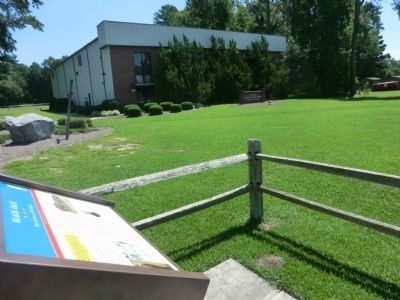
Black Jack Free Will Baptist Church Family Life Center in the background.
Topics and series. This historical marker is listed in this topic list: War, US Civil. In addition, it is included in the North Carolina Civil War Trails series list. A significant historical date for this entry is March 26, 1864.
Location. 35° 30.073′ N, 77° 14.852′ W. Marker is in Black Jack, North Carolina, in Pitt County. It is at the intersection of Black Jack-Simpson Road and Spencer Loop Road, on the left when traveling south on Black Jack-Simpson Road. The marker is on the grounds of the Black Jack Free Will Baptist Church. Touch for map. Marker is at or near this postal address: 2972 Black Jack Simpson Road, Greenville NC 27858, United States of America. Touch for directions.

Regionally, this marker is in North Carolina’s Coastal Plain. It is also in the American South, specifically in the Upper South, and on the Eastern Seaboard. Globally, it is in the North Atlantic Region, North America, the Western Hemisphere, the Western World, and the Anglosphere. Historically, it finds itself in what was once the territory of the Mississippian Culture, one of the original Thirteen Colonies, one of the
Photographed by Don Morfe, August 14, 2014
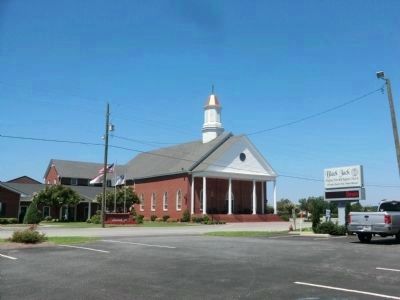
3. Black Jack Free Will Baptist Church
Other nearby markers. At least 8 other markers are within 10 miles of this marker, measured as the crow flies: Bryan Grimes (approx. 5½ miles away); Haddocks Crossroads (approx. 6 miles away); Red Banks Church (approx. 7.2 miles away); Trinity Cemetery (approx. 7.3 miles away); Fort Fisher Hero (approx. 7.3 miles away); a different marker also named Trinity Church (approx. 8.2 miles away); Trinity School (approx. 8.3 miles away); East Carolina College Veterans Memorial (approx. 9.7 miles away).
Other markers no longer nearby. Red Banks Church (was approx. 7.2 miles away but has been replaced with another marker now near it); Trinity Church (was approx. 8.2 miles away but has been replaced with another marker now near it); Tranter's Creek (was approx. 9.4 miles away but has been permanently removed).
National Archives and Records Administration
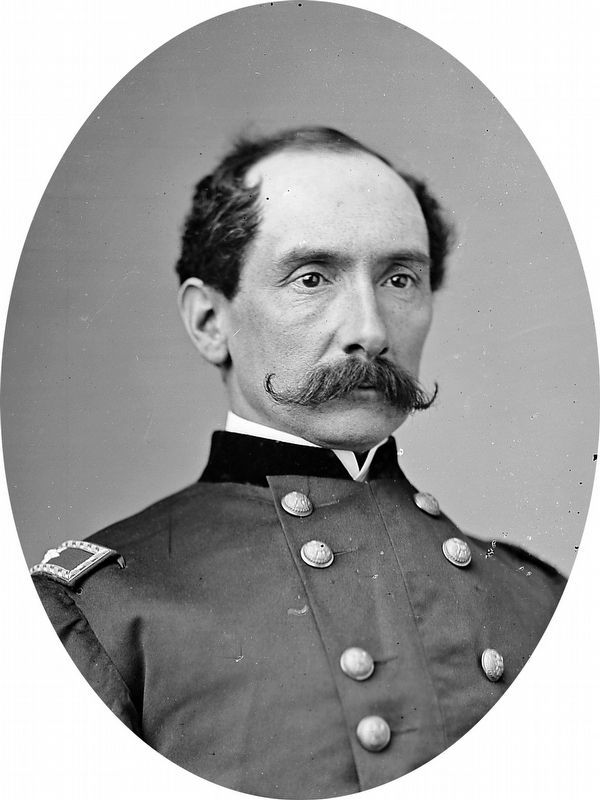
4. Gen. Edward E. Potter
Brady National Photographic Art Gallery ca. 1860 - ca. 1865 - NARA
Credits. This page was last revised on November 8, 2024. It was originally submitted on September 5, 2014, by Don Morfe of Baltimore, Maryland. This page has been viewed 2,068 times since then and 92 times this year. Photos: 1, 2, 3. submitted on September 5, 2014, by Don Morfe of Baltimore, Maryland. 4. submitted on December 1, 2020, by Allen C. Browne of Silver Spring, Maryland. • Bernard Fisher was the editor who published this page.
