St. Augustine in St. Johns County, Florida — The American South (South Atlantic)
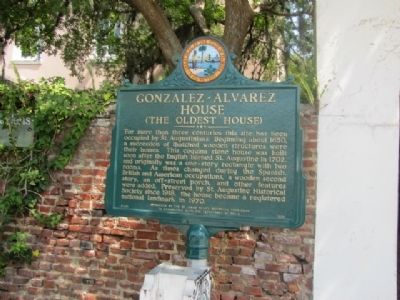
Gonzalez-Alvarez House
(The Oldest House)
Photographed by James R. Murray, May 24, 2014
1. Gonzalez-Alvarez House Marker
Erected 1986 by Florida Department of State. (Marker Number F-311.)
Topics. This historical marker is listed in this topic list: Notable Buildings. A significant historical year for this entry is 1650.
Location. 29° 53.281′ N, 81° 18.607′ W. Marker is in St. Augustine, Florida, in St. Johns County. It is on St Francis Street east of Charlotte Street, on the right when traveling west. Touch for map. Marker is at or near this postal address: 14 St Francis Street,
this page online

Regionally, this marker is in First Coast and in Greater Jacksonville. It is also in the American South and on the Eastern Seaboard. Globally, it is in the North Atlantic Region, North America, a Gulf of Mexico state, the Western Hemisphere, the Western World, and the Anglosphere. Historically, it finds itself in what was once New Spain, the territory of the Mississippian Culture, one of the Confederate States of America, and the Antebellum South.
Other nearby markers. At least 8 other markers are within walking distance of this marker: Saint Augustine’s Oldest House (a few steps from this marker); La Florida’s El Camino Real (a few steps from this marker); St. Francis Barracks (a few steps from this marker); Four Centuries----Five Flags (a few steps from this marker); Tovar House (a few steps from this marker); a different marker also named Tovar House (within shouting distance of this marker); González-Alvarez House (within shouting distance of this marker); State Arsenal (within shouting distance of this marker). Touch for a list and map of
Photographed by James R. Murray, May 24, 2014
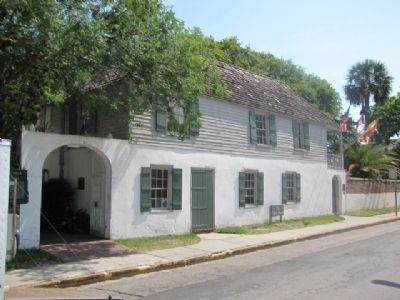
2. Gonzalez-Alvarez House and Marker
The marker is to the far left in this view.
Photographed by James R. Murray, May 24, 2014
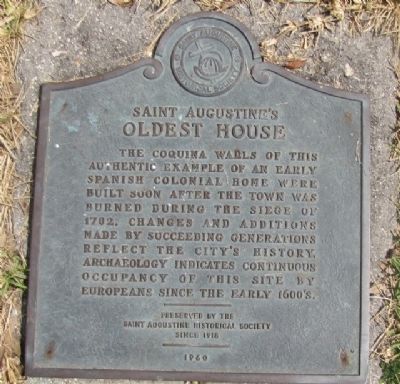
3. An additional nearby Gonzalez-Alvarez House Marker
Saint Augustine’s Oldest House
The coquina walls of this authentic example of an early Spanish colonial home were built soon after the town was burned during the siege of 1702. Changes and aditions made by succeeding generations reflect the city’s history. Archaeology indicates continuous occupancy of this site by Europeans since the early 1600’s.
Preserved by the Saint Augustine Historical Society since 1918
1960
Credits. This page was last revised on January 2, 2019. It was originally submitted on September 19, 2014, by James R. Murray of Elkton, Florida. This page has been viewed 903 times since then and 32 times this year. Photos: 1, 2, 3. submitted on September 19, 2014, by James R. Murray of Elkton, Florida. • Bernard Fisher was the editor who published this page.
