River Market in Little Rock in Pulaski County, Arkansas — The American South (West South Central)
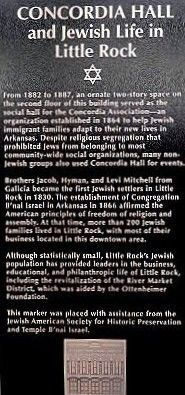
Concordia Hall and Jewish Life in Little Rock
Photographed by Jerry Klinger, March 20, 2009
1. Concordia Hall and Jewish Life in Little Rock Marker
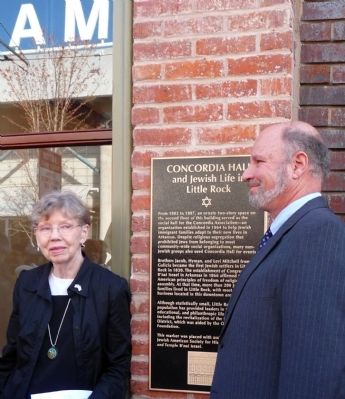
From 1882 to 1887, an ornate two-story space on the second floor of this building served as the social hall for the Concordia Association – an organization established in 1864 to help Jewish immigrant families adapt to their new lives in Arkansas. Despite religious segregation that prohibited Jews from belonging to most community-wide social organizations, many non-Jewish groups also used Concordia Hall for events.
Brothers Jacob, Hyman and Levi Mitchell from Galicia became the first Jewish settlers in Little Rock in 1830. The establishment of Congregation B’nai Israel in Arkansas in 1866 affirmed the American principles of freedom of religion and assembly. At that time, more than 200 Jewish families lived in Little Rock, with most of their businesses located in this downtown area.
Although statistically small, Little Rock’s Jewish population has provided leaders in the business, educational, and philanthropic life of Little Rock, including the revitalization of the River Market District, which was aided by the Ottenheimer Foundation.
This marker was placed with assistance from the Jewish American Society for Historic Preservation and Temple B’Nai Israel.
Erected 2009 by Jewish American Society for Historic Preservation.
Topics and series. This historical marker is listed in this topic list: Religion & Religious Structures. In addition, it is included in the Jewish American Society for Historic Preservation. series list. A significant historical year for this entry is 1882.
Location. 34° 44.848′ N, 92° 15.982′ W. Marker is in Little Rock, Arkansas, in Pulaski County. It is in River Market. It is on President Clinton Avenue, on the right when traveling east. Touch for map. Marker is at or near this postal address: 407 President Clinton Ave, Little Rock AR 72201, United States of America. Touch for directions.

Regionally,
this page online
Other nearby markers. At least 8 other markers are within walking distance of this marker: Geyer & Adams Building (a few steps from this marker); Porbeck & Bowman Building (a few steps from this marker); Augustus Hill Garland (about 400 feet away, measured in a direct line); One Old Rock (about 500 feet away); A Piece of the Rock, a Piece of History (about 500 feet away); Smaller Rock, Big Bridge (about 600 feet away); The Big Rock and the Little Rock (about 600 feet away); The "Little Rock" (about 600 feet away). Touch for a list and map of all markers in Little Rock.
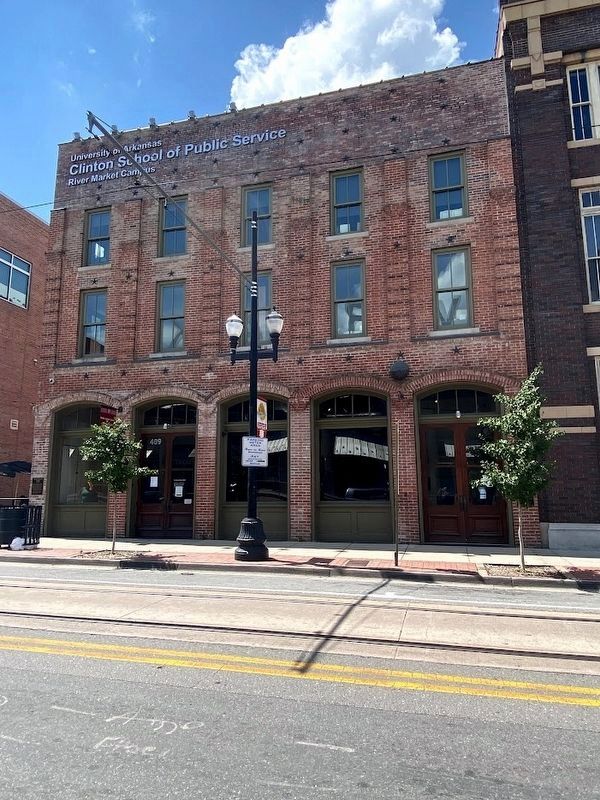
More about this marker. Concordia Hall, a Jewish community social gathering place, was housed on the second floor of the Porbeck & Bowman building in downtown Little
March 20, 2009
2. Concordia Hall and Jewish Life in Little Rock Marker
Also see . . . Jewish American Society for Historic Preservation. The Jewish American Society for Historic Preservation is a non-profit, volunteer organization. The purpose of the Society is to identify and recognize sites of American Jewish Historical interest. The Society sponsors and promotes programs of local and national historic interest. Cooperating with local Historical Societies, Communities, Churches and Synagogues, the Society encourages dialogue and interactive recognition of the commonality of the American Experience. (Submitted on January 26, 2010, by Jerry Klinger of Boynton Beach, Florida.)
Additional commentary.
1. Arkansas Jewish History
Jewish participation in Arkansas life dates from 1820. One year after Arkansas was organized as a territory in 1819, Abraham Bloch moved to Arkansas with his family. Over time he established himself as leading member of Arkansas' social, economic
Photographed by Darren Jefferson Clay, July 7, 2020
3. Concordia Hall and Jewish Life in Little Rock Marker
The marker is behind the tree on the right side of this view.
— Submitted January 26, 2010, by Jerry Klinger of Boynton Beach, Florida.
Additional keywords. JASHP Jewish American History
Credits. This page was last revised on October 17, 2025. It was originally submitted on January 26, 2010, by Jerry Klinger of Boynton Beach, Florida. This page has been viewed 2,456 times since then and 143 times this year. Last updated on October 15, 2014, by Sally L Blewett of Little Rock, Arkansas. Photos: 1, 2. submitted on January 26, 2010, by Jerry Klinger of Boynton Beach, Florida. 3. submitted on May 25, 2023, by Darren Jefferson Clay of Duluth, Georgia. • Bill Pfingsten was the editor who published this page.
