Mendoza, Argentina — Southern South America
The Hill of Glory
Cerro de la Gloria
Photographed by Marsha A. Matson, November 18, 2014
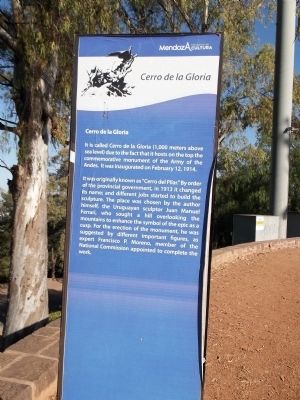
1. Cerro de la Gloria Marker
It was originally known as "Cerro del Pilar." By order of the provincial government, in 1913 it changed its name; and different jobs started to build the sculpture. The place was chosen by the author himself, the Uruguayan sculptor Juan Manuel Ferrari, who sought a hill overlooking the mountains to enhance the symbol of the epic as a cusp. For the erection of the monument, he was suggested by different important figures, as expert Francisco P. Moreno, member of the National Commission appointed to complete the work.
Erected by Mendoza, Argentina.
Topics. This memorial is listed in this topic list: Military. A significant historical month for this entry is February 1918.
Location. 32° 53.318′ S, 68° 53.475′ W. Memorial is in Mendoza. It is on Bajada del Cierro. The markers and monument are located on a hilltop in General San Martin Park. Touch for map. Memorial is in this post office area: Mendoza M5500, Argentina. Touch for directions.

Regionally,
this page online
Other nearby markers. At least one other marker is within 5 kilometers of this marker, measured as the crow flies: Monument to Hispanic-Argentine Brotherhood (approx. 4.6 kilometers away).
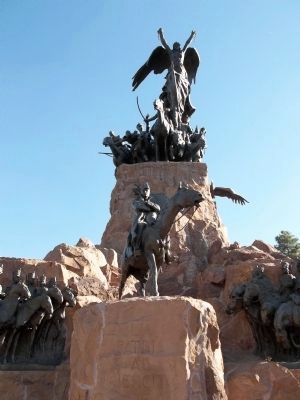
Regarding The Hill of Glory. This monument is stunning in its artistic storytelling and its location overlooking the Andes. It summarizes the role of the City of Mendoza and the Army of the Andes in successful freeing Chile from Spanish rule in 1817 through four friezes on each side of the monument.
Also see . . . Army of the Andes. The Army of the Andes, led by José de San Martín, crossed the Andes in 1817 to successfully free Chile from Spanish rule. Its staging point was Mendoza, Argentina. (Submitted on December 2, 2014, by Marsha A. Matson of Palmetto Bay, Florida.)
Photographed by Marsha A. Matson, November 18, 2014
2. North side of the Monument
Photographed by Marsha A. Matson, November 18, 2014
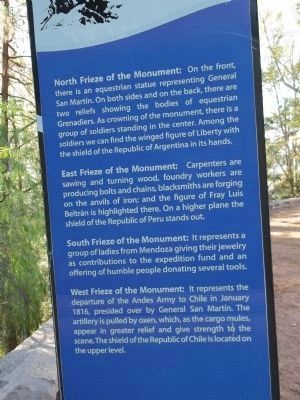
3. Cerro de la Gloria marker two
North Frieze of the Monument: On the front, there is an equestrian statue representing General San Martin. On both sides and on the back, there are two reliefs showing the bodies of equestrian Grenadiers. As crowning of the monument, there is a group of soldiers standing in the center. Among the soldiers we can find the winged figure of Liberty with the shield of the Republic of Argentina in its hands.
East Frieze of the Monument: Carpenters are sawing and turning wood, foundry workers are producing bolts and chains, blacksmiths are forging on the anvils of iron, and the figure of Fray Luis Beltran is highlighted there. On a higher plane the shield of the Republic of Peru stands out.
South Frieze of the Monument: It represents a group of ladies from Mendoza giving their jewelry as contributions to the expedition fund and an offering of humble people donating several tools.
West Frieze of the Monument: It represents the departure of the Andes Army to Chile in January 1816, presided over by General San Martin. The artillery is pulled by oxen, which, as the cargo mules, appear in greater relief and give strength to the scene. The shield of the Republic of Chile is located on the upper level.
Photographed by Marsha A. Matson, November 18, 2014
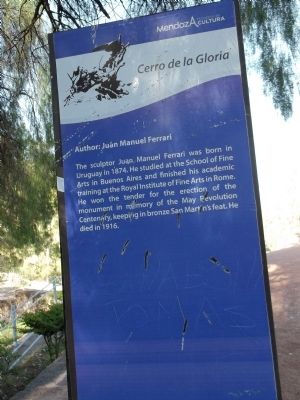
4. Marker describing the sculptor
Author: Juan Manuel Ferrari
The sculptor Juan Manuel Ferrari was born in Uruguay in 1874. He studied at the School of Fine Arts in Buenos Aires and finished his acdemic training at the Royal Institute of Fine Arts in Rome. He won the tender for the erection of the monument in memory of the May Revolution Centenary, keeping in bronze San Martin's feat. He died in 1916.
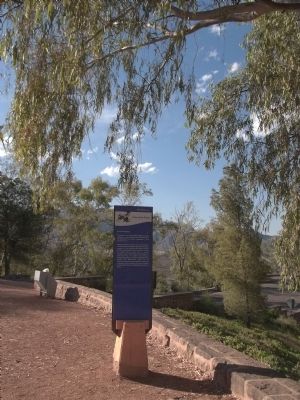
Photographed by Marsha A. Matson, November 18, 2014
5. Cerro de la Gloria Marker
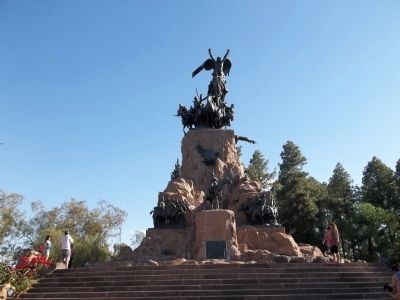
Photographed by Marsha A. Matson, November 18, 2014
6. Cierro de la Gloria Monument
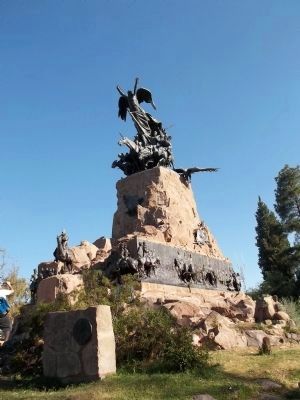
Photographed by Marsha A. Matson, November 18, 2014
7. West Frieze of the Monument
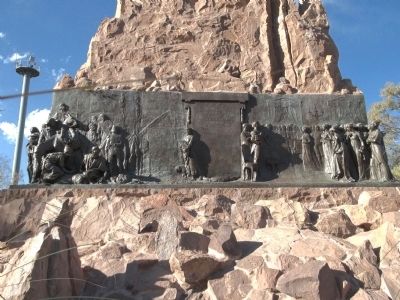
Photographed by Marsha A. Matson, November 18, 2014
8. South frieze of the monument
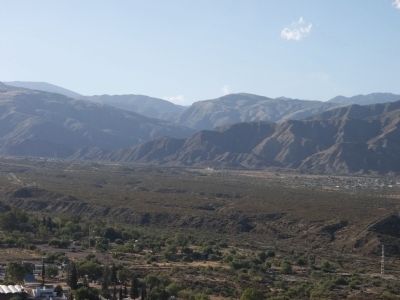
Photographed by Marsha A. Matson, November 18, 2014
9. View of the Andes from the monument
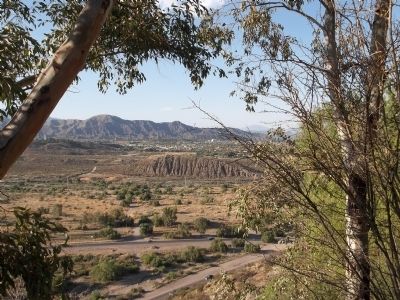
Photographed by Marsha A. Matson, November 18, 2014
10. View of the Andes from the monument
Credits. This page was last revised on September 24, 2026. It was originally submitted on December 2, 2014, by Marsha A. Matson of Palmetto Bay, Florida. This page has been viewed 976 times since then and 69 times this year. Photos: 1, 2, 3, 4, 5, 6, 7, 8, 9, 10. submitted on December 2, 2014, by Marsha A. Matson of Palmetto Bay, Florida. • Bill Pfingsten was the editor who published this page.
