St. Augustine in St. Johns County, Florida — The American South (South Atlantic)
The Old St. Johns County Jail
Photographed by Cosmos Mariner, December 10, 2014
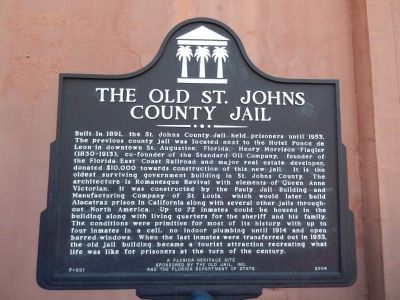
1. The Old St. Johns County Jail Marker
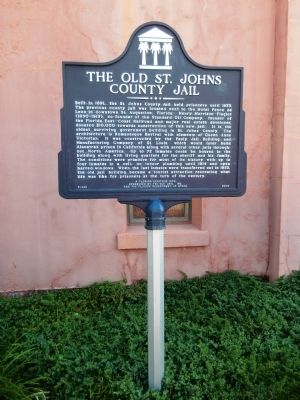
Built in 1891, the St. Johns County Jail held prisoners until 1953. The previous county jail was located next to the Hotel Ponce de Leon in downtown St. Augustine, Florida. Henry Morrison Flagler (1830-1913), co-founder of the Standard Oil Company, founder of the Florida East Coast Railroad and major real estate developer, donated $10,000 towards construction of this new jail. It is the oldest surviving government building in St. Johns County. The architecture is Romanesque Revival with elements of Queen Anne Victorian. It was constructed by the Pauly Jail Building and Manufacturing Company of St. Louis, which would later build Alcatraz prison in California along with several other jails throughout North America. Up to 72 inmates could be housed in the building along with living quarters for the sheriff and his family. The conditions were primitive for most of its history with up to four inmates in a cell, no indoor plumbing until 1914 and open barred windows. When the last inmates were transferred out in 1953, the old jail building became a tourist attraction recreating what life was like for prisoners at the turn
this page online
Erected 2004 by Florida Heritage Site sponsored by the Old Jail, Inc. and the Florida Department of State. (Marker Number F-521.)
Topics. This historical marker is listed in this topic list: Notable Buildings. A significant historical year for this entry is 1891.
Location. 29° 54.479′ N, 81° 19.125′ W. Marker is in St. Augustine, Florida, in St. Johns County. It can be reached from San Marco Avenue (Business U.S. 1) 0.1 miles south of May Street (State Road A1A), on the left when traveling south. Marker located at the northeast corner of the Old Jail building on the grounds of the Old Jail Museum complex. Touch for map. Marker is at or near this postal address: 167 San Marco Avenue, Saint Augustine FL 32084, United States of America. Touch for directions.

Regionally, this marker is in First Coast and in Greater Jacksonville. It is also in the American South and on the Eastern Seaboard. Globally, it is in the North Atlantic Region, North America, a Gulf of Mexico state, the Western Hemisphere, the Western World, and the Anglosphere. Historically, it finds itself in what was once New Spain, the territory
Photographed by Cosmos Mariner, December 10, 2014
2. The Old St. Johns County Jail Marker (tall view)
Other nearby markers. At least 8 other markers are within walking distance of this marker: The Old Jail (here, next to this marker); Sheriff’s Police Car (a few steps from this marker); Down on the Farm (a few steps from this marker); The 1899-1904 Wiles Houses (a few steps from this marker); Potter’s Field (within shouting distance of this marker); The 1910 Mary Peck House (within shouting distance of this marker); Cracker Horses (within shouting distance of this marker); The 1910 Cracker House (within shouting distance of this marker). Touch for a list and map of all markers in St. Augustine.
Also see . . .
1. Old St. Johns County Jail.
Built by Henry Flagler in 1891 and placed on the National Register of Historic Places in 1987, the Old Jail served as the St Johns County Jail until 1953. Maximum Security housed the most dangerous prisoners held at the Jail and includes a Death Row cell, for those condemned to die. A total of 8 men were hung from the Gallows on the Jail compound during its history. Overall conditions
Photographed by Cosmos Mariner, December 10, 2014
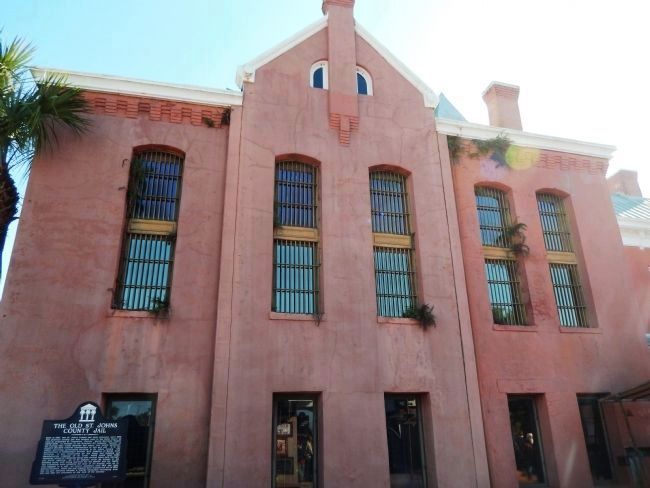
3. The Old St. Johns County Jail (north end view)
Historical marker is visible in lower left corner.
2. The Old Jail, St. Augustine, Florida.
The jail has a restored gallows and a "birdcage" cell that makes a nice photo-op. Inside, the highlight of the tour is an animatronic sheriff Joe Perry, who gives a short speech from atop the maximum security cell block, holding a hangman's rope. (Submitted on December 10, 2014, by Cosmos Mariner of Cape Canaveral, Florida.)
Photographed by Cosmos Mariner, December 10, 2014
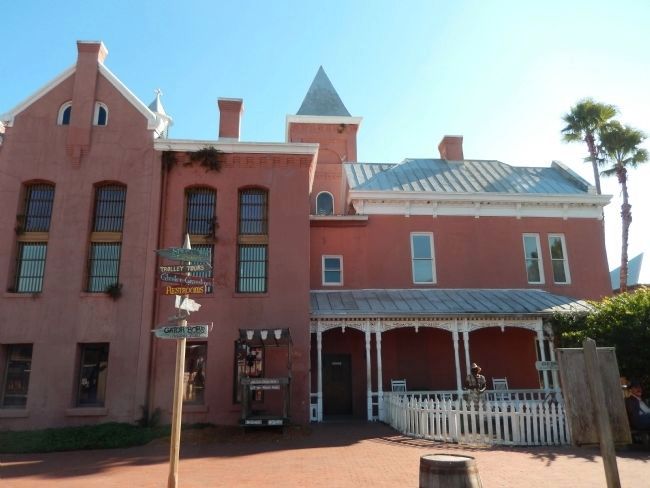
4. The Old St. Johns County Jail (front center view)
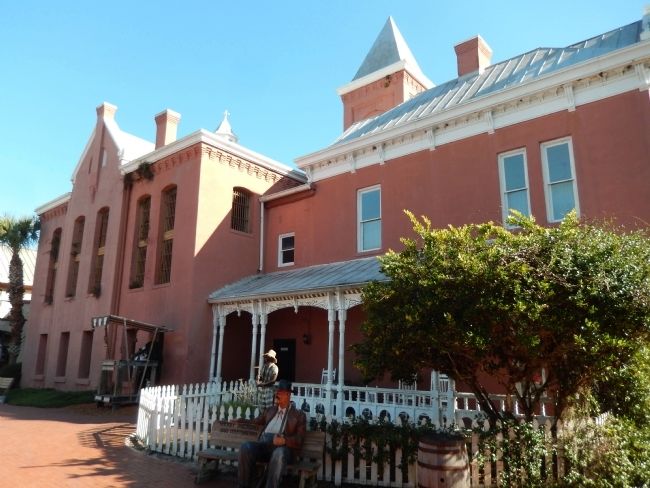
Photographed by Cosmos Mariner, December 10, 2014
5. The Old St. Johns County Jail (south end view)
Statue of Sheriff Joe Perry (sitting on the bench) can be seen in the foreground.
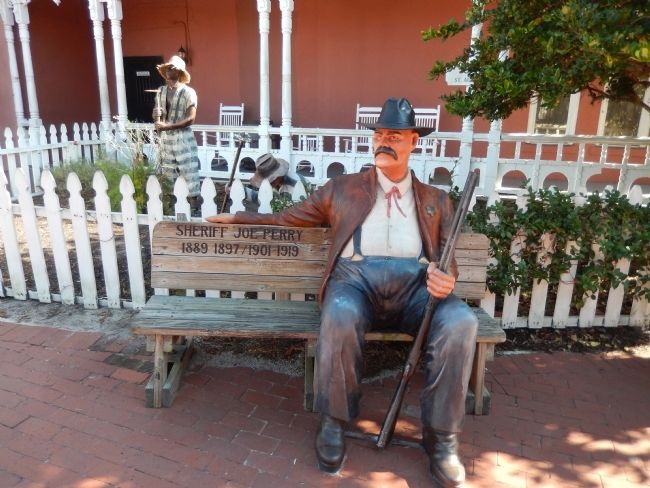
Photographed by Cosmos Mariner, December 10, 2014
6. Sheriff Joe Perry Statue
Credits. This page was last revised on December 29, 2025. It was originally submitted on December 10, 2014, by Cosmos Mariner of Cape Canaveral, Florida. This page has been viewed 2,322 times since then and 85 times this year. Last updated on December 11, 2014, by Jamie Cox of Melbourne, Florida. Photos: 1, 2, 3, 4, 5, 6. submitted on December 10, 2014, by Cosmos Mariner of Cape Canaveral, Florida. • Bill Pfingsten was the editor who published this page.
