Vieux-Québec-Cap-Blanc-colline Parlementaire in Capitale-Nationale, — Central Canada (French-Canadian)
O Canada!
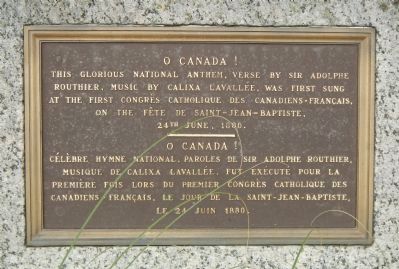
Photographed by Barry Swackhamer, July 25, 2014
1. O Canada! Marker

French:
Topics. This historical marker is listed in these topic lists: Arts, Letters, Music • Patriots & Patriotism. A significant historical date for this entry is June 24, 1880.
Location. 46° 48.232′ N, 71° 13.051′ W. Marker is in Québec, in Capitale-Nationale. It is in Vieux-Québec-Cap-Blanc-colline Parlementaire. It is on Avenue George VI. Touch for map. Marker is at or near this postal address: Avenue George VI, Québec G1R 6C7, Canada. Touch for directions.

Regionally, this marker is in Central Canada. Globally, it is in North America, the Western Hemisphere, and the Western World. Historically, it finds itself in what was once a British colony, the Viceroyalty
this page online
Other nearby markers. At least 8 other markers are within walking distance of this marker: Do You Know Joan of Arc? (here, next to this marker); A Golf Club on the Plains of Abraham (within shouting distance of this marker); Jardin Jeanne d'Arc / Joan of Arc Garden (about 90 meters away, measured in a direct line); Martello Towers in Quebec / Tours Martello de Québec (about 90 meters away); Martello Towers / Tours Martello (about 150 meters away); Montcalm (about 150 meters away); Louis-Alexandre Taschereau (about 150 meters away); Le Siège de Québec, 1759 / The Siege of Québec, 1759 (about 180 meters away). Touch for a list and map of all markers in Québec.
More about this marker. This marker is located in Québec City's National Battlefields Park near the statue of Joan of Arc.
Also see . . . O Canada - Wikipedia. The lyrics were originally in French and translated into English in 1906. Robert Stanley Weir wrote in 1908 another English version, which is the official and most popular version, one that is not a literal translation of the French. Weir's lyrics have been revised twice, taking their present form in 1980, but the French lyrics remain unaltered. "O Canada" had served as a de facto national anthem since 1939, officially becoming Canada's national anthem in 1980 when the Act of Parliament making it so received Royal Assent and became effective on July 1 as part of that year's Dominion Day celebrations.
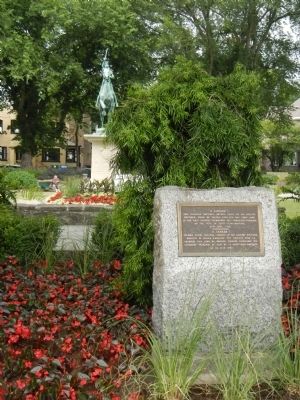
Photographed by Barry Swackhamer, July 25, 2014
2. O Canada! Marker
Credits. This page was last revised on February 9, 2023. It was originally submitted on February 15, 2015, by Barry Swackhamer of Brentwood, California. This page has been viewed 662 times since then and 28 times this year. Photos: 1, 2. submitted on February 15, 2015, by Barry Swackhamer of Brentwood, California. • Andrew Ruppenstein was the editor who published this page.
