Weapons of War
American Artillery
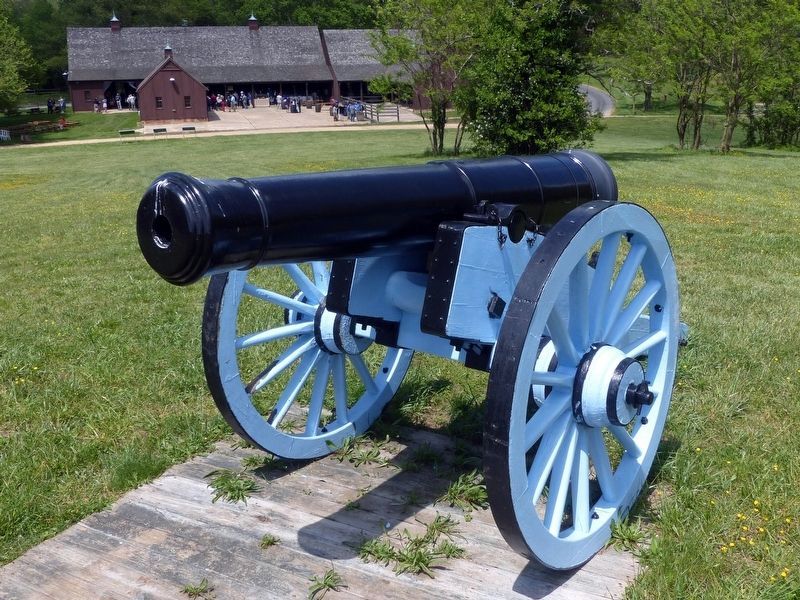
| — | Replica Fiberglass Cannon on Carriage | — |
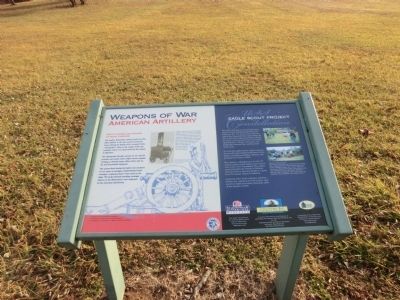
The Chesapeake Flotilla carried 24, 32, and 42-pounder cannonades (short, light cannon capable of firing a relatively large caliber shot) and 12, 18, and 24-pounder long guns.
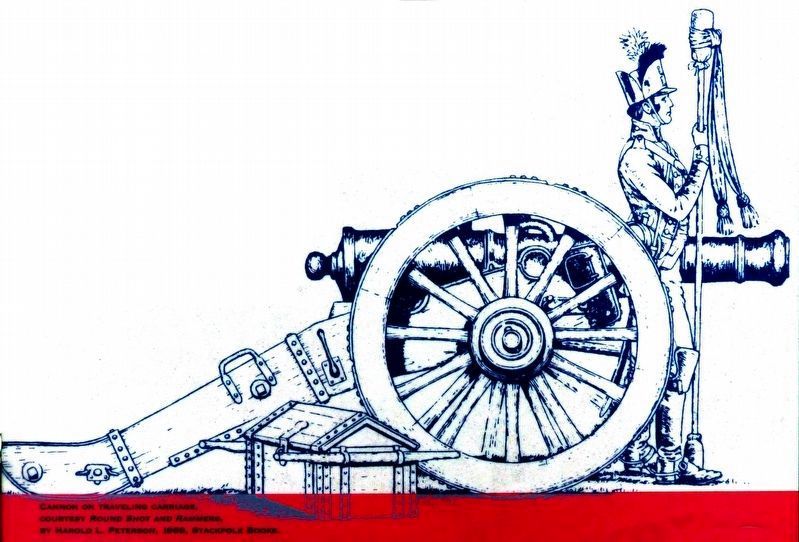
The cannon fired during the battle were mounted on two types of carriages. Small-wheeled naval carriages—replicated here--- were used on the ships. The large-wheeled traveling carriages (shown in the illustration) were employed by the American land forces.
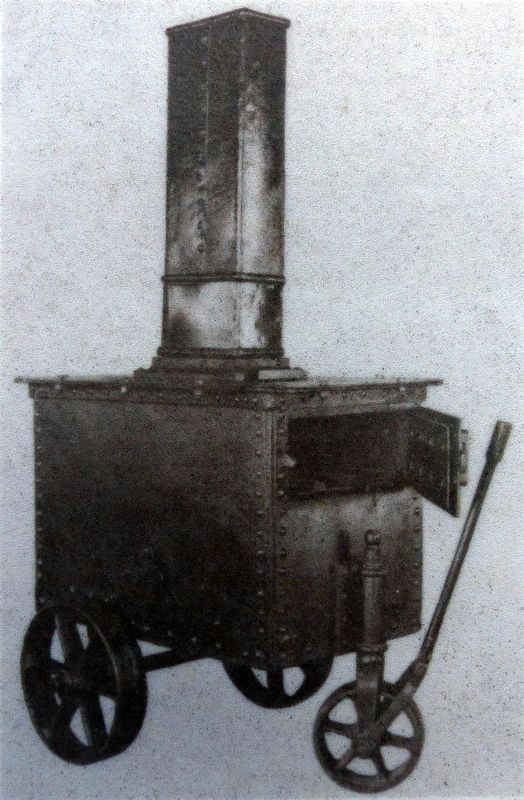
(Inscription beside the furnace in the upper center)
During the Battle of St. Leonard Creek, a small portable furnace---perhaps similar to the one shown at left--except mounted on large wheeled carriage---was used by the American land forces to heat solid shot, which upon striking wooden ships, could set them on fire. One soldier lost his arms when a mishandled hot shot caused an explosion at the gun battery.
U.S.S. Constellation
Eagle Scout
this page online
To create this replica battery, Erich conducted the research and coordinated all aspects of the project, including assembling volunteers who provided 121.5 hours of labor.
The cannon is a fiberglass cast of a late 18th century cannon found during recent renovations of the U.S.S. Constellation. The cannon was purchased by the Friends of Jefferson Patterson Park & Museum, thanks to a grant from the Eugene Chancy Foundation. Numerous other local companies and foundations also contributed to the project, making this a highly successful community effort in the summer of 2000.
(Inscription under the drawing in the left bottom)
Cannon on Traveling Carriage, Courtesy Round Shot and Rammers, by Harold L. Peterson, 1969, Stackpole Books.
(Inscription under the photos on the
Project Participants: Joey Black, Matt Black, Chris Chulski, Sean Daly, Brandon Davis, Erich Eshelman, Ricky Gines, Roberto Gines, Ray Hiben, Bradley Jeshelnik, Morgan Kaumyer, Josh McAlister, Matt McMinn, Daniel McMurry, Brandon Perkings, Matt Sanders, Joey Sntivasci, Jay Simpson, Kyle Simpson, and Jeremy Smith.
Funding provided to the Friends of Jefferson Patterson Park and Museum, Inc. by the Chesapeake Bay Gateways Network, National Park Service.
Erected by Maryland Department of Housing and Community Development.
Topics. This historical marker is listed in this topic list: War of 1812. A significant historical year for this entry is 1812.
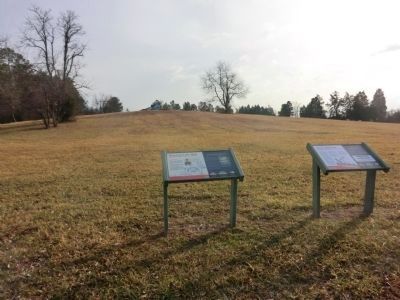
Location. 38° 23.902′ N, 76° 30.408′ W. Marker is in St. Leonard, Maryland, in Calvert County. It is on Jefferson Patterson Park Road. The marker is located on the grounds of the Jefferson Patterson Park and Museum near the Visitor Center. Touch for map. Marker is in this post office area: Saint Leonard MD 20685, United States of America. Touch for directions.
Regionally, this marker is in Southern Maryland. It is also in the American South, specifically in the Upper South, in
Other nearby markers. At least 8 other markers are within walking distance of this marker: Naval Warfare (within shouting distance of this marker); The War of 1812 Living History (within shouting distance of this marker); "O! say can you see…" (about 300 feet away, measured in a direct line); War in the Chesapeake (about 300 feet away); Jefferson Patterson Park & Museum (about 300 feet away); Fate of the Flotilla (about 400 feet away); a different marker also named Jefferson Patterson Park & Museum (about 600 feet away); What is this Big White Building? (approx. ¼ mile away). Touch for a list and map of all markers in St. Leonard.
Credits. This page was last revised on July 22, 2016. It was originally submitted on February 20, 2015, by Don Morfe of Baltimore, Maryland. This page has been viewed 746 times since then and 27 times this year. Photos: 1, 2, 3. submitted on February 20, 2015, by Don Morfe of Baltimore, Maryland. 4, 5, 6. submitted on July 13, 2016, by Allen C. Browne of Silver Spring, Maryland. • Bill Pfingsten was the editor who published this page.
