Corinne in Box Elder County, Utah — The American Mountains (Southwest)
The Locomotives of Golden Spike - Jupiter
Photographed by Barry Swackhamer, August 27, 2014
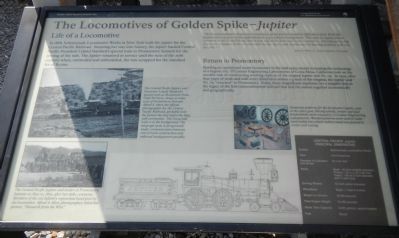
1. The Locomotives of Golden Spike - Jupiter Marker
Captions: (left, center) The Central Pacific Jupiter and Governor Leland Stanford’s special train at Monument Point, Utah Territory, about 30 miles west of Promontory Summit. Alfred A. Hart, the official photographer for the Central Pacific Railroad, probably took this picture the day before the May 10th ceremonies. The Great Salt Lake is in the background. The telegraph (pole in the background (sic, foreground)) made communication between end of track construction and railroad headquarters possible.; (bottom left) The Central Pacific Jupiter and tender at Promontory Summit on May 10, 1869, after the last spike ceremony. Members of the 21st Infantry regimental band pose by the locomotive. Alfred A. Hart, photographer, titled this picture, “Monarch from the West.”; (right, center) Numerous patterns fro the locomotive’s parts, such as the valve gear, driving wheels, tender and lead truck wheels, were created by O’Connor Engineering Laboratories. Wooden patterns were used to make sand molds into which molten metal was poured to create each casting.; (bottom right) Central Pacific Jupiter Principal Dimensions. Click on this image to enlarge it a read the chart.
Life of a Locomotive
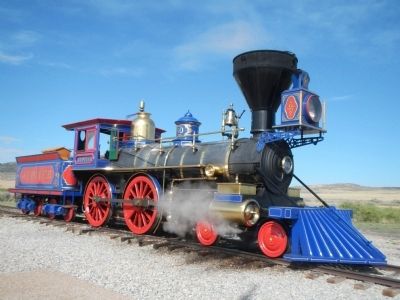
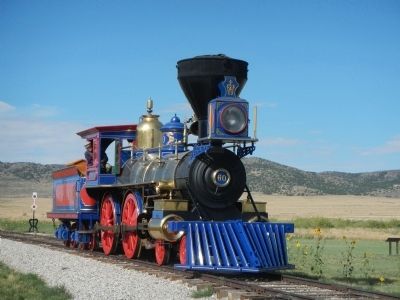
In 1868, Schenectady Locomotive Works in New York built the Jupiter for the Central Pacific Railroad. Steaming her way into history, the Jupiter hauled Central Pacific President Leland Stanford’ special train to Promontory Summit for the joining of the rails. The Jupiter remained in service until the turn of the 20th century when, outmoded and unheralded, she was scrapped for the standard fee of $1,000.
Return to Promontory
Building an operating steam locomotive in the mid-1970’s meant recreating the technology of a bygone era. O’Connor Engineering Laboratories of Costa Mesa, California took on the sizeable task of constructing working replicas
this page online
Erected by National Park Service, U.S. Department of the Interior.
Topics. This historical marker is listed in this topic list: Railroads & Streetcars. A significant historical year for this entry is 1836.
Location. 41° 37.076′ N, 112° 33.105′ W. Marker is in Corinne, Utah, in Box Elder County. It can be reached from Golden Spike Road (22000 West Road) near 6400 North Road, on the right when traveling west. Touch for map. Marker is in this post office area: Corinne UT 84307, United States of America. Touch for directions.

Regionally, this marker is in the Cache Valley and in the West Desert. It is also in the American Mountain West and on the Colorado Plateau. Globally, it is in North America, the Rocky Mountains, the Western Hemisphere, the Western World, and the Anglosphere.
Photographed by Barry Swackhamer, August 27, 2014
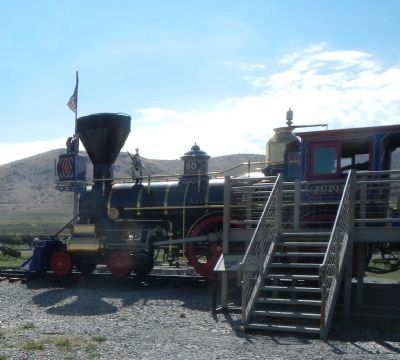
2. The Locomotives of Golden Spike - Jupiter Marker
The marker is located beside the viewing stand.
Other nearby markers. At least 8 other markers are within walking distance of this marker: September 8, 1942 (a few steps from this marker); May 10, 1869 (a few steps from this marker); The Locomotives of Golden Spike - No. 119 (a few steps from this marker); September 1869 (within shouting distance of this marker); May 9, 1869 (within shouting distance of this marker); a different marker also named September 1869 (within shouting distance of this marker); Competition 1869 (within shouting distance of this marker); Last Spike Driven (within shouting distance of this marker). Touch for a list and map of all markers in Corinne.
More about this marker. This marker is located in the exhibit area behind the Golden Spike Visitors Center.
Also see . . .
1. Central Pacific Railroad Photographic History Museum. The website for all things photographic (and more) relating to the Transcontinental Railroad. (Submitted on February 22, 2015, by Barry Swackhamer of Brentwood, California.)
2. Jupiter (locomotive). The Jupiter was not Leland Stanford's original choice for transporting his party to the Golden Spike site. Originally, Stanford's train was to be pulled by another Central Pacific locomotive, the Antelope... (At a logging camp)... the workers rolled a large log down the mountain, which struck the Antelope. With the engine damaged, a message was sent to the upcoming station to hold the approaching train. There, Stanford's consist was added to the Jupiter 's train.
Photographed by Barry Swackhamer, August 27, 2014
3. Central Pacific's Jupiter
Additional keywords. The Locomotives of Golden Spike - Jupiter
Photographed by Barry Swackhamer, August 27, 2014
4. Central Pacific's Jupiter
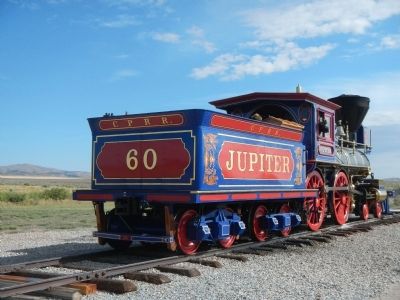
Photographed by Barry Swackhamer, August 27, 2014
5. Central Pacific's Jupiter
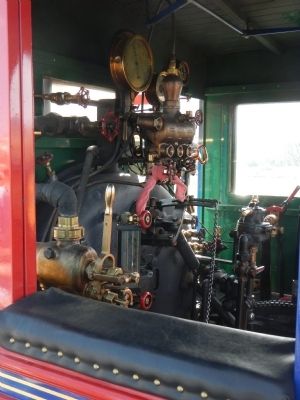
Photographed by Barry Swackhamer, August 27, 2014
6. The locomotive cab of the Central Pacific's Jupiter
Credits. This page was last revised on June 16, 2016. It was originally submitted on February 22, 2015, by Barry Swackhamer of Brentwood, California. This page has been viewed 1,683 times since then and 103 times this year. Photos: 1, 2, 3, 4, 5, 6. submitted on February 22, 2015, by Barry Swackhamer of Brentwood, California. • Andrew Ruppenstein was the editor who published this page.
