Bodega in Sonoma County, California — The American West (Pacific Coastal)
Watson School
1857 - 1967
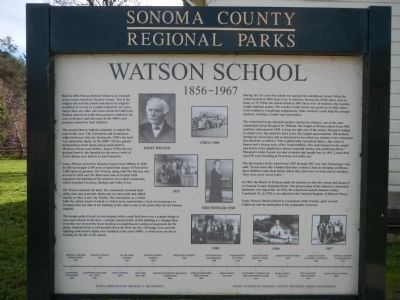
Photographed by Barry Swackhamer, February 25, 2015
1. Watson School Marker
Click on photo to view historical photos and timeline of events.
The coastal Miwok Indians originally occupied the land in this area. The Tsuwutena and Kennekono tribes lived near this area. During the 1700’s the land was claimed by Spain. In the 1800’s Mexico gained independence from Spain and granted land to Mexican citizens and soldiers. Jasper O’Farrell was granted land by the Spanish for his survey work of Yerba Buena, now known as San Francisco.
James Watson arrived in Sonoma County from Illinois in 1849. In 1852 he bought 1,100 acres of land from Jasper O’Farrell for 1,000 sacks of potatoes. Mr. Watson, along with Mr. Purrine who arrived in 1852 and Mr. Robertson who arrived in 1855, organized the building of the school to serve their community which included Freestone, Bodega and Valley
this page online
Mr. Watson donated the land. The community donated their skills, time and materials. Redwood was harvested and milled nearby in what is now Joy Woods. The community as a whole built the school, proof of which is evident in its construction. A lack of consistency in framing from one side of the building to the other is due to the joint effort by the Pioneer families.
The simple gable (Greek revival origins) with a small bell tower was a typical design of one-room schools at that time. A unique characteristic of this building is a sloping floor from rear toward the front forming an amphitheater seating arrangement for the desks. Students liked to roll marbles down the floor for fun. Oil lamps were used for lighting until electric lights were installed in the early 1900’s. A wood stove served as heating for the life of the school.
During the 111 years the school was opened, the enrollment varied. When the school opened in 1856 there were 11 students. During the 1920’s there were as many as 35. When the school closed in 1967 there were 10 students. One teacher taught multiple grades. The teacher would lecture one grade level while
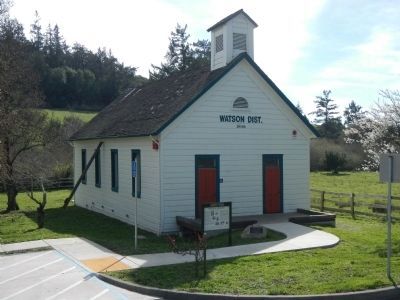
Photographed by Barry Swackhamer, February 25, 2015
2. Watson School and Marker
The school had many talented teachers during its existence, one of the most memorial being Margaret M. Witham. She taught at Watson school from 1902 until her retirement in 1950. Living one mile east of the school, Margaret walked to school every day until her later years. She taught approximately 350 students during her career here and as testament to her talent one student at her retirement described her as follows, “She is gifted with a practical mind, a fine sense of humor and a strong sense of her responsibilities. Her quiet impact on the minds and hearts of her pupils have shown unusually lasting and gratifying effects.” Margaret’s sister Louise was also a teacher and taught here in 1891. Louise then spent 50 years teaching at Freestone, two miles east.
The last teacher at the school from 1955 through 1967 was Alice Entzminger who said, “it was more like a family than like a school. I had no discipline problems; these children came from homes where they knew how to work and be obedient.
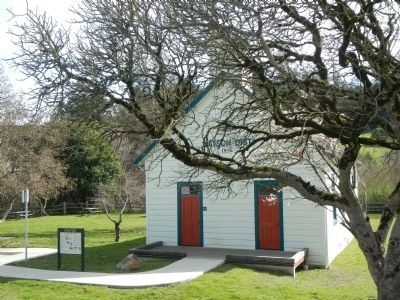
Photographed by Syd Whittle, February 25, 2015
3. Watson School
Having two entrance doors was a common feature of many one-room schoolhouses of the 1800's. The left door was used by the boys and the right door by the girls.
In 1967, the Board of Trustees made the decision to close the school and donate it to Sonoma County Regional Parks. The preservation of the school as a historical landmark was important. In 1978, it was placed on the National Register of Historic Places.
Today. Watson District School is a testament of the frontier spirit of early California and the dedication of the community it served.
Erected by Sonoma County Regional Parks Foundation.
Topics. This historical marker is listed in this topic list: Education. A significant historical year for this entry is 1856.
Location. 38° 21.356′ N, 122° 56.325′ W. Marker is in Bodega, California, in Sonoma County. It is on Bodega Highway, on the right when traveling east. The marker and school are located at the Watson School Historical Park. Touch for map. Marker is at or near this postal address: 15538 Bodega Highway, Bodega CA 94922, United States of America. Touch for directions.

Regionally, this marker is in California’s Wine Country, in the San Francisco Bay Area, in the North Coast, and specifically on the Coast Ranges. It is also on the
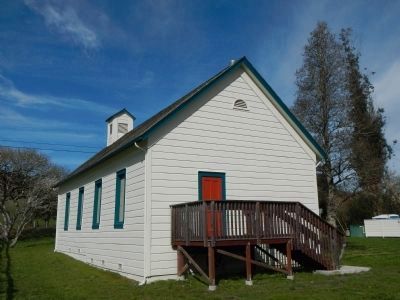
Photographed by Barry Swackhamer, February 25, 2015
4. Rear View of the Schoolhuse
Other nearby markers. At least 8 other markers are within 5 miles of this marker, measured as the crow flies: Running Fence (a few steps from this marker); Freestone House (approx. 1.7 miles away); Potter School Est. 1873 (approx. 1.9 miles away); Church of Saint Teresa of Avila (approx. 1.9 miles away); Bodega Bay (approx. 2 miles away); Christo’s Running Fence (approx. 2.7 miles away); Occidental Union Hotel (approx. 3.6 miles away); Sturgeons Mill (approx. 4.6 miles away). Touch for a list and map of all markers in Bodega.
Also see . . . Running Fence - Watson School Historic Park. Sonoma County Regional Parks entry (Submitted on December 8, 2020, by Larry Gertner of New York, New York.)
Photographed by Barry Swackhamer, February 25, 2015
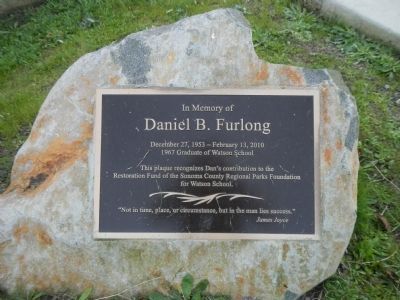
5. Dedication Plaque
Daniel B. Furlong
December 27, 1953 - February 13, 2010
1967 Graduate of Watson School
This plaque recognizes Dan's contribution to the
Restoration Fund of the Sonoma County Regional Parks Foundation
for Watson School
"Not in time, place, or circumstances, but in the man lies success."
James Joyce
Photographed by Alvis Hendley, June 28, 2026
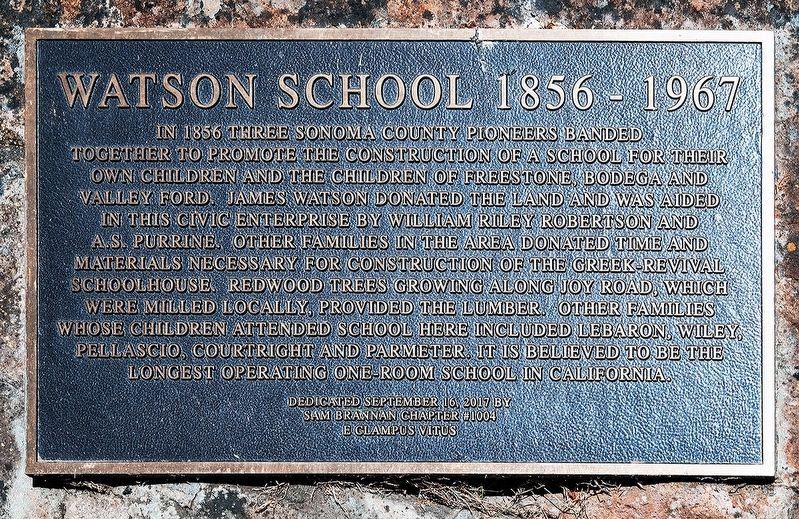
6. Watson School 1856-1967
In 1856 three Sonoma County pioneers banded together to rpomote the construction of a school for their own children and the children of Freestone, Bodega and Valley Ford. James Watson donated the land and was aided in this civic enterprise by William Riley Robertson and A.S. Purrine. Other families in the area donated time and materials necessary for construction of the Greek-revival schoolhouse. Redwood trees growing along Joy Road, which were milled locally, provided the lumber. Other families whose children attended school here included Lebaron, Wiley, Pallascio, Courtright and Parmeter. It believed to be the longest operating one-room school in California.
Dedicated September 16, 2017 by
Sam Brannan Chapter #1004
E Clampus Vitus
Photographed by Alvis Hendley, June 28, 2026
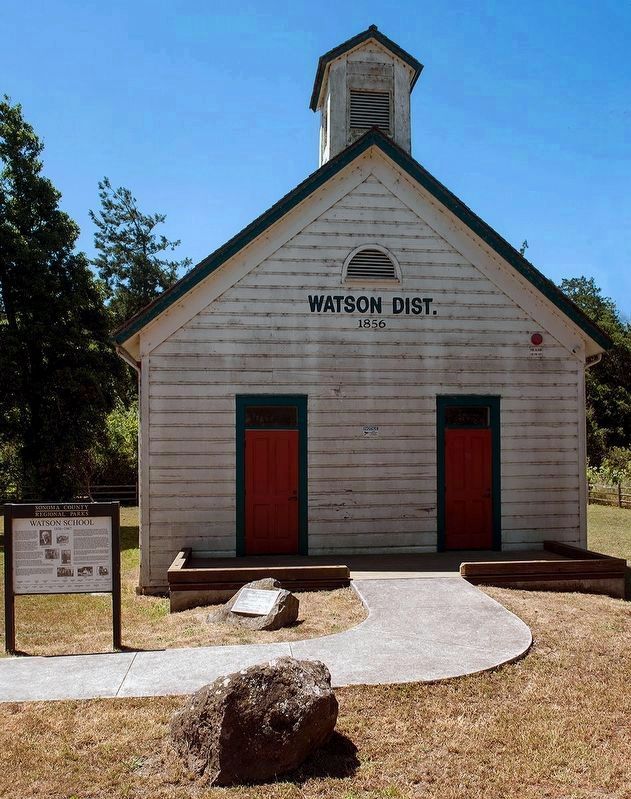
7. Watson School
The marker is mounted on the larger of the two stones in front of the schoolhouse.
Photographed by Alvis Hendley, June 28, 2026
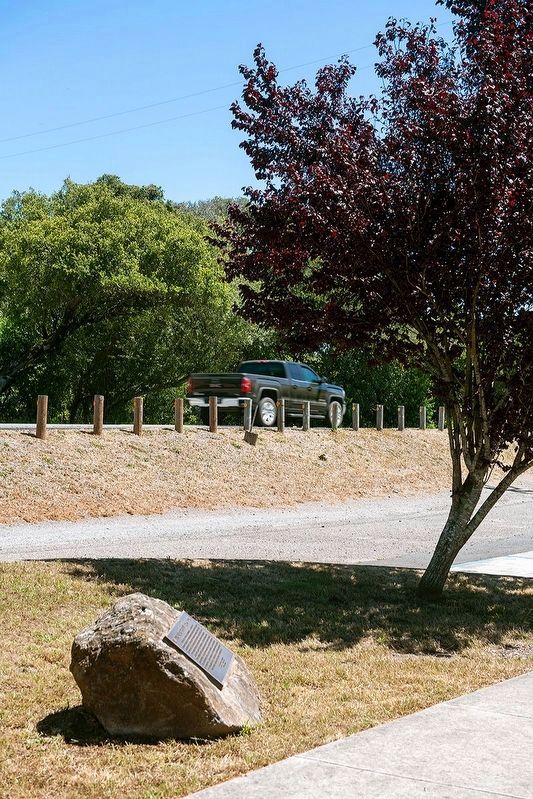
8. Watson School Marker
Credits. This page was last revised on August 4, 2026. It was originally submitted on February 28, 2015, by Barry Swackhamer of Brentwood, California. This page has been viewed 984 times since then and 61 times this year. Photos: 1, 2, 3, 4, 5. submitted on February 28, 2015, by Barry Swackhamer of Brentwood, California. 6, 7, 8. submitted on July 30, 2026, by Alvis Hendley of San Francisco, California. • Syd Whittle was the editor who published this page.
