Hermitage in Davidson County, Tennessee — The American South (East South Central)
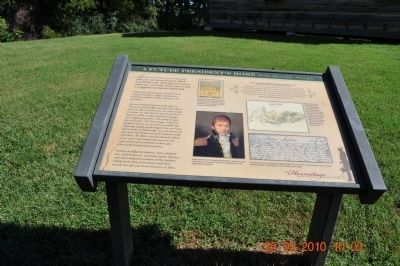
A Future President's Home
From Adversity, Strength
Photographed by Sandra Hughes, September 25, 2010
1. A Future President's Home Marker
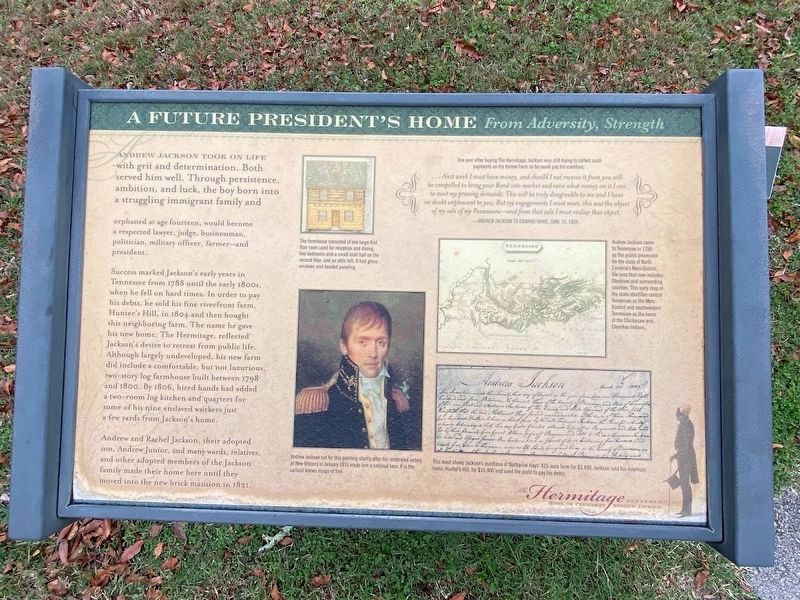
orphaned at age fourteen, would become a respected lawyer, judge, businessman, politician, military officer, farmer - and president.
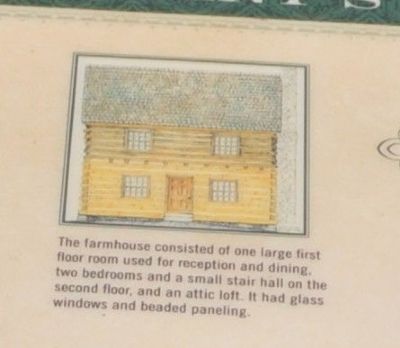
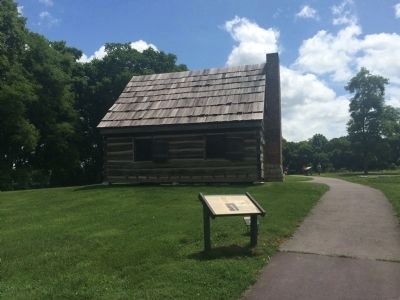
Success marked Jackson’s early years in Tennessee from 1788, until the early 1800s, when he fell on hard times. In order to pay his debts, he sold his fine riverfront farm, Hunter’s Hill, in 1804 and then bought this neighboring farm. The name he gave his new home, The Hermitage, reflected Jackson’s desire to retreat from public life. Although largely undeveloped, his new farm did include a comfortable, but not luxurious, two-story log farmhouse built between 1798 and 1800. By 1806, hired hands had added a two-room log kitchen and quarters for some of his nine enslaved workers just a few yards from Jackson’s home.
Andrew and Rachel Jackson, their adopted son, Andrew Junior, and many wards, relatives, and other adopted members of the Jackson family made their home here until they moved into the new brick mansion in
this page online
Erected by The Hermitage.
Topics. This historical marker is listed in these topic lists: Government & Politics • Notable Buildings. A significant historical year for this entry is 1788.
Location. 36° 13.014′ N, 86° 36.687′ W. Marker is in Hermitage, Tennessee, in Davidson County. It is on Rachel's Lane. Touch for map. Marker is in this post office area: Hermitage TN 37076, United States of America. Touch for directions.

Regionally, this marker is in Middle Tennessee and in Greater Nashville. It is also in the American South and specifically in the Upper South. Globally, it is in North America, the Western Hemisphere, the Western World, and the Anglosphere. Historically, it finds itself in what was once the territory of the Mississippian Culture, one of the Confederate States of America, and the Antebellum South.
Other nearby markers. At least 8 other markers are within walking distance of this marker: The First Hermitage (a few steps from this marker); The Hermitage Landscape (a few steps from this marker); A home for Jackson’s Slaves (within shouting distance of this marker); Growing Cotton (within shouting
Photographed by Sandra Hughes, September 25, 2010
2. The Farmhouse
The farmhouse consisted of one large first floor room used or reception and dining, two bedrooms and a small stair hall on the second floor, and an attic loft. It had glass windows and beaded paneling.
Photographed by Sandra Hughes, September 25, 2010
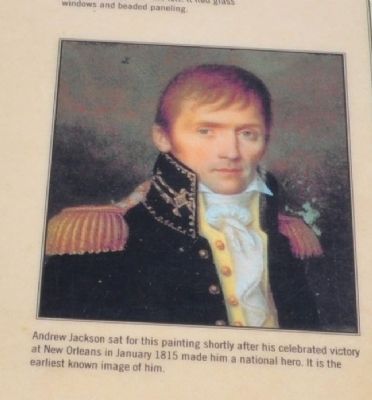
3. Andrew Jackson 1815
Andrew Jackson sat for this painting shortly after his celebrated victory at New Orleans in January 1815 made him a national hero. It is the earliest known image of him.
Photographed by Sandra Hughes, September 25, 2010
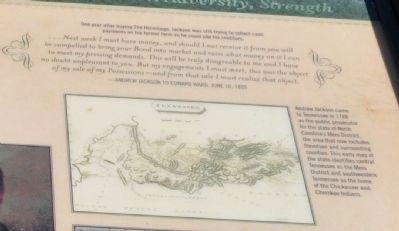
4. Purchase of the Hermitage
One year after buying the Hermitage, Jackson was still trying to collect cash payment on his former farm so he could pay his creditors.
…Next week I must have money, and should I not receive it from you will be compelled to bring your Bond into market and rise what money on it I can to meet my pressing demands. This will be truly disagreeable to me and I have no doubt unpleasant to you. But my engagements I must meet, this was the object of my sale of my possessions- and from that sale, I must realize that object.
-Andrew Jackson to Edward Ward, June 10, 1805
Andrew Jackson came to Tennessee in 1788 as the public prosecutor for the state of North Carolina’s Mero District, the area that now includes Davidson and surrounding counties. This early map of the state identifies central Tennessee as the Mero District and southwestern Tennessee as the home of the Chickasaw and Cherokee Indians.
Photographed by Sandra Hughes, September 25, 2010
5. The Deed
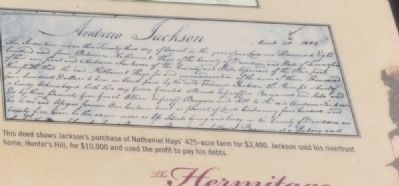
This deed shows Jackson’s purchase of Nathaniel Hayes’ 425-acre farm for $3,400; Jackson sold his riverfront home, Hunter’s Hill for $10,000 and used the profit to pay his debts.
Photographed by Darren Jefferson Clay, November 12, 2022
6. A Future President's Home Marker
Photographed by J. Makali Bruton, June 14, 2015
7. Wide view of A Future President's Home Marker
Credits. This page was last revised on February 7, 2023. It was originally submitted on February 9, 2012, by Sandra Hughes Tidwell of Killen, Alabama, USA. This page has been viewed 933 times since then and 28 times this year. Last updated on March 13, 2015, by J. Makali Bruton of Washington, District of Columbia. Photos: 1, 2, 3, 4, 5. submitted on February 9, 2012, by Sandra Hughes Tidwell of Killen, Alabama, USA. 6. submitted on January 23, 2023, by Darren Jefferson Clay of Duluth, Georgia. 7. submitted on July 12, 2015, by J. Makali Bruton of Washington, District of Columbia. • Bill Pfingsten was the editor who published this page.
