Midtown in Nashville in Davidson County, Tennessee — The American South (East South Central)
The Parthenon
Photographed by Denise Boose, July 11, 2012
1. The Parthenon Marker
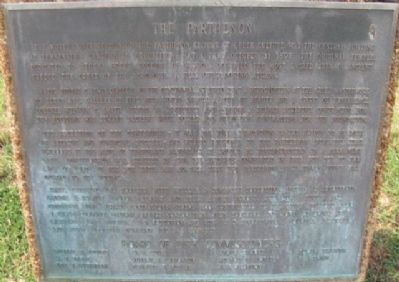
Major Eugene C. Lewis, director of the Centennial believed that a reproduction of the Greek masterwork to serve as a gallery of fine arts would inspire a love of beauty and a spirit of excellence. Colonel William C. Smith served as architect and George J. Zolnay, sculptor. Contractor for the building was Edward Laurent with Foster and Creighton contracting for the foundation.
The reception of the Centennial – It was the first exposition in the nation to be both an artistic and financial success – and public response to the Parthenon indicated, that although it was made of temporary materials, it should be reconstructed on a permanent basis. Construction was started in 1921, the exterior completed in 1925, but due to the lack of funds it was not until May 20, 1931, that the Parthenon
this page online
Hart, Freeland and Roberts, with William B. Dinsmoor consulting, served as architects George J. Zolnay, Leopold Scholz and Belle Linney Scholz, sculptors. Foster and Creighton were general contractors, others who contributed to the work included John J. Early Company, General Bronze Corporation, John Bouchard and Sons, Herbrice and Lawrence H.E. Parmer, J.J. Hutchinson and Son, J.O. Kirkpatrick, Charles A. Howell Art Mosaic and Tile Company and A. T. Kanaday.
Board of Park Commissioners
Robert M. Dudley
M.T. Bryan
Lee J. Loventhal
W.R. Cole
Robert T. Creighton
Charles M. McCabe
Percy Warner
Rogers Coldwell
J.R.W. Brown
Edwin Warner
Topics. This historical marker is listed in this topic list: Notable Buildings. A significant historical date for this entry is May 1, 1897.
Location. 36° 8.962′ N, 86° 48.844′ W. Marker is in Nashville, Tennessee, in Davidson County. It is in Midtown. It is on 27th Avenue North 0.3 miles north of West End Avenue, on the right when traveling north. Touch for map. Marker is at or near this postal address: 2600 West End Ave, Nashville TN 37203, United States
Photographed by Denise Boose, July 11, 2012
2. The Parthenon Marker

Regionally, this marker is in Middle Tennessee. It is also in the American South and specifically in the Upper South. Globally, it is in North America, the Western Hemisphere, the Western World, and the Anglosphere. Historically, it finds itself in what was once the territory of the Mississippian Culture, one of the Confederate States of America, and the Antebellum South.
Other nearby markers. At least 8 other markers are within walking distance of this marker: Federal Defenses (within shouting distance of this marker); John W. Thomas (within shouting distance of this marker); The Nashville Parthenon (about 400 feet away, measured in a direct line); Snakes & Slides: The Exposition's Vanity Fair (about 400 feet away); Tennessee Woman Suffrage Monument (about 500 feet away); Jane Greenebaum Eskind (about 500 feet away); Beth Halteman Harwell (about 500 feet away); Lois Marie DeBerry (about 500 feet away). Touch for a list and map of all markers in Nashville.
Another marker is no longer nearby. Battle of Nashville (was within shouting distance of this marker but has been confirmed missing).
Photographed by Denise Boose, July 11, 2012
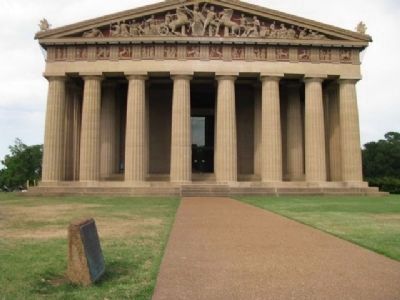
3. The Parthenon Marker and rear of the Parthenon.
Photographed by Denise Boose, July 11, 2012
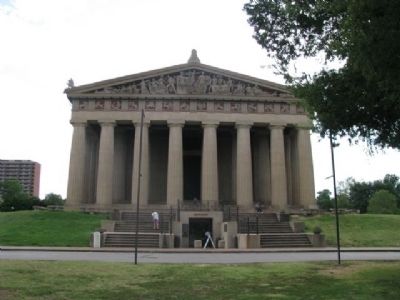
4. The Parthenon main entrance.
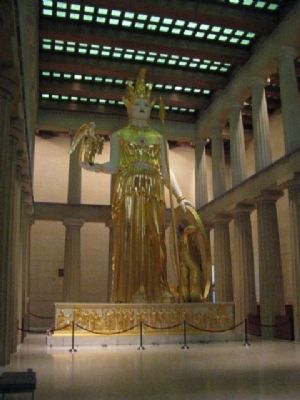
Photographed by Denise Boose, July 11, 2012
5. Athena inside the Parthenon.
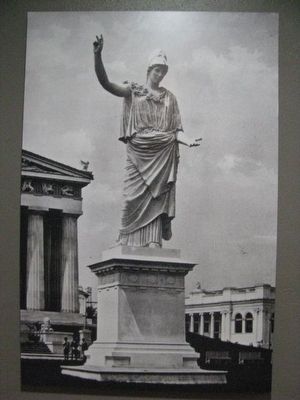
Photographed by Denise Boose, July 11, 2012
6. Athena~Photograph and info from the Parthenon Museum
Enid Yandell's 25-foot-tall sculpture (40 feet including the base) of the goddess Athena stood in front of the east end of the Parthenon. At the time, this enormous statue was the largest ever created by a woman. The sculpture is an exact replica, on much larger scale, of the Athena of Velletri in the Louvre Museum in Paris. Yandell sculpted it in her Paris studio in three part, then had it shipped to the United States. Before it left, Yandell hosted a bon voyage party for the statue, treating her guest to a candle-lit feast inside Athena's torso. It was a popular symbol of the Centennial Exposition, and images of it graced souvenirs and promotional materials. It is unknown what happened to the statue after the Centennial Exposition. It was made of plaster staff, much like the buildings, and would not have been able to withstand extended expose to the weather.
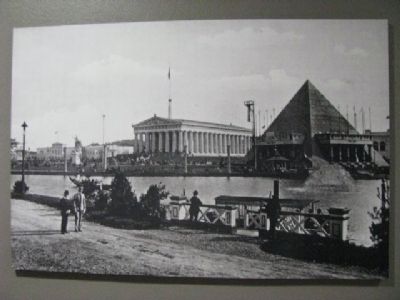
Photographed by Denise Boose, July 11, 2012
7. Photograph from the Parthenon Museum
Vistors look across Lake Watauga toward some of the fair's spectacular buildings, including the Parthenon and the Memphis-Shelby Country building (right), which was based on the pyramid of Cheops, also known as the Great Pyramid of Giza, in Egypt.
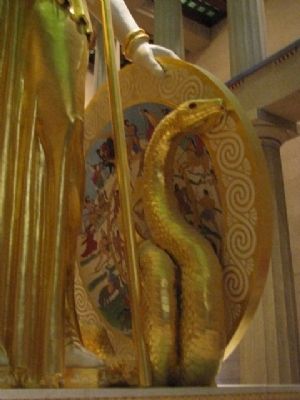
Photographed by Denise Boose, July 11, 2012
8. Athena's shield
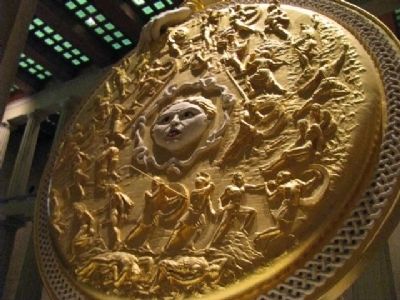
Photographed by Denise Boose, July 11, 2012
9. Athena's shield
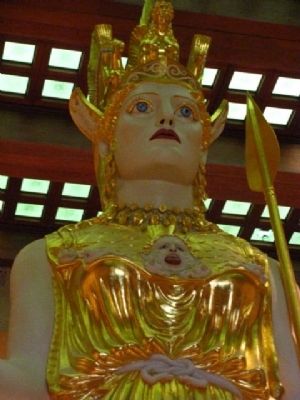
Photographed by Denise Boose, July 11, 2012
10. Athena
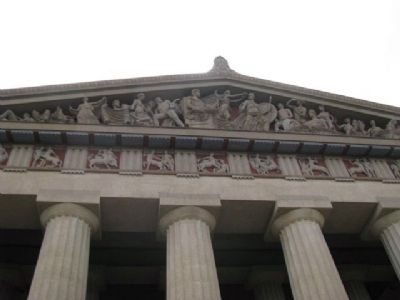
Photographed by Denise Boose, July 11, 2012
11. The Parthenon sculptures
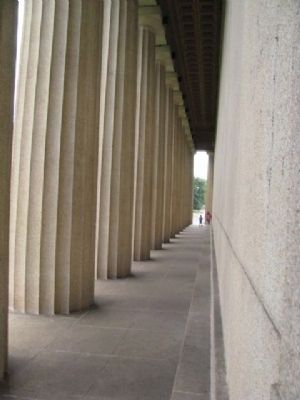
Photographed by Denise Boose, July 11, 2012
12. The Parthenon Pillars
Credits. This page was last revised on February 7, 2023. It was originally submitted on July 20, 2012, by Denise Boose of Tehachapi, California. This page has been viewed 1,337 times since then and 62 times this year. Last updated on March 14, 2015, by J. Makali Bruton of Washington, District of Columbia. Photos: 1, 2, 3, 4, 5, 6, 7, 8, 9, 10, 11, 12. submitted on July 20, 2012, by Denise Boose of Tehachapi, California. • Bill Pfingsten was the editor who published this page.
