Graduate Hospital in Philadelphia in Philadelphia County, Pennsylvania — The American Northeast (Mid-Atlantic)
Marian Anderson
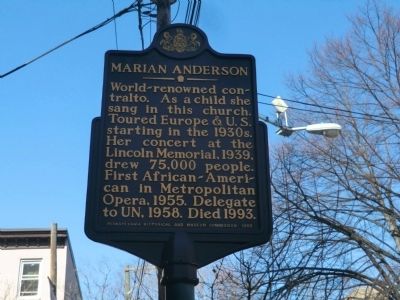
Photographed by Don Morfe, March 23, 2015
1. Marian Anderson Marker
Erected 1993 by Pennsylvania Historical & Museum Commission.
Topics and series. This historical marker is listed in these topic lists: African Americans • Arts, Letters, Music • Women. In addition, it is included in the Pennsylvania Historical and Museum Commission (PHMC) series list. A significant historical year for this entry is 1939.
Location. 39° 56.572′ N, 75° 10.47′ W. Marker is in Philadelphia, Pennsylvania, in Philadelphia County. It is in Graduate Hospital. It is on Fitzwater Street. The marker is located in front of the Union Baptist Church. Touch for map. Marker is at or near this postal address: 1910 Fitzwater Street, Philadelphia PA 19146, United States of America. Touch for directions.

Regionally, this marker is in Southeast Pennsylvania. It is also in the American Northeast and in the Mid-Atlantic. Globally, it is in North America, the
this page online
Other nearby markers. At least 8 other markers are within walking distance of this marker: Marian Anderson House (within shouting distance of this marker); Citizens and Southern Bank (about 800 feet away, measured in a direct line); Christian Street YMCA (approx. 0.2 miles away); Mercy Hospital (approx. 0.2 miles away); The Graduate Apartments (approx. 0.2 miles away); John C. Asbury (approx. ¼ mile away); Philadelphia Knights of Pythias (approx. ¼ mile away); John Page Nicholson (approx. 0.3 miles away). Touch for a list and map of all markers in Philadelphia.
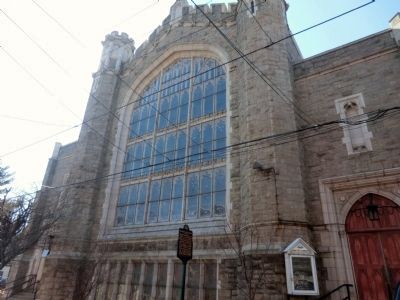
Photographed by Don Morfe, March 23, 2015
2. Union Baptist Church
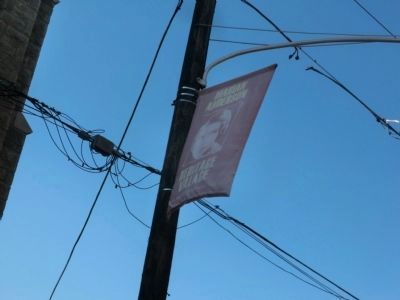
Photographed by Don Morfe, March 23, 2015
3. Marian Anderson Heritage Village flag
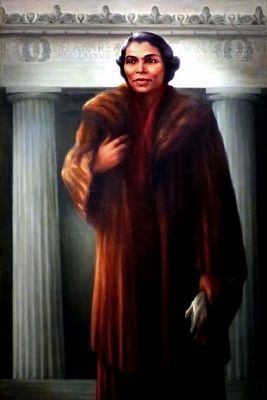
Photographed by Allen C. Browne, February 16, 2015
4. Marian Anderson
This portrait of Marian Anderson by Betsy Graves Reyneau hangs in the National Portrait Gallery in Washington, DC.
“Arturo Toscanini said that Marian Anderson had a voice that came along ‘once in a hundred years.’ When one of Anderson's teachers first heard her sing, the magnitude of her talent moved him to tears. Because she was black, however, her initial prospects as a concert singer in this country were sharply limited, and her early professional triumphs took place mostly in Europe. The magnitude of her musical gifts ultimately won her recognition in the United States as well. Despite that acclaim, in 1939 the Daughters of the American Revolution banned her from performing at Constitution Hall. First Lady Eleanor Roosevelt ultimately intervened and facilitated Anderson's Easter Sunday outdoor concert at the Lincoln Memorial—an event witnessed by 75,000 and broadcast to a radio audience of millions. The affair generated great sympathy tor Anderson and became a defining moment in America's civil rights movement.” — National Portrait Gallery
“Arturo Toscanini said that Marian Anderson had a voice that came along ‘once in a hundred years.’ When one of Anderson's teachers first heard her sing, the magnitude of her talent moved him to tears. Because she was black, however, her initial prospects as a concert singer in this country were sharply limited, and her early professional triumphs took place mostly in Europe. The magnitude of her musical gifts ultimately won her recognition in the United States as well. Despite that acclaim, in 1939 the Daughters of the American Revolution banned her from performing at Constitution Hall. First Lady Eleanor Roosevelt ultimately intervened and facilitated Anderson's Easter Sunday outdoor concert at the Lincoln Memorial—an event witnessed by 75,000 and broadcast to a radio audience of millions. The affair generated great sympathy tor Anderson and became a defining moment in America's civil rights movement.” — National Portrait Gallery
Credits. This page was last revised on February 2, 2023. It was originally submitted on March 25, 2015, by Don Morfe of Baltimore, Maryland. This page has been viewed 1,134 times since then and 93 times this year. Photos: 1, 2, 3. submitted on March 25, 2015, by Don Morfe of Baltimore, Maryland. 4. submitted on October 1, 2015, by Allen C. Browne of Silver Spring, Maryland. • Bill Pfingsten was the editor who published this page.
