Selma in Dallas County, Alabama — The American South (East South Central)
Edmund Pettus Bridge
National Historic Landmark

Photographed by Jeff Leichsenring, July 7, 2025
1. Edmund Pettus Bridge Marker
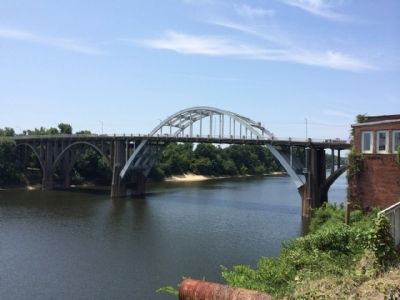
Edmund Pettus Bridge has been designated a National Historic Landmark. This site possesses national significance for its association with "Bloody Sunday," a seminal event in the Civil Rights Movement. Here, on March 7, 1965, law enforcement officers violently attacked peaceful marchers. Media coverage of the confrontation raised public awareness of the need for voting rights legislation and resulted in a national outcry that pressured Congress to pass the Voting Rights Act of 1965.
2013
National Park Service - United States Department of the Interior
Erected 2014 by the National Park Service.
Topics and series. This historical marker is listed in these topic lists: Bridges & Viaducts • Civil Rights. In addition, it is included in the National Historic Landmarks series list. A significant historical month for this entry is March 1943.
Location. 32° 24.342′ N, 87° 1.121′ W. Marker is in Selma, Alabama, in Dallas County. It is at the intersection of Broad Street (Business U.S. 80) and Water Avenue, on the right when traveling south on Broad Street. Bridge crosses the Alabama River entering downtown Selma. Touch for map.
this page online

Regionally, this marker is in the American South, specifically in the Deep South, and in the Black Belt. Globally, it is in North America, a Gulf of Mexico state, the Western Hemisphere, the Western World, and the Anglosphere. Historically, it finds itself in what was once New Spain, the territory of the Mississippian Culture, one of the Confederate States of America, and the Antebellum South.
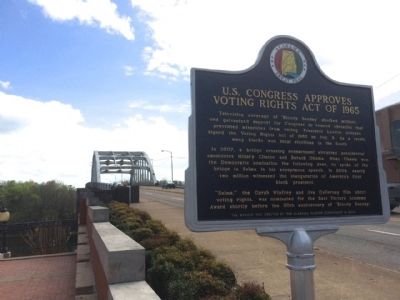
Other nearby markers. At least 8 other markers are within walking distance of this marker: 'Bloody Sunday' Attack at Edmund Pettus Bridge / U.S. Congress Approves Voting Rights Act of 1965 (about 300 feet away); Site of Selma-Dallas County’s 1st Bridge 1884-1940 (about 400 feet away); This Tablet Commemorates the Visit of Lafayette (about 400 feet away); Water Avenue (about 400 feet away); Ecor Bienville (about 500 feet away); St. James Hotel (about 500 feet away); Lafayette's Tour (about 600 feet away); The Sleeping Prophet (about 700 feet away). Touch for a list and map of all markers in Selma.
Another marker is no longer
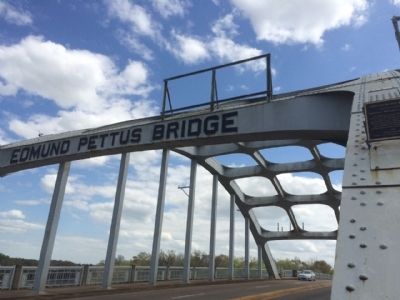
Photographed by Mark Hilton, March 25, 2015
2. Edmund Pettus Bridge and Marker
Also see . . .
1. Unveiling of Historic Landmark designation. (Submitted on March 28, 2015, by Mark Hilton of Montgomery, Alabama.)
2. Wikipedia article on bridge. (Submitted on March 28, 2015, by Mark Hilton of Montgomery, Alabama.)
3. Biography of Edmund Pettus. (Submitted on March 28, 2015, by Mark Hilton of Montgomery, Alabama.)
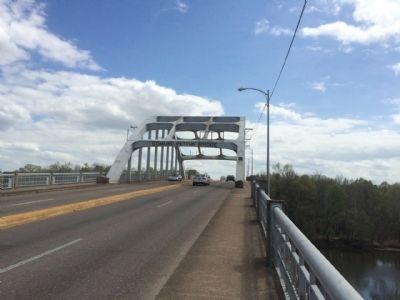
Photographed by Mark Hilton, March 25, 2015
3. Edmund Pettus Bridge
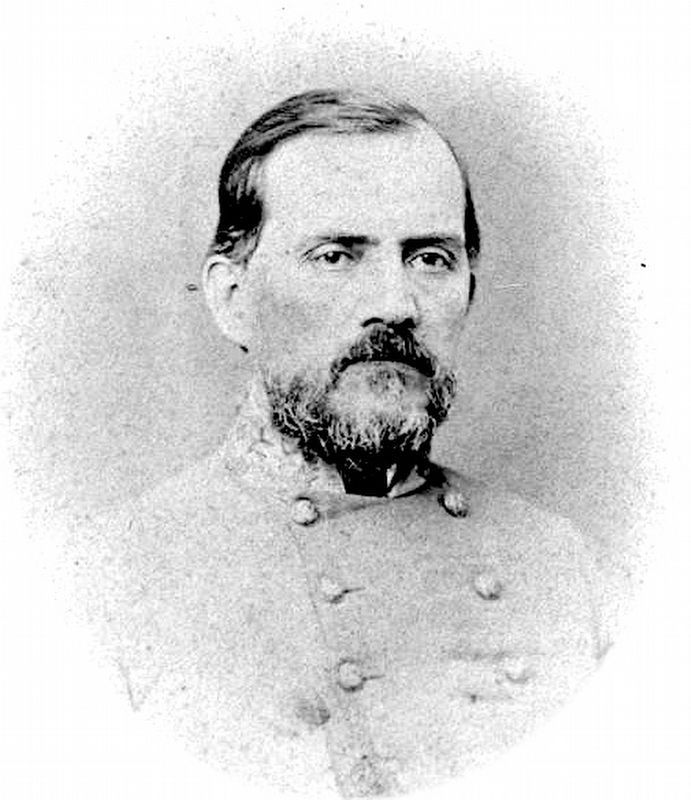
National Archives
4. Bigadier General Edmund Winston Pettus, C.S.A.
Before his appointment to brigadier general, Pettus had been a colonel of the 20th Alabama Infantry, C.S.A.
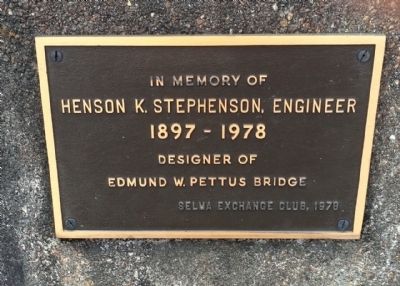
Photographed by Mark Hilton, March 25, 2015
5. Edmund Pettus Bridge plaque
Located near Water Avenue on bridge approach.
Photographed by Mark Hilton, July 30, 2014
6. Edmund Pettus Bridge above Alabama River.
Photographed by Mark Hilton, March 25, 2015
7. 'Bloody Sunday' / Voting Rights marker
Credits. This page was last revised on July 16, 2025. It was originally submitted on March 28, 2015, by Mark Hilton of Montgomery, Alabama. This page has been viewed 2,471 times since then and 120 times this year. Photos: 1. submitted on July 15, 2025, by Jeff Leichsenring of Garland, Texas. 2, 3. submitted on March 28, 2015, by Mark Hilton of Montgomery, Alabama. 4. submitted on July 3, 2019, by Allen C. Browne of Silver Spring, Maryland. 5, 6, 7. submitted on March 28, 2015, by Mark Hilton of Montgomery, Alabama.
