
Milford in Caroline County, Virginia — The American South (Mid-Atlantic)
Lt. Col. George Armistead (1780-1818)
⎯⎯⎯
The War of 1812
Photographed by Kevin W., April 5, 2015
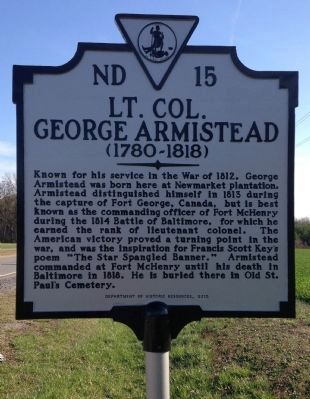
1. Lt. Col. George Armistead (1780-1818) Marker
Lt. Col. George Armistead (1780-1818). Known for his service in the War of 1812, George Armistead was born here at Newmarket plantation. Armistead distinguished himself in 1813 during the capture of Fort George, Canada, but is best known as the commanding officer of Fort McHenry during the 1814 Battle of Baltimore, for which he earned the rank of lieutenant colonel. The American victory proved a turning point in the war, and was the inspiration for Francis Scott Key’s poem “The Star Spangled Banner.” Armistead commanded at Fort McHenry until his death in Baltimore in 1818. He is buried there in Old St. Paul’s Cemetery.
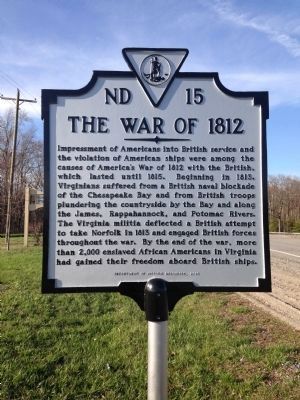
The War of 1812. Impressment of Americans into British service and the violation of American ships were among the causes of America’s War of 1812 with the British, which lasted until 1815. Beginning in 1813, Virginians suffered from a British naval blockade of the Chesapeake Bay and from British troops plundering the countryside by the Bay and along the James, Rappahannock, and Potomac Rivers. The Virginia militia deflected a British attempt to take Norfolk in 1813 and engaged British forces throughout
this page online
Erected 2014 by Department of Historic Resources. (Marker Number ND-15.)
Topics and series. This historical marker is listed in these topic lists: African Americans • War of 1812. In addition, it is included in the Virginia Department of Historic Resources (DHR) series list. A significant historical year for this entry is 1812.
Location. 38° 0.053′ N, 77° 20.112′ W. Marker is in Milford, Virginia, in Caroline County. It is at the intersection of Richmond Turnpike (U.S. 301) and New Market Lane, on the right when traveling south on Richmond Turnpike. Touch for map. Marker is in this post office area: Milford VA 22514, United States of America. Touch for directions.

Regionally, this marker is in the Piedmont and in Central Virginia. It is also in the American South, specifically in the Upper South, and on the Eastern Seaboard. Globally, it is in the North Atlantic Region, North America, the Western Hemisphere, the Western World, and the Anglosphere. Historically, it finds itself in
Photographed by Kevin W., April 5, 2015
2. The War of 1812 Marker
Other nearby markers. At least 8 other markers are within 4 miles of this marker, measured as the crow flies: Richard and Mildred Loving (approx. half a mile away); Edmund Pendleton's Home (approx. 0.6 miles away); Milford Station (approx. 2.6 miles away); 1864 Union Occupation of Bowling Green (approx. 3½ miles away); Loving v Virginia (approx. 3½ miles away); Caroline County Courthouse (approx. 3½ miles away); Star Hotel (approx. 3½ miles away); Caroline County World War I Memorial (approx. 3½ miles away). Touch for a list and map of all markers in Milford.
Photographed by Kevin W., April 5, 2015
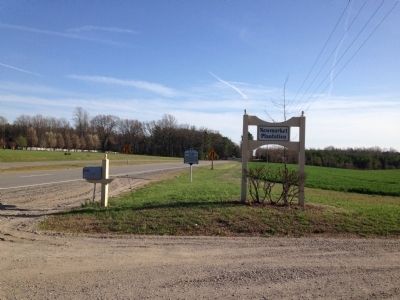
3. Lt. Col. George Armistead (1780-1818) Marker
Photographed by Allen C. Browne, September 5, 2015
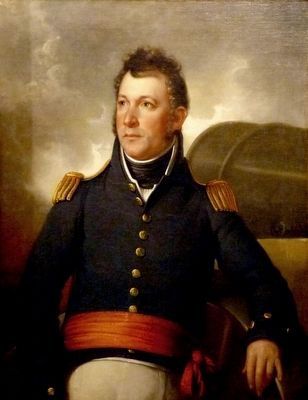
4. George Armistead (1780-1818)
This 1818 painting of George Armistead by Rembrandt Peale hangs in the Maryland Historical Society Museum in Baltimore, Maryland.
“George Armistead is most often remembered for commissioning Mary Pickersgill to make ‘a flag so large… the British would have no difficulty seeing from a distance’ and flying that forty-two-by-thirty-foot flag over Fort McHenry during the twenty-five hour bombardment in September 1814. Francis Scott Key immortalized the flag in his verses about the ‘star-spangled banner.’ As commander of the fort on that fateful day, Armistead and his men held the British Navy at bay and earned a celebrated position among the city's defenders.” — Maryland Historical Society
“George Armistead is most often remembered for commissioning Mary Pickersgill to make ‘a flag so large… the British would have no difficulty seeing from a distance’ and flying that forty-two-by-thirty-foot flag over Fort McHenry during the twenty-five hour bombardment in September 1814. Francis Scott Key immortalized the flag in his verses about the ‘star-spangled banner.’ As commander of the fort on that fateful day, Armistead and his men held the British Navy at bay and earned a celebrated position among the city's defenders.” — Maryland Historical Society
Credits. This page was last revised on July 3, 2021. It was originally submitted on April 5, 2015, by Kevin W. of Stafford, Virginia. This page has been viewed 1,467 times since then and 63 times this year. Photos: 1, 2, 3. submitted on April 5, 2015, by Kevin W. of Stafford, Virginia. 4. submitted on September 29, 2015, by Allen C. Browne of Silver Spring, Maryland.
