Near Livingston in Overton County, Tennessee — The American South (East South Central)
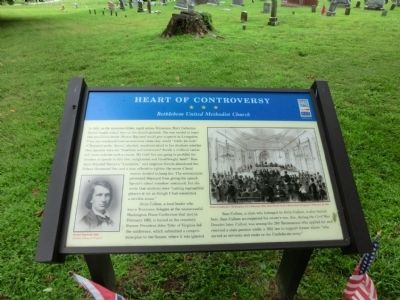
Heart of Controversy
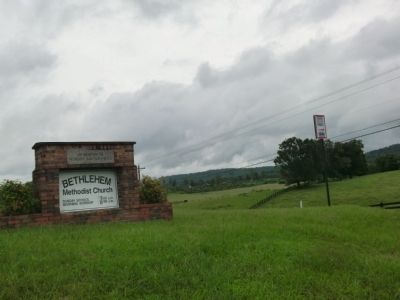
Bethlehem United Methodist Church
Photographed by Don Morfe, July 22, 2013
1. Heart of Controversy Marker
Alvin Cullom, a local leader who was a Tennessee delegate at the unsuccessful Washington Peace Conference that met in February
this page online
Sam Cullom, a slave who belonged to Alvin Cullom, is also buried here. Sam Cullom accompanied his owner’s son, Jim, during the Civil War. Decades later, Cullom was among the 280 Tennesseans who applied for and received a state pension under a 1921 law to support former slaves “who served as servants and cooks in the Confederate army.”
(Inscription under the photo on the lower left side)
Horace Maynard, 1859-Courtesy Library of Congress.
(Inscription under the photo on the lower right side)
Peace Conference, Washington, D.C., February 1861, from Frank Leslie’s Illustrated Newspaper, February 16, 1861
Erected by Tennessee Civil War Trails.
Topics and series. This historical marker is listed in this topic list: War, US Civil. In addition, it is included in the Former U.S. Presidents: #10 John Tyler, and the Tennessee Civil War Trails series lists. A significant historical month for this entry is February 1861.
Location. 36° 19.983′ N, 85° 18.55′ W. Marker is near Livingston,
Photographed by Don Morfe, July 22, 2013
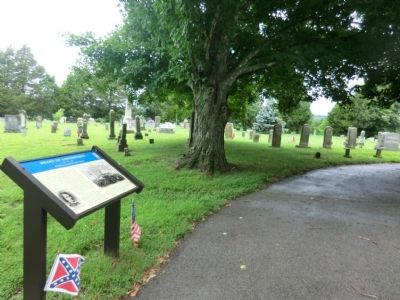
2. Heart of Controversy Marker

Regionally, this marker is in Tennessee’s Cumberland Plateau and in the Highland Rim. It is also in the American South, specifically in the Upper South, in Appalachia, and specifically in Southern Appalachia. Globally, it is in North America, the Western Hemisphere, the Western World, and the Anglosphere. Historically, it finds itself in what was once the territory of the Mississippian Culture, one of the Confederate States of America, and the Antebellum South.
Other nearby markers. At least 8 other markers are within 4 miles of this marker, measured as the crow flies: Hartsaw Cove Farm (approx. half a mile away); Crockett's Camp (approx. 2½ miles away); Overton County Courthouse (approx. 3½ miles away); a different marker also named Overton County Courthouse (approx. 3½ miles away); Specialist 4 James T. Davis (approx. 3.6 miles away); Staff Sergeant Loval E. Ayers (approx. 3.6 miles
Photographed by Don Morfe, July 22, 2013
3. Heart of Controversy Marker
Credits. This page was last revised on June 16, 2016. It was originally submitted on September 2, 2013, by Don Morfe of Baltimore, Maryland. This page has been viewed 1,370 times since then and 42 times this year. Last updated on April 9, 2015, by J. Makali Bruton of Washington, District of Columbia. Photos: 1, 2, 3. submitted on September 2, 2013, by Don Morfe of Baltimore, Maryland. • Bill Pfingsten was the editor who published this page.
