Pigeon Island, Gros Islet, Saint Lucia — Caribbean Region (Lesser Antilles)
Fort Rodney
1778
Photographed by J. Makali Bruton, April 26, 2015
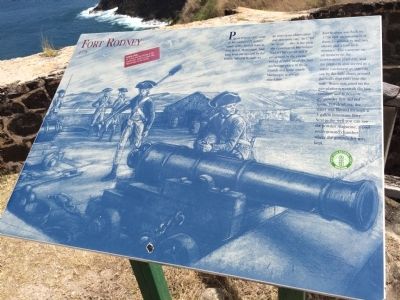
1. Fort Rodney Marker
Pigeon Island, only some 40 kilometres (25 miles) south of the French base at Fort Royal, Martinique, had long been recognized by the British Admiral Rodney as an important observation and defensive site. In 1780 he wrote ”…this is the post the Governor of Martinique had set his eye on and if possessed by the enemy would deprive us of the best anchorage place in these islands and from which Martinique is always attackable…”
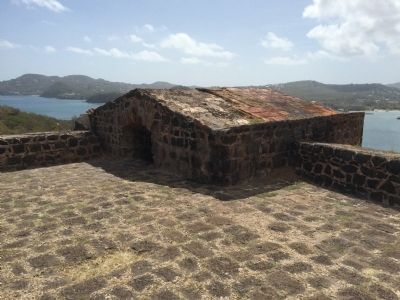
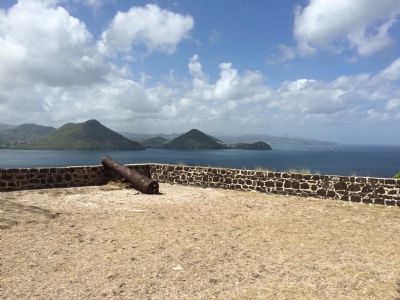
Fort Rodney was built in 1778 with an armament of three 24-pounders and two eleven and a half inch mortars. The cannons sat on timbers on the cobblestone platform, and the platform also served as a water catchment as you can see by the little drain around the walls that runs into the well. Water was used on the gun platform to swab the hot cannons and to remove gunpowder that did not ignite. For drinking, the water was filtered through a 3-gallon limestone filter. Next to the well you can see the powder magazine, a cool underground chamber where the gunpowder was kept.
Look for St. Lucia and the Pitons to the south-east, and on a clear day, Martinique to the north.
Erected by Saint Lucia National
this page online
Topics. This memorial is listed in these topic lists: Colonial Era • Forts and Castles. A significant historical year for this entry is 1778.
Location. 14° 5.48′ N, 60° 58.009′ W. Memorial is on Pigeon Island, Gros Islet. It is on no nearby street. This marker is at Fort Rodney. Touch for map. Memorial is in this post office area: Pigeon Island, Gros Islet LC01 101, Saint Lucia. Touch for directions.

Regionally, it is one of the Lesser Antilles on the Caribbean Sea, on in the Atlantic Ocean, in North America, in the Western Hemisphere, and in the Anglosphere. Historically, it finds itself in what was once a British colony.
Other nearby markers. At least 8 other markers are within walking distance of this marker: U.S. Signal Station (within shouting distance of this marker); Musket Redoubt (about 90 meters away, measured in a direct line); Carib Caves (about 120 meters away); Josset's House (about 180 meters away); Gunslide (approx. 0.3 kilometers away); Lime Kiln (approx. 0.3 kilometers away); Cooperage (approx. 0.4 kilometers away); C.O.'s Quarters (approx. 0.4 kilometers away). Touch for a list and map of
Photographed by J. Makali Bruton, April 26, 2015
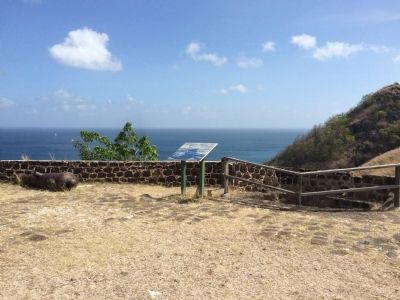
2. Wide view of Fort Rodney Marker
This view looks north towards Signal Peak on the right. The well is also seen to the right of the marker, protected by a railing.
Another marker is no longer nearby. Ridge Battery (was about 150 meters away but has been confirmed missing).
Photographed by J. Makali Bruton, April 26, 2015
3. Fort Rodney powder magazine
Photographed by J. Makali Bruton, April 26, 2015
4. Fort Rodney cannon with a view south to the Pitons.
Credits. This page was last revised on June 12, 2026. It was originally submitted on April 26, 2015, by J. Makali Bruton of Washington, District of Columbia. This page has been viewed 3,467 times since then and 246 times this year. Photos: 1, 2, 3, 4. submitted on April 26, 2015, by J. Makali Bruton of Washington, District of Columbia. • Andrew Ruppenstein was the editor who published this page.
