Faribault in Rice County, Minnesota — The American Midwest (Upper Plains)
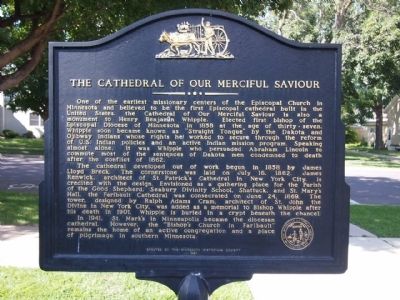
The Cathedral of Our Merciful Saviour
Photographed by McGhiever, August 17, 2013
1. The Cathedral of Our Merciful Saviour Marker
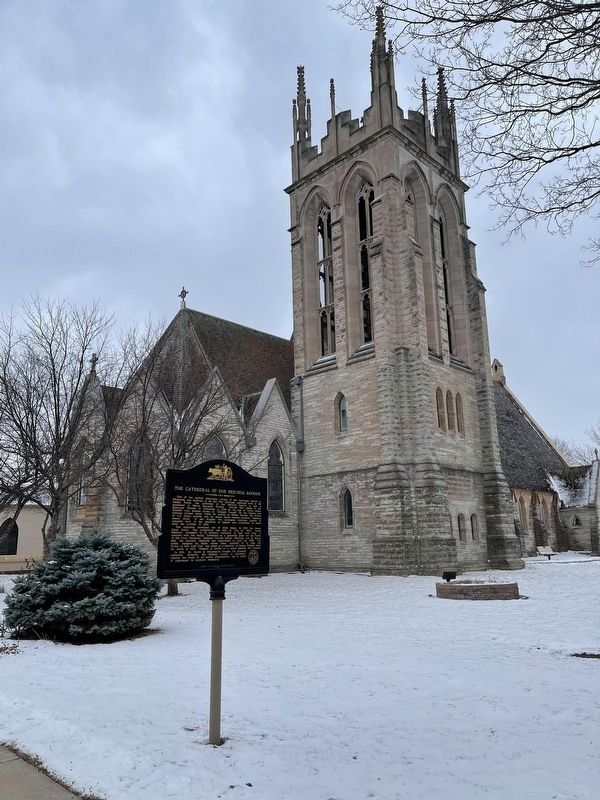
The cathedral developed out of work begun in 1858 by James Lloyd Breck. The cornerstone was laid on July 16, 1862. James Renwick, architect of St. Patrick's Cathedral in New York City, is credited with the design. Envisioned as a gathering place for the Parish of the Good Shepherd, Seabury Divinity School, Shattuck, and St. Mary's Hall, the Faribault Cathedral was consecrated on June 24, 1869. The tower, designed by Ralph Adams Cram, architect
this page online
Erected 1987 by Minnesota Historical Society.
Topics. This historical marker is listed in this topic list: Religion & Religious Structures. A significant historical month for this entry is June 1534.
Location. 44° 17.812′ N, 93° 16.238′ W. Marker is in Faribault, Minnesota, in Rice County. It is on 6th St NW, on the right when traveling east. Touch for map. Marker is at or near this postal address: 515 2nd Ave NW, Faribault MN 55021, United States of America. Touch for directions.

Regionally, this marker is in Southeast Minnesota. It is also in the American Midwest and in the Corn Belt. Globally, it is in North America, the Western Hemisphere, the Western World, and the Anglosphere. Historically, it finds itself in what was once Rupert’s Land, the territory of the Mississippian
Photographed by Liz Koele
2. The Cathedral of Our Merciful Saviour Marker
Other nearby markers. At least 8 other markers are within walking distance of this marker: Seabury Divinity School & Taopi "Wounded Man" (about 500 feet away, measured in a direct line); Faribault Riverfront 1880 (about 500 feet away); KDHL Radio (about 600 feet away); Bishop Henry B. Whipple (about 600 feet away); Minnesota State Academy for the Deaf (about 600 feet away); Flour Milling & Woolen Milling (about 700 feet away); Downtown Faribault 1888 (about 700 feet away); The Faribault Fur Trade (about 700 feet away). Touch for a list and map of all markers in Faribault.
Also see . . . Historic Faribault Stop 14 - Cathedral of Our Merciful Saviour. A six minute video history of the Cathredral, as part of a longer serialized video walking tour of Faribault. (Submitted on May 11, 2015.)
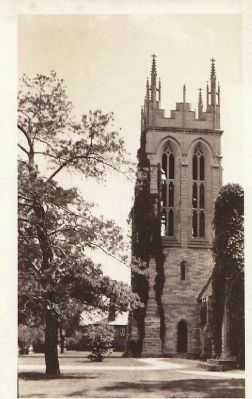
circa 1920
3. The Cathedral of Our Merciful Saviour - Postcard View
Credits. This page was last revised on September 22, 2022. It was originally submitted on May 1, 2015, by McGhiever of Minneapolis, Minnesota. This page has been viewed 868 times since then and 33 times this year. Photos: 1. submitted on May 1, 2015, by McGhiever of Minneapolis, Minnesota. 2. submitted on September 12, 2022, by Liz Koele of St. Paul, Minnesota. 3. submitted on May 11, 2015. • Andrew Ruppenstein was the editor who published this page.
