Beloit in Dallas County, Alabama — The American South (East South Central)
The Beloit Industrial Institute
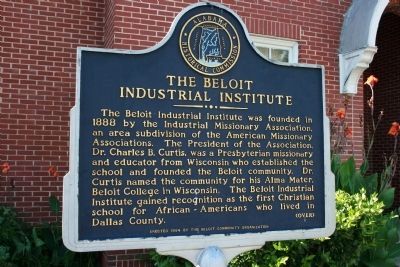
Photographed by Timothy Carr, August 15, 2009
1. The Beloit Industrial Institute Marker
The Beloit Industrial Institute was founded in 1888 by Industrial Missionary Association, an area subdivision of the American Missionary Associations. The President of the Association, Dr. Charles B. Curtis, was a Presbyterian missionary and educator from Wisconsin who established the school and founded the Beloit community. Dr. Curtis named the community for his Alma Mater, Beloit College in Wisconsin. The Beloit Industrial Institute gained recognition as the first Christian school for African - Americans who lived in Dallas County.
From 1888 to 1923, the Beloit school functioned as the intellectual, social and religious hub for the thriving Beloit community. The school was the first in Dallas County to combine agribusiness training with strong Christian teachings. In 1923, the Dallas County School Board gained legal possession of the school which they retained until 1963 when desegregation and zoning forced the closing of the school's doors. For a period of ten years, the school building was owned by a private business. In 1974 the building was purchased by the Beloit Community Organization. It now functions as a multi
this page online
Erected 1994 by Alabama Historical Commission, Beloit Community Organization.
Topics and series. This historical marker is listed in these topic lists: African Americans • Education • Religion & Religious Structures. In addition, it is included in the Alabama Historical Commission series list. A significant historical year for this entry is 1888.
Location. 32° 21.258′ N, 87° 9.204′ W. Marker is in Beloit, Alabama, in Dallas County. It is on Alabama Route 22, on the left when traveling east. Touch for map. Marker is in this post office area: Marion Junction AL 36759, United States of America. Touch for directions.

Regionally, this marker is in the American South, specifically in the Deep South, and in the Black Belt. Globally, it is in North America, a Gulf of Mexico state, the Western Hemisphere, the Western World, and the Anglosphere. Historically, it finds itself in what was once New Spain, the territory of the Mississippian Culture, one of the
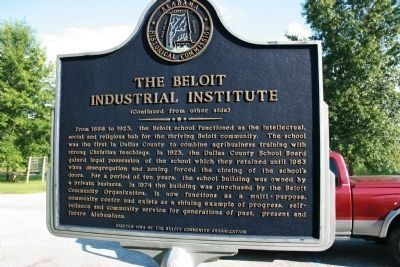
Photographed by Tim Carr, August 15, 2009
2. The Beloit Industrial Institute Marker
Other nearby markers. At least 8 other markers are within 4 miles of this marker, measured as the crow flies: Whitt Cemetery (approx. 0.7 miles away); Alabama's First Gothic Revival Church (approx. 3.7 miles away); Cahawba’s Current Residents (approx. 3.7 miles away); Cahawba's Changing Landscape (approx. 3.7 miles away); Black Belt Transformations (approx. 3.7 miles away); What Happened to Cahaba (approx. 3.7 miles away); Lafayette's Tour (approx. 3.8 miles away); C.C. Pegues & His Most Unusual Home (approx. 3.8 miles away).
Other markers no longer nearby. Cahawba (was approx. 0.3 miles away but has been confirmed missing); Alabama's Native Prairie (was approx. 3.7 miles away but has been permanently removed); Missing Pieces (was approx. 3.7 miles away but has been permanently removed).
More about this marker. School is located off Highway 22 just across the railroad tracks.
Additional commentary.
1. Marker Author
The text of this marker was written by Darion Petty, then a graduate student in the Office of the Vice President for Student Affairs at the University
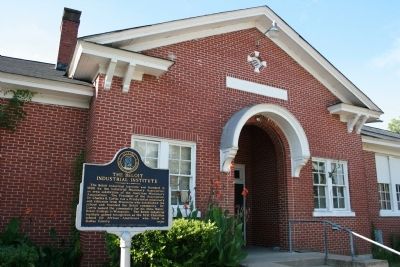
Photographed by Timothy Carr, August 15, 2009
3. The Beloit Industrial Institute Marker
Harry J. Knopke, Ph.D.
Emeritus Vice President for Student Affairs
The University of Alabama
— Submitted April 16, 2010, by Harry Knopke of Grand Rapids, Michigan.
Credits. This page was last revised on April 22, 2024. It was originally submitted on September 3, 2009, by Timothy Carr of Birmingham, Alabama. This page has been viewed 2,582 times since then and 37 times this year. Last updated on May 20, 2015, by J. Makali Bruton of Washington, District of Columbia. It was the Marker of the Week February 16, 2025. Photos: 1. submitted on September 3, 2009, by Timothy Carr of Birmingham, Alabama. 2. submitted on September 4, 2009, by Timothy Carr of Birmingham, Alabama. 3. submitted on September 3, 2009, by Timothy Carr of Birmingham, Alabama. • Bernard Fisher was the editor who published this page.
