
Hillsborough in Hillsborough County, New Hampshire — The American Northeast (New England)
Pierce Homestead
Photographed by Pat Filippone, November 26, 2010
1. Pierce Homestead Marker
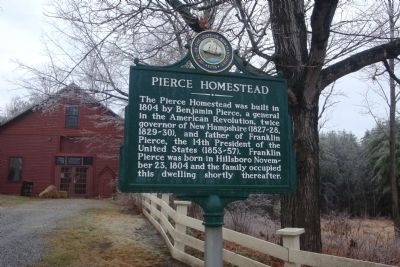
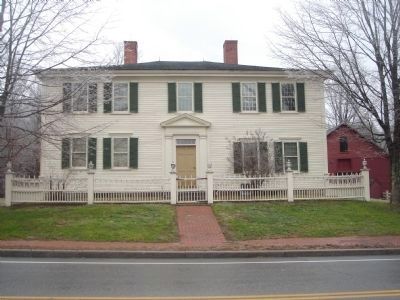
The Pierce Homestead was built in 1804 by Benjamin Pierce, a general in the American Revolution, twice governor of New Hampshire (1827-28, 1829-30), and father of Franklin Pierce, the 14th President of the United States (1853-57). Franklin Pierce was born in Hillsboro November 23, 1804 and the family occupied this dwelling shortly thereafter.
Erected by New Hampshire Division of Historical Resources. (Marker Number 065.)
Topics and series. This historical marker is listed in these topic lists: Government & Politics • War, US Revolutionary. In addition, it is included in the Former U.S. Presidents: #14 Franklin Pierce, and the New Hampshire Historical Highway Markers series lists. A significant historical date for this entry is November 23, 1855.
Location. 43° 6.961′ N, 71° 56.986′ W. Marker is in Hillsborough, New Hampshire, in Hillsborough County. It is on Second New Hampshire Turnpike (New Hampshire Route 31) 0.1 miles north of West Main Street, on the right when traveling north. Touch for map. Marker is at or near this postal address: 301 Second New Hampshire Turnpike, Hillsborough NH 03244, United States of America. Touch for directions.

Regionally,
this page online
Other nearby markers. At least 8 other markers are within 6 miles of this marker, measured as the crow flies: Birthplace of Franklin Pierce (within shouting distance of this marker); Stone Arch Bridges (approx. 1.6 miles away); Colonial Grant (approx. 2.2 miles away); War Memorial (approx. 2.7 miles away); Butler Park (approx. 2.7 miles away); Memorial Day Order (approx. 2.7 miles away); Hillsborough War Memorial (approx. 2.7 miles away); Deering Veterans (approx. 6 miles away). Touch for a list and map of all markers in Hillsborough.
Also see . . .
1. Franklin Pierce Homestead. Wikipedia entry: Links to National Register of Historic Places Nomination Form (Submitted on February 5, 2025, by Larry Gertner of New York, New York.)
2. Franklin Pierce. Wikipedia entry (Submitted on May 25, 2015, by Bill Pfingsten of Bel Air, Maryland.)
Additional keywords. Franklin Pierce
Photographed by Pat Filippone, November 26, 2010
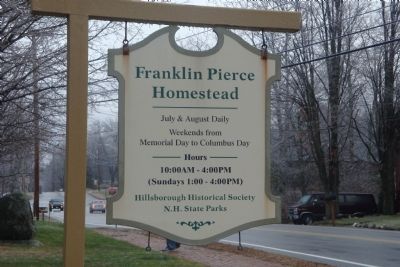
2. Pierce Homestead Marker
Photographed by Pat Filippone, November 26, 2010
3. Pierce Homestead
Photographed by Allen C. Browne, August 9, 2015
4. Franklin Pierce
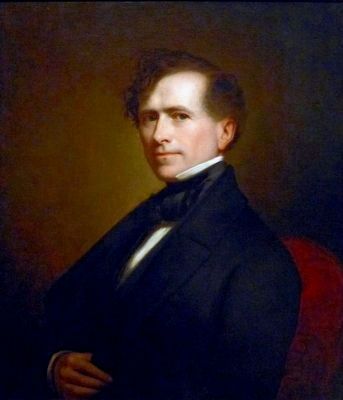
This 1853 Portrait of Franklin Pierce by George A. P. Healy hangs in the National Portrait Gallery in Washington. DC.
“In 1852, Franklin Pierce seemed to his fellow Democrats to be an ideal choice for the presidency. A northerner with southern sympathies, Pierce could seemingly engender credibility in both regions in a year marked by continuing debate over slavery. But his willingness to listen to proslavery extremists served the country poorly once he was in office. The most obvious case in point was his approval of the Kansas-Nebraska Act in 1854, which allowed slaveholders to settle in an area once closed to slavery. The result was armed violence in Kansas and an escalation in hostilities between North and South. Northerners could not find words harsh enough to describe him: Ralph Waldo Emerson, for example, accused him of ’imbecility.’
George P. A. Healy derived the original version of this image from sittings that took place in Boston in November 1852, shortly after Pierce's election was confirmed. At the same time, Healy was painting for Pierce a likeness of the president-elect's campaign biographer and longtime friend Nathaniel Hawthorne.” — National Portrait Gallery
“In 1852, Franklin Pierce seemed to his fellow Democrats to be an ideal choice for the presidency. A northerner with southern sympathies, Pierce could seemingly engender credibility in both regions in a year marked by continuing debate over slavery. But his willingness to listen to proslavery extremists served the country poorly once he was in office. The most obvious case in point was his approval of the Kansas-Nebraska Act in 1854, which allowed slaveholders to settle in an area once closed to slavery. The result was armed violence in Kansas and an escalation in hostilities between North and South. Northerners could not find words harsh enough to describe him: Ralph Waldo Emerson, for example, accused him of ’imbecility.’
George P. A. Healy derived the original version of this image from sittings that took place in Boston in November 1852, shortly after Pierce's election was confirmed. At the same time, Healy was painting for Pierce a likeness of the president-elect's campaign biographer and longtime friend Nathaniel Hawthorne.” — National Portrait Gallery
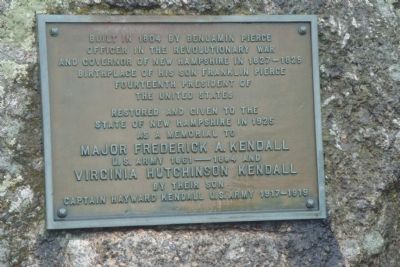
Photographed by Pat Filippone, November 26, 2010
5. Pierce Homestead Marker
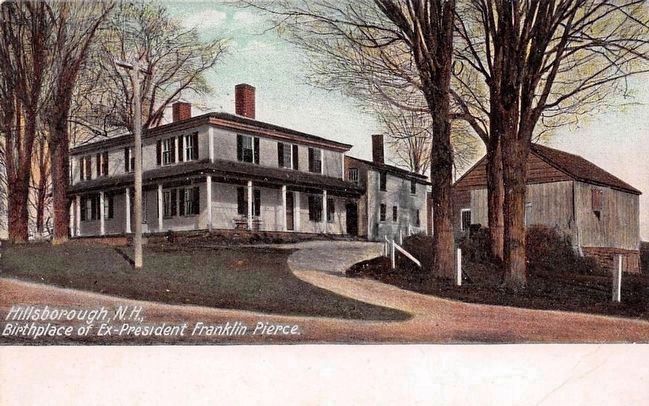
circa 1910
6. Hillsborough, N.H., Birthplace of Ex-President Franklin Pierce
Credits. This page was last revised on February 5, 2025. It was originally submitted on May 24, 2015, by Pat Filippone of Stockton, California. This page has been viewed 1,209 times since then and 59 times this year. Photos: 1, 2, 3. submitted on May 24, 2015, by Pat Filippone of Stockton, California. 4. submitted on September 19, 2015, by Allen C. Browne of Silver Spring, Maryland. 5. submitted on May 24, 2015, by Pat Filippone of Stockton, California. 6. submitted on September 18, 2015. • Bill Pfingsten was the editor who published this page.
