Perquín, Morazán, El Salvador — Central America (West Coast)
75 mm cannon
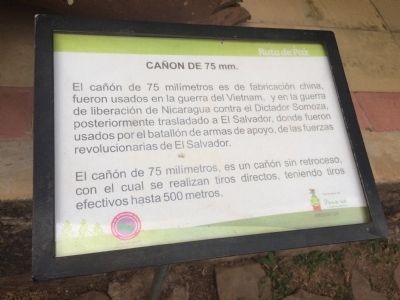
Cañón de 75 mm.
Photographed by J. Makali Bruton, April 13, 2015
1. 75 mm cannon Marker

El cañón de 75 milímetros, es un cañón sin retroceso, con el cual se realizan tiros directos, teniendo tiros efectivos hasta 500 metros.
75 mm cannon
This 75 mm cannon was made in China, used in the Vietnam war and then in Nicaragua’s war of liberation against the dictator Somoza. It was then sent to El Salvador where it was used by the weapons support battalion of the revolutionary forces of El Salvador.
The 75 mm cannon is recoilless, and with it direct shots can be taken, with effective shots up to 500 meters (1/3 mile).
Topics. This historical marker is listed in this topic list: Military.
Location. 13° 57.5′ N, 88° 9.793′ W. Marker is in Perquín, Morazán. It is on Calle La Esperanza. Marker is on the grounds of the Museum of the Salvadoran
this page online

Regionally, it is in North America, specifically in Central America, in Mesoamerica, on the Ring of Fire, on the Pacific Rim, and in the Western Hemisphere. Historically, it finds itself in what was once New Spain and also a Spanish colony.
Other nearby markers. At least 8 other markers are within 26 kilometers of this marker, measured as the crow flies: 120 mm mortar (here, next to this marker); Direct strike against the Counter-Insurgency Plan (here, next to this marker); French and Mexican recognition (a few steps from this marker); Peugeot armored car (within shouting distance of this marker); El Mozote (approx. 8.4 kilometers away); El Mozote Children's Memorial (approx. 8.5 kilometers away); First Century of Ciudad Barrios (approx. 24.4 kilometers away in San Miguel); Oscar Romero Park (approx. 24.4 kilometers away in San Miguel). Touch for a list and map of all markers in Perquín.
Photographed by J. Makali Bruton, April 13, 2015
2. 75 mm cannon Marker
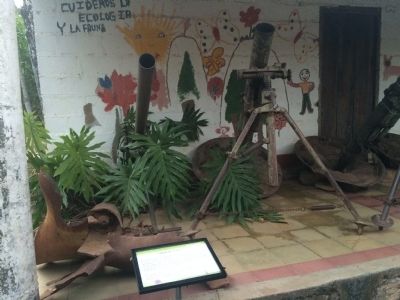
The 75 mm cannon is on the left. On the right is the 120 mm mortar.
Credits. This page was last revised on August 8, 2019. It was originally submitted on May 24, 2015, by J. Makali Bruton of Washington, District of Columbia. This page has been viewed 476 times since then and 15 times this year. Photos: 1, 2. submitted on May 24, 2015, by J. Makali Bruton of Washington, District of Columbia. • Andrew Ruppenstein was the editor who published this page.
